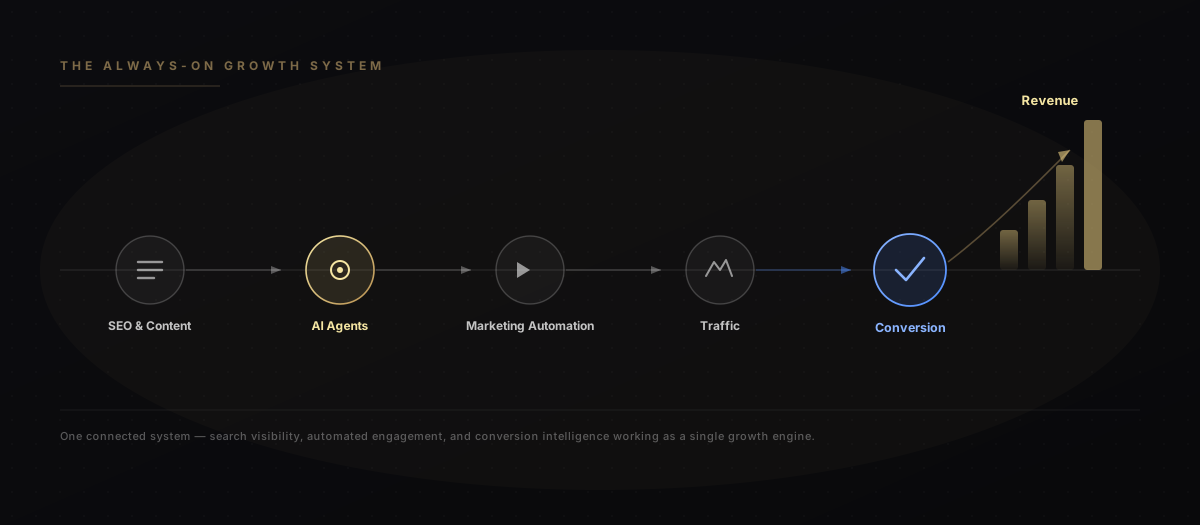
"Our traffic is up 40% and revenue barely moved." We hear some version of that sentence constantly from Shopify merchants. Merchants who've already done the hard work of fixing SEO and turning on marketing automation. The search question behind it is almost always the same: can AI agents actually fix this, or will they just generate more traffic that converts at the same disappointing rate?
It's a fair question. Honestly. Most AI automation deployed in ecommerce today is aimed at the wrong end of the funnel. Search optimization agents and marketing automation agents are genuinely good at getting more qualified people to a store. Almost none of that automation is built to watch what happens after the click — to notice that a visitor from a high-intent search term bounced off a product page in four seconds, or that a returning customer abandoned a cart at the shipping-cost step for the third time. Traffic and conversion get treated as two separate projects, run by two separate tools, reporting into two separate dashboards. And the result is exactly what merchants describe: more visits, same conversion rate, flat revenue.
This article covers the part of the system that closes that gap — how AI agents read behavioral and analytics data in real time, personalize the product and cart experience without waiting for a quarterly A/B test cycle, and connect every automated touchpoint back to the sale it actually influenced. It picks up right where our two earlier pieces on Shopify automation leave off: SEO and traffic automation and AI-agent-driven marketing automation both solve the top of the funnel. This one solves the last mile — where traffic either becomes revenue or quietly disappears.
What Shopify Merchants Are Actually Asking
The frustration that shows up on r/shopify and r/ecommerce around this specific problem has a consistent shape, even though the store category, size, and vertical vary widely. A few patterns come up often enough to be worth naming directly.
The most common thread is the traffic-to-conversion gap itself. A merchant reports organic sessions, ad impressions, or email click-throughs climbing meaningfully over a few months, but revenue stays roughly flat or grows far slower than the traffic did. The natural next question — "so what's actually converting?" — is where most threads stall out, because the merchant genuinely doesn't know.
The second recurring theme is attribution confusion. Merchants running several tools at once — an SEO plugin, an email platform, a paid ads dashboard, Shopify's native analytics — describe not being able to say with any confidence which channel or automation actually produced a given sale. Multiple tools claim partial credit for the same order, none of the numbers reconcile, and the merchant ends up trusting gut feel over any of the dashboards.
The third theme is a deep, and honestly reasonable, distrust of generic "AI personalization" claims. Merchants who've tried bolt-on personalization apps often describe the results as gimmicky — a popup recommending an irrelevant product, a countdown timer that resets every visit, discount logic eroding margin without measurably lifting conversion. That skepticism is earned. Personalization not built on real behavioral data and real guardrails tends to look like noise dressed up as intelligence.
Underneath all three patterns sits the same root cause: automation got added at the traffic layer without ever connecting to the data layer that would show whether it actually worked.
The Full-Funnel View
The diagram below shows the complete system this article is describing — not three separate tools, but one connected pipeline where each layer feeds the next, and where revenue data flows back up to inform what the earlier layers should prioritize next.
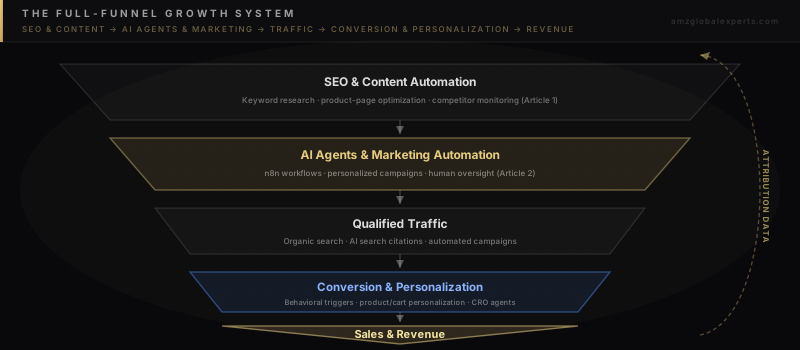
From Automated Traffic to Automated Revenue
Turning traffic into revenue at scale takes three things working together: a conversion layer that reacts to real behavior instead of static rules, personalization operating at the product and cart level rather than the homepage banner level, and attribution infrastructure disciplined enough to say which touchpoint actually closed the sale. Each one depends on the other two. Personalization without attribution is a guess, and attribution without a conversion layer to act on the findings is just reporting.
Conversion Rate Optimization Triggered by Behavioral Data
Static CRO — the quarterly A/B test, the seasonal homepage refresh — assumes visitor behavior stays stable enough to test against for weeks at a time. It rarely does. An AI-driven conversion layer instead treats behavioral signals as a live input: scroll depth on a product page, time-to-first-interaction, repeated visits to the same product without purchase, cart additions followed by hesitation at shipping cost, mobile versus desktop friction points. Agents monitor these signals continuously through the store's analytics and event-tracking stack, flagging or acting on patterns as they emerge instead of waiting for a human to notice a dip in a monthly report.
What actually matters here is the distinction between an agent that proposes a change and an agent that silently applies one. The systems worth building trigger a defined, reversible action — surface a specific piece of social proof, adjust the order of trust signals, prioritize a different shipping message — inside guardrails a merchant has approved in advance. Anything touching price or discount depth routes through human or rules-based approval before it goes live, for the same reason marketing automation should never send a campaign unreviewed: conversion tactics that erode trust or margin do lasting damage a short-term lift doesn't offset.
Personalization at the Product and Cart Level
Homepage personalization is honestly the least valuable form of personalization, because by the time a visitor reaches the homepage they've already made most of the decisions that determine whether they'll buy. The higher-leverage surfaces are the product page and the cart, the two places where a shopper is actively deciding.
On the product page, personalization agents can adjust which complementary products get recommended based on what similar high-intent visitors ultimately purchased together, instead of a static "customers also bought" block that never changes. In the cart, agents can surface the specific objection most likely blocking that particular visitor — free-shipping threshold proximity, a return-policy reminder, a bundle solving a price-sensitivity signal — instead of a generic upsell every visitor sees regardless of context.
This only works if the underlying data is trustworthy. An agent personalizing off incomplete or duplicated event data will just optimize for noise. That's precisely why the technical foundation — properly instrumented analytics, clean event tracking, a single source of truth for customer and session data — has to get built before the personalization layer turns on, not after.
Full-Funnel Attribution: Closing the Loop
Attribution is the least glamorous part of this system. Honestly, it's also the most consequential. Without it, a merchant running SEO automation, email automation, paid campaigns, and on-site personalization simultaneously has no reliable way to know which of those four systems is actually driving the incremental sale in front of them. Only which one happens to touch the order last, and that's a very different thing.
A full-funnel attribution setup traces a completed order back through every meaningful touchpoint that preceded it: the organic search query and landing page from the SEO layer, the automated email or retargeting sequence from the marketing layer, the on-site conversion trigger that closed the purchase. Built correctly, this isn't a single vanity metric but a connected dataset — typically assembled from Shopify's order and customer data, an analytics platform capturing session-level events, and a workflow layer (commonly n8n) stitching the pieces together and writing the results back into a reporting layer the merchant actually looks at.
The payoff is direct. Simple, even. Budget and automation effort stop being allocated by intuition and start being allocated by evidence. If a specific SEO content cluster is quietly responsible for a disproportionate share of high-value orders, that's worth knowing before the next content sprint gets planned, not after.
Twenty-five years of systems architecture experience teaches you the same lesson in every domain: automation without disciplined data infrastructure just moves the chaos downstream faster. Closing the loop from traffic to revenue isn't primarily an AI problem. It's a data-plumbing problem that AI agents can then operate on top of, reliably, once it's solved properly.
How This Connects to SEO, AI Agents, and Marketing Automation
None of the conversion and personalization work described above replaces the earlier stages of the system. It depends on them. Shopify AI automation for SEO and traffic is what earns the qualified click in the first place: agents researching keyword opportunity, optimizing product-page content, and monitoring competitor movement so the store shows up for the searches that matter. AI agents running marketing automation then nurture and re-engage that audience — automated campaigns, segmentation, and outreach bringing visitors back with the right message at the right moment, always under human review before anything goes live.
This article is the layer sitting after both of those systems have done their job. Traffic has arrived. A relationship has started forming through marketing automation. Now the question is whether that traffic converts, and whether the store can prove which part of the system deserves credit when it does. Treat the three articles as one operating system, not three separate initiatives: SEO and content automation generate the opportunity, marketing automation nurtures it, and conversion optimization with full-funnel attribution is what turns the opportunity into revenue and tells you which levers to pull harder next quarter.
Merchants running Amazon alongside Shopify face a parallel version of this same problem on the operations side — automating fulfillment, pricing, and catalog actions without losing control of what an agent is allowed to do unsupervised. Our guide to automating Amazon operations with n8n, AWS, and MongoDB Atlas covers that architecture in depth, and the same orchestration-plus-approval-gate pattern applies directly to the conversion agents described here.
Strategic Recommendations
Short-Term: 0–30 Days
- Audit current analytics instrumentation for gaps — duplicate events, missing UTM parameters, and untracked conversion actions are the most common reason personalization efforts fail before they start.
- Identify the two or three highest-traffic product pages with the largest gap between sessions and add-to-cart rate, and diagnose the specific friction point before building any automation around them.
- Consolidate reporting into a single dashboard that shows SEO, marketing, and on-site conversion data side by side, even manually, so the traffic-to-conversion relationship becomes visible.
Mid-Term: 30–90 Days
- Deploy a behavioral-trigger conversion layer on the highest-value product and cart pages, starting with reversible, low-risk interventions (messaging and ordering, not pricing).
- Build the first version of a full-funnel attribution pipeline connecting SEO, marketing automation, and Shopify order data through a workflow orchestration layer.
- Establish approval guardrails for any agent action that touches price, discount depth, or brand messaging, mirroring the human-in-the-loop model used on the marketing automation side.
Long-Term: 6–12 Months
- Feed attribution data back into SEO and marketing prioritization, so content and campaign investment follows evidence of what actually converts rather than assumptions about it.
- Expand personalization from product and cart pages into post-purchase and retention flows, using the same behavioral-data discipline established earlier.
- Treat the full pipeline — SEO, marketing automation, conversion, attribution — as a single system with shared data infrastructure, reviewed and refined on a recurring cadence rather than rebuilt piecemeal each time a new tool is added.
How AMZ Global Experts Helps
We were built by operators with more than twenty-five years of combined IT and systems architecture experience, applied specifically to ecommerce growth infrastructure. That background matters most exactly where this article has focused: the unglamorous data-plumbing work of clean analytics instrumentation, reliable API integrations, and workflow orchestration AI agents can actually be trusted to run on top of without introducing silent errors into pricing, inventory, or customer data.
We design and build the full pipeline described here for Shopify brands — SEO and content automation, AI-agent-driven marketing workflows, and the conversion and attribution layer connecting them to revenue — using n8n for orchestration, AWS for compute and hosting, and native Shopify, analytics, and marketing platform APIs, all governed by human approval gates on anything touching brand, pricing, or customer trust. If your store's SEO listing optimization foundation still needs work before conversion automation can layer on top, our listing optimization service covers the underlying content and structure that both search visibility and conversion depend on.
Conclusion
More traffic was never actually the goal. Revenue was. AI agents can generate meaningful traffic gains, and the two articles preceding this one show how. But traffic only becomes revenue once a system exists to read what visitors do after they arrive, personalize the experience based on that behavior within clear guardrails, and trace every completed sale back to the touchpoint that earned it. Build that system, and the traffic your SEO and marketing automation already produce starts converting at a rate that actually reflects its quality, instead of disappearing into a dashboard that can't explain where it went.
If your store has already invested in SEO and marketing automation and revenue still isn't moving the way it should, that gap is almost always fixable. It starts with an honest audit of the data infrastructure connecting your traffic to your sales.
Book a Growth Strategy Session
We'll map your full traffic-to-revenue system in one working session — SEO, marketing automation, conversion, and attribution — and hand you a 90-day roadmap to close the gap. Direct operator access. No agencies, no layers.
Reserve Your Session →Frequently Asked Questions
Most of the time, it's because traffic and conversion are being managed as two separate problems. SEO and marketing automation bring more qualified visitors to the store, but nothing downstream is watching what those visitors actually do once they land — where they hesitate, what they compare, when they abandon a cart. Without a system reading behavioral and analytics data in real time and acting on it, added traffic just dilutes the conversion rate instead of lifting revenue. Closing that gap means connecting SEO and marketing data to a conversion and personalization layer, not adding more top-of-funnel volume.
Both, actually, but they're two distinct functions built on different data. Traffic-generation agents work with search and content signals. Conversion agents work with on-site behavioral data — scroll depth, cart abandonment patterns, product-page engagement, session replay signals — adjusting offers, layout, and messaging accordingly. A properly built ecommerce automation system runs both functions and, critically, connects them through shared analytics so each layer improves the other over time.
Personalization agents take in signals like traffic source, browsing history, cart contents, and past purchase behavior, then adjust specific conversion levers — product recommendations, bundle offers, urgency messaging, checkout incentives — within predefined brand and pricing guardrails set by the merchant. The agent proposes and tests variations, but a human or a pre-approved rules engine still governs pricing, discounting, and brand voice, so personalization scales without turning into unmanaged automated discounting.
It's the practice of tracing a completed sale back through every touchpoint that contributed to it — the SEO content that first earned a click, the automated email or ad that brought the customer back, the on-site conversion trigger that closed the sale. Without proper attribution infrastructure, merchants can't tell which automated system is actually producing revenue versus which is just generating activity, which makes it impossible to know where to invest further automation budget.
They form a sequential pipeline. SEO and content automation build search visibility and earn qualified clicks. AI marketing agents nurture and re-engage that audience through automated, personalized campaigns. Traffic arrives at the store. Conversion and personalization agents then read behavioral and analytics data to turn that traffic into completed sales. Revenue and attribution data flow back to the top of the funnel, informing which keywords, campaigns, and offers to prioritize next, which makes the system self-reinforcing instead of three disconnected tools.
No. Modern automation stacks built on orchestration tools like n8n, cloud infrastructure such as AWS, and native Shopify and analytics APIs let a small, disciplined team run a system that would've previously required a much larger in-house engineering group. The constraint isn't headcount. It's having someone who understands both the marketing objective and the technical architecture well enough to build the system correctly and keep a human in the loop on anything touching pricing, brand voice, or customer trust.