Can AI agents actually run Shopify marketing without losing brand voice? How much of ecommerce marketing can realistically be automated versus needing a human? Those are the two questions merchants ask most often right now, and honestly, there's no simple yes or no. It depends entirely on which piece of the marketing engine you're talking about. Some work should run continuously in the background with no human touching it. Other work should never leave a person's hands. Most of the interesting failures in Shopify automation come from merchants getting that line wrong in one direction or the other: either automating everything and watching brand voice and margin erode, or refusing to automate anything and burning the team out on repetitive analysis a machine could do overnight.
This article is about where that line actually sits. AI agents are well suited to the parts of digital marketing that are continuous, data-heavy and low-risk if wrong on the first pass — SEO monitoring, keyword discovery, customer segmentation, abandoned-cart triggers, competitor tracking, campaign performance analysis. They're poorly suited to the parts that are irreversible or brand-defining the moment they go live: the exact wording of a promotional email, a discount percentage, a pricing change. A Shopify marketing engine built correctly puts AI agents to work everywhere the first category applies and keeps a human approval gate everywhere the second one does. That's the operating model this piece walks through, with a diagram of what it looks like in practice and a concrete set of steps to build toward it.
What Shopify Merchants Are Actually Asking
Spend time in r/shopify, r/ecommerce and r/marketing threads about AI and automation, and a handful of recurring patterns show up again and again. Not as isolated complaints, but as a consistent set of concerns shaping how merchants actually want this technology deployed.
The first is distrust of fully-automated email campaigns that read as generic. Merchants describe testing AI-generated subject lines and body copy that technically follow best practices but sound like they were written for no one in particular, the kind of email a subscriber deletes on sight because nothing in it signals the brand actually knows who they are. The pattern isn't that AI writing is bad. It's that unreviewed AI writing defaults to the statistical average of every email it was trained on, which is precisely the opposite of what makes a brand's voice recognizable.
The second is frustration with abandoned-cart flows that annoy rather than convert. A common thread: a shopper adds an item, gets distracted, and receives three increasingly aggressive discount emails within 48 hours, training that customer to abandon carts intentionally just to trigger a coupon. Merchants who've been burned by this want abandoned-cart automation that understands intent and history, not a single sequence firing at everyone regardless of whether they're a first-time visitor or a five-time repeat buyer.
The third theme is a preference for AI that flags rather than acts unsupervised. Merchants running lean teams say they want an agent that says "this segment's open rate dropped 40% over two weeks, here's a draft to address it," not an agent that silently changes the send strategy on its own. The value is in surfacing the signal fast. Decision authority stays with a person.
The fourth is concern about automated discounting quietly eroding margin. Several threads describe AI-optimization tools that, left unchecked, gravitate toward discount-heavy tactics. Discounts are the fastest lever for improving short-term conversion metrics. The long-term effect is different, though: training the customer base to wait for a sale, and margin drift that doesn't show up until the quarterly numbers land.
These four patterns point to the same underlying principle: merchants aren't rejecting automation. They're rejecting unsupervised automation on anything touching a customer directly or a pricing lever. That distinction is the spine of everything that follows.
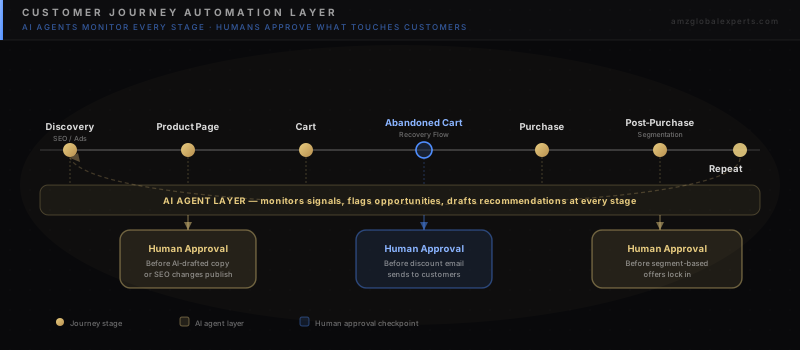
Where AI Agents Actually Fit in the Shopify Marketing Engine
The applications below are ordered by how much of the marketing engine they touch, not by novelty. SEO automation is covered briefly here — for the deeper technical treatment of AI-driven keyword research, content-gap analysis and product-page optimization workflows, see our companion guide, Shopify AI Automation: How AI Agents Can Boost SEO, Traffic and Conversions. This piece focuses on the marketing engine that sits downstream of traffic: what happens to a visitor once they've arrived.
Automated SEO Audits and Keyword Discovery
An AI agent scanning search console data, crawl reports and competitor rankings on a recurring schedule catches technical regressions and content gaps faster than a monthly manual audit ever will — broken canonical tags, thin collection pages, keyword opportunities a competitor just started ranking for. This is table-stakes background monitoring; the depth is in the linked companion article. What matters here is that SEO data feeds the same customer-journey system the rest of this article describes — organic traffic is stage one of the funnel, not a separate workstream.
Email Marketing Automation and Customer Segmentation
This is where the marketing engine earns its keep. AI agents can continuously re-segment a customer list based on purchase recency, category affinity, average order value, and engagement trend, work that would take a marketing analyst hours to do manually and that goes stale within a week of being done by hand. The agent's job is maintaining live segments and drafting campaign angles for each one: a win-back sequence for lapsed high-value customers, a cross-sell sequence for recent first-time buyers, a loyalty acknowledgment for repeat purchasers approaching a spend threshold. The agent proposes the segment logic and drafts the copy. A person reviews both before the segment goes live and before the first send in a new sequence goes out.
Abandoned Cart and Post-Purchase Workflows
Cart abandonment recovery is the clearest example of where behavioral data should shape the automation, not just trigger it. An agent distinguishing a first-time visitor who abandoned a $40 cart from a repeat customer who abandoned a $400 cart should route them into different sequences: different timing, different tone, different offer logic, and critically, not the same discount-first instinct for both. Post-purchase, that same monitoring layer can flag when a customer's reorder window is approaching based on product type and historical cadence, surfacing a replenishment opportunity to the marketing team rather than firing an email automatically the moment a date is hit.
Competitor and Campaign Performance Monitoring
An agent watching competitor pricing, promotional cadence and new product launches — alongside your own campaign performance metrics — can compress a task that used to require a weekly manual pull into a standing dashboard with anomaly alerts. When a campaign's cost-per-acquisition trends up three days in a row, or a competitor drops a promotion that's pulling traffic, the agent's job is simple. Surface it same-day, instead of at the next scheduled review meeting.
Conversion-Rate Optimization Triggered by Behavioral Data
Product pages, checkout flows and on-site messaging all generate behavioral signal: scroll depth, exit points, cart-to-checkout drop-off by device and traffic source. An AI agent monitoring this data can flag where the funnel is leaking and propose specific test hypotheses: a shipping-cost objection showing up disproportionately on mobile checkout, a product description that isn't answering the question visitors are searching for before they bounce. The agent identifies the pattern and drafts the fix. Whether that fix actually ships is still a call for whoever owns the storefront experience.
The pattern across every application above: AI agents are strongest at the parts of marketing that are continuous, data-dense, and reversible if wrong. They are weakest — and should have the least autonomy — anywhere a mistake reaches a customer's inbox or a customer's price.
Where AI Agents Should Lead vs. Where Humans Must Stay in Control
This is the operating question that determines whether AI automation compounds into a real advantage or turns into a source of quiet brand damage. The line isn't about how capable the AI is. Current agent frameworks can draft convincing email copy, propose plausible discount structures, and generate SEO content that reads fluently. That's not the point. The line is about where a mistake is cheap to catch and where it isn't.
Autonomous Zones: Where Agents Should Operate Without Waiting on a Human
- Data gathering and monitoring — pulling search console data, campaign metrics, competitor pricing, and behavioral analytics on a continuous schedule. Nothing here reaches a customer directly, so the cost of an agent running unattended is near zero.
- Segmentation modeling — maintaining live customer segments based on behavior and purchase history. The segment logic can update automatically; what happens to a segment (which campaign it receives) still routes through review.
- Anomaly flagging — surfacing when a metric moves outside its normal range, whether that's a conversion rate drop, a spike in cart abandonment on one device type, or a competitor's new promotion. Flagging is inherently safe; it's information, not action.
- First-draft content generation — SEO copy, email subject line variants, ad copy drafts. Producing a draft carries no customer-facing risk as long as nothing publishes automatically from that draft.
Human-Required Zones: Where Judgment Has to Stay With a Person
- Final copy and brand voice approval — every customer-facing sentence should have a person's sign-off before it ships, not because AI drafting is unreliable but because brand voice is a judgment call about tone, timing and context that a model trained on general patterns cannot fully own.
- Pricing and discount decisions — the Reddit sentiment above is right to be wary here. An optimization system chasing short-term conversion metrics will drift toward discounting as its easiest lever unless a person is explicitly weighing margin against the gain.
- Customer-facing email and SMS sends — the moment a message reaches a real inbox, the cost of getting tone or timing wrong stops being theoretical. This is the single highest-leverage approval gate in the whole system.
- Discount and promotion strategy — not just the size of a single discount, but the broader pattern of when and how often the brand discounts at all. That's a positioning decision, not an optimization output.
The system that works is one where the autonomous zone runs continuously and feeds a short, high-signal queue of decisions into the human-required zone — not a system where a person has to review everything, and not one where nothing gets reviewed at all. Both extremes fail for different reasons: the first burns out the team, the second is exactly what erodes trust in the threads above.
Why Disciplined Operations Matter More Than the AI Itself
Most of the marketing damage attributed to "AI automation gone wrong" traces back to operational discipline, not model quality. A campaign that sends the wrong segment a discount code, or an SEO change shipping to production without a staging review, is a process failure. The kind that predates AI by decades and just shows up faster now because the automation runs continuously instead of waiting for someone to remember to do it manually.
We bring more than two decades of IT operating discipline to how these systems get built, the same practices that have always separated reliable infrastructure from fragile infrastructure: staged environments, defined approval gates, audit trails, rollback plans, applied here to marketing automation instead of software deployment. The AI capability is table stakes at this point. What determines whether a Shopify brand's automation compounds into real revenue or turns into generic noise is whether it's built inside that kind of operating discipline or just bolted on without it.
Strategic Recommendations
Short-Term (0–30 Days)
- Audit current abandoned-cart and post-purchase flows for over-triggering — count how many sequential emails a single abandoned cart generates and whether timing varies by customer history.
- Stand up a read-only monitoring agent for SEO and campaign performance before touching anything customer-facing. Prove the data pipeline works before adding action to it.
- Define, in writing, which categories of action require human approval before anything automated goes live. This becomes the governance document every future agent gets built against.
Mid-Term (30–90 Days)
- Build live customer segmentation feeding a review queue — segment logic runs automatically, campaign assignment and copy still route through approval.
- Pilot behavior-based abandoned-cart sequencing that differentiates by customer history and cart value instead of one universal flow.
- Introduce competitor and campaign-performance anomaly alerts so the team is reacting same-day instead of at the next scheduled review.
Long-Term (6–12 Months)
- Expand agent autonomy in proven-reliable areas only — a category earns more autonomy after a defined review period shows consistent, low-error output, not by default.
- Integrate SEO, email, segmentation and CRO signals into a single behavioral data view so agents across functions are working from the same customer picture, not siloed dashboards.
- Formalize the human-approval workflow into the team's actual operating rhythm — a standing review cadence, not an ad hoc check whenever someone remembers.
How AMZ Global Experts Helps
We build the marketing automation layer for Shopify brands the same way we've built infrastructure for two decades: with governance first, automation second. That means defining the approval gates before the agents go live, not after something ships that shouldn't have. For the SEO and content-automation side of this system, our approach mirrors the framework in Shopify AI Automation: How AI Agents Can Boost SEO, Traffic and Conversions. For the operational orchestration layer that connects data sources, agents, and notification systems, our n8n and AI workflow architecture guide outlines the same pattern applied to Amazon operations — the underlying discipline (orchestration layer, data store, human approval gate) transfers directly to Shopify marketing. And for teams building the engineering side of these systems, our AI-powered development guide covers the agent-and-review workflow from the software side.
None of this matters if the marketing activity it produces doesn't turn into revenue. Once SEO, content, and this marketing engine are generating traffic and engagement on autopilot, the next question is what happens to that activity downstream: how it converts, and which touchpoint actually gets credit for the sale. That's the focus of our companion guide, AI-Powered E-Commerce Automation: How Shopify AI Agents Turn SEO Traffic Into Sales, which picks up exactly where this article leaves off.
If your Shopify marketing is still running on manual weekly reviews, or if you've tried automation and it produced generic email copy or margin-eroding discount patterns, the fix usually isn't less automation. It's the same automation with the approval gates built in from the start.
A Shopify marketing engine that runs AI agents continuously in the background while keeping humans in control of brand voice, pricing and every customer-facing send isn't a compromise between automation and control. It's the only version of this that holds up past the first quarter. Book a growth strategy session and we'll map where your current marketing stack should hand off to agents — and where it absolutely shouldn't.
Frequently Asked Questions
AI agents can draft, monitor and flag continuously, but brand voice only holds when a human reviews and approves anything customer-facing before it sends. The failure mode isn't the AI's writing ability. It's removing the review gate. Treat AI output as a first draft from a fast, tireless analyst, not as final copy.
Data gathering, monitoring, segmentation logic, anomaly flagging and first-draft content can run autonomously. Final copy approval, pricing and discount decisions, and anything sent directly to a customer's inbox should stay human-approved. In practice, that's roughly 60-70% of the operational workload automated, with the remaining decisions still needing sign-off.
Automation itself doesn't hurt conversion. Generic, over-triggered sequences do. AI agents improve abandoned-cart performance when they're used to personalize timing and content per segment, not when they're left to fire a single template at every visitor regardless of behavior or purchase history.
No. Pricing and discount strategy directly affect margin and brand positioning, so this should stay a human decision. AI agents are well suited to flagging when a discount might recover a stalling segment or when margin erosion is trending in the wrong direction. The trigger and the approval stay with a person.
SEO automation focuses on keyword research, content gaps, technical audits and product-page optimization to drive organic traffic. Marketing automation is the broader engine: email, segmentation, cart recovery, campaign analysis and conversion optimization across the full customer journey, of which SEO is just one input among several.
Start with read-only monitoring agents — competitor tracking, campaign performance analysis, segmentation modeling — before allowing any agent to draft customer-facing content. Add a human approval gate before anything publishes or sends, then expand agent autonomy only in the areas that have proven reliable over a defined review period.