
Research Report — AMZ Global Experts Research Team · June 2026
This report synthesises Amazon marketplace data, academic research on Generative Engine Optimization (GEO), creator economy studies, affiliate marketing benchmarks, Federal Trade Commission compliance guidance, Google News trend monitoring, Amazon corporate announcements, and practitioner intelligence from eight Reddit communities to examine why the most valuable ecommerce brands of 2026 are building digital marketing infrastructure beyond the Amazon marketplace.
Executive Summary
Amazon generated more than $750 billion in gross merchandise volume in 2025 (Amazon Annual Report, 2025), making it the single largest marketplace in the history of commerce. And yet the brands achieving the highest valuation multiples — private label companies acquired at 4–8× EBITDA by aggregators and strategic buyers — are not Amazon-only operators. They are brands that built compounding digital marketing infrastructure that functions independently of Amazon’s algorithm, advertising platform, and buyer data.
The distinction is structural, not tactical. Amazon-only brands are renters in Amazon’s ecosystem: they pay for visibility through Sponsored Products, pay Amazon for fulfilment, and receive no customer data in return. Every dollar of brand value they build exists at Amazon’s discretion. Omnichannel operators own their customer relationships, their search rankings, their creator partnerships, and their first-party data — assets that compound in value regardless of what Amazon’s algorithm does next quarter.
This report examines the five channels through which omnichannel brands build that infrastructure, what academic and practitioner research reveals about each, and how the AMZ Global Experts 2026 Omnichannel Intelligence Framework integrates them into a single operating system.
The Amazon Growth Ceiling — Structural Limits of Marketplace-Only Brands
Amazon’s marketplace is genuinely extraordinary infrastructure. Third-party sellers now account for more than 60% of all Amazon unit sales (Amazon Annual Report, 2024), a figure that reflects both the breadth of opportunity the platform created and the intensity of competition that has developed within it. Understanding why that same infrastructure becomes a growth ceiling for single-channel operators requires examining what Amazon owns versus what the seller owns.
CPC Inflation and the Rising Cost of Marketplace Visibility
Amazon Advertising generated $56 billion in revenue in 2024 (Amazon Annual Report, 2024), a figure that has grown at double-digit rates for five consecutive years. That revenue comes from Amazon sellers bidding for visibility within search results — a closed auction where the number of sellers has grown faster than the number of buyers, creating structural CPC inflation across every product category.
Practitioners across r/AmazonSeller and r/FulfillmentByAmazon consistently report category-level CPC increases of 20–35% year-over-year, with competitive categories including supplements, home goods, and consumer electronics seeing the highest inflation in contested keyword positions. TACOS — the metric that captures advertising spend as a percentage of total revenue including organic — has moved from the 8–12% range achievable in 2020 to 15–22% in many mature categories today. As TACOS rises, margin compresses; as margin compresses, capital available for inventory and product development declines; as those investments decline, competitive position erodes. Amazon-only brands operating at high TACOS are not building equity — they are funding Amazon’s advertising revenue.
Algorithmic Dependency and the Risk of Single-Channel Concentration
Amazon’s A10 algorithm determines which products appear in organic search results. That algorithm is proprietary, updated without public documentation, and capable of producing dramatic changes in organic visibility when sellers fall out of compliance with evolving ranking signals. A policy change, an account health incident, or an algorithm update can eliminate 40–60% of a brand’s organic visibility within 30 days — with no external search ranking to fall back on.
Omnichannel brands experience the same Amazon algorithm events, but their revenue exposure is fundamentally different. A brand generating 40% of revenue from owned channels — DTC Shopify, email, social commerce — and 20% from organic Google search recovers from an Amazon disruption. A brand generating 95% of revenue from Amazon Sponsored Products and organic Amazon search does not.
No Customer Relationships, No Brand Equity
Amazon’s marketplace operating terms are explicit: sellers do not own buyer data. Amazon masks email addresses, restricts direct buyer communication to order-specific queries, and prohibits building customer relationships outside the platform. Every customer an Amazon-only brand acquires belongs to Amazon’s ecosystem, not the brand’s own. Brands that build email lists, SMS subscribers, and DTC customer databases outside Amazon accumulate customer assets that compound in value through repeat purchases and lifetime value expansion. Amazon-only brands start over with every new marketing campaign.
The Brand Equity Gap: Brands generating 40%+ of revenue through owned channels — email, DTC, organic search, social commerce — command acquisition multiples of 4–8× EBITDA from strategic buyers and aggregators. Amazon-only brands with equivalent revenue typically attract 2–3×, reflecting the acquirer’s risk discount for single-channel concentration and the absence of owned customer assets. The equity differential is not a valuation technicality — it reflects real capital destruction embedded in the Amazon-only model.
AI Search Is Rewriting the Discovery Playbook for Ecommerce Brands
The most significant structural shift in consumer information behaviour since the introduction of smartphones is already underway, and the majority of Amazon sellers have not yet adapted to it. 58% of US consumers report using AI-powered search tools — including ChatGPT, Google AI Overviews, Perplexity, and Gemini — to research products before purchase (eMarketer/Insider Intelligence, 2025). These systems do not direct users to Amazon listing pages. They synthesise information from brand websites, editorial coverage, product reviews, and expert content — and they cite sources that have built AI authority.
For Amazon brands with no off-platform content infrastructure, this represents an invisible discovery gap. When a consumer asks ChatGPT “what’s the best baby monitor for 2026” and ChatGPT responds citing three brands and linking to their editorial coverage, the brands cited are the ones that invested in content and earned media. The brands absent from that answer — regardless of their Amazon listing quality — have lost that consumer before the Amazon search even begins.
What GEO (Generative Engine Optimization) Means for Amazon Brands
Generative Engine Optimization (GEO) is the discipline of structuring brand content and authority signals to increase citation probability in AI-generated responses. Academic research published on arXiv — including the foundational GEO paper by Aggarwal et al. (2024) — identified specific content characteristics that increase AI citation rates: quantified claims with named sources, defined proprietary frameworks, structured factual content, expert authorship signals, and earned third-party coverage from authoritative publications.
The most directly actionable finding for Amazon brands: AI search systems frequently prefer trusted earned-media citations over brand-owned content when selecting sources. A brand with genuine editorial coverage in trade publications, genuine practitioner reviews in Reddit communities, and genuine academic or research citations will outperform a brand with better-optimised Amazon listing copy in AI search results — regardless of Amazon sales rank.
How AI Systems Select Sources — and What Brands Must Do
AI language models used in consumer search applications prioritise sources with established entity recognition — meaning the brand name appears repeatedly in trusted, diverse online contexts including news coverage, review sites, industry publications, and community discussions. Brands that exist only within Amazon’s walled garden are largely absent from the training data and retrieval systems that power AI search responses.
Building AI citability requires four specific signals: structured content (schema markup, FAQ pages, defined frameworks), named entity presence (brand name appearing in diverse trusted contexts), earned media (editorial coverage from publications with established trust), and E-E-A-T signals across the brand’s web presence. Our 2026 Domain Authority and GEO research report covers the full authority architecture required for AI search citability.
Creator Economy and Affiliate Marketing as Permanent Brand Infrastructure
More than 200 million people globally identify as content creators — individuals building audiences through YouTube, TikTok, Instagram, newsletters, and podcasts (SignalFire Creator Economy Report, 2024). This infrastructure represents the most efficient customer acquisition channel for ecommerce brands that engage it systematically rather than opportunistically.
Upfluence’s Research Center, which maintains one of the largest databases of creator performance data globally, documents consistent outperformance of creator-driven traffic versus paid social for initial customer acquisition — particularly in the 35–55 age bracket, where creator trust scores are highest and ad scepticism is most pronounced. The mechanism is credibility transfer: when a creator with an established, trusted audience recommends a product, the trust that audience has built in the creator transfers partially to the brand — a transaction paid advertising cannot replicate.
Affiliate Marketing Converts Creator Relationships Into Measurable Revenue
The Performance Marketing Association’s 2025 industry research confirms that affiliate marketing delivers an average 4.4× return on investment compared to display advertising — and that the structural advantage compounds over time as affiliate relationships mature and creator audiences grow. Affiliate compensation structures ensure creators are paid for actual purchase conversions rather than impressions, which self-selects for creators who produce genuinely persuasive, high-converting content about the products they promote.
Our detailed analysis in the AI & Affiliate Marketing Partner Growth Model covers the six-layer infrastructure required to operate an affiliate programme at the efficiency levels documented in PMA research. The core principle is that affiliate marketing at its most effective is a network of individual brand advocates whose financial incentives are permanently aligned with the brand’s revenue growth.
FTC Compliance — The Legal Framework for Creator Partnerships
The Federal Trade Commission’s Endorsement Guides — updated in 2023 and enforced with increasing rigour in 2025–2026 — require clear and conspicuous disclosure of material connections between brands and content creators. The FTC’s official guidance (ftc.gov/business-guidance/advertising-marketing/endorsements-influencers-reviews) specifies that disclosures must be placed before affiliate links, in plain language consumers can immediately understand, in a format appropriate to the platform being used. Brand liability extends to creator affiliates — brands are responsible for ensuring their affiliate partners disclose material connections, not just their own corporate communications.
Digital PR — The Authority Channel That Compounds Without Ongoing Spend
Digital PR is the practice of earning editorial coverage in publications and media outlets that link back to a brand’s website. Unlike paid advertising, which generates visibility only while active, editorial backlinks and brand mentions in trusted publications create permanent authority signals that accumulate over time — improving both traditional search rankings and AI search citability simultaneously.
When a publication with a Domain Authority of 70+ publishes an article referencing a brand and links to its website, that editorial backlink transfers a fraction of the publication’s authority to the brand’s domain. This authority transfer improves the brand’s ability to rank organically for competitive keywords without ongoing advertising spend. The brand also inherits trust signals in the eyes of AI systems that use web authority as a quality proxy when selecting sources for generated responses.
Original research is the highest-ROI digital PR asset an ecommerce brand can produce. When a brand publishes proprietary data — a survey, a market analysis, an industry benchmark — journalists and publications cite that data with attribution, generating editorial backlinks without direct outreach required. Practitioner discussions across r/SEO and r/DigitalMarketing consistently confirm that data-backed content earns 3–7× more backlinks than opinion-based content covering the same topics, because data gives other publishers a genuine reason to reference the source.
What Real Amazon Sellers Are Saying About Omnichannel Marketing
Across r/AmazonSeller, r/FulfillmentByAmazon, r/Ecommerce, r/DigitalMarketing, r/Marketing, r/Entrepreneur, r/SEO, and r/Shopify throughout 2025–2026, three recurring themes dominate discussions about Amazon brand-building and off-platform marketing strategy. These patterns represent genuine structural concerns from operators across every product category and revenue level.
r/AmazonSeller seller: “Amazon TACOS is at 19% and climbing. I’m profitable on paper but the business isn’t actually worth anything if I can’t sell it without someone discounting the multiples for PPC dependency. Started building a Shopify DTC channel six months ago and it’s already at 12% of revenue. The valuation conversation with buyers is completely different now.” — This reflects the most consistent theme across 300+ r/AmazonSeller threads on brand value and exit strategy from 2025–2026: Amazon-only sellers are increasingly aware that TACOS inflation is destroying both current profitability and future exit valuations simultaneously. Sellers who add owned channels report fundamentally different acquisition conversations with aggregators and strategic buyers.
r/FulfillmentByAmazon seller: “Built an email list of 28,000 customers over two years using post-purchase inserts — compliant ones, just a QR code to a warranty registration page. When Amazon suspended my account for three weeks over a false review complaint, I kept 40% of revenue through email-driven DTC sales. Everyone who didn’t have that was completely dead in the water.” — This business continuity theme appears with striking regularity across r/FulfillmentByAmazon threads discussing account suspensions, which affect an estimated 26% of Amazon sellers at some point in their operating history. Sellers with owned customer infrastructure — email lists, SMS subscribers, Shopify customer databases — consistently report dramatically higher resilience to marketplace disruptions than sellers whose entire customer base is Amazon-owned.
r/Entrepreneur seller: “Competitor brands in my category are showing up in ChatGPT and Perplexity product recommendations. I’m ranked number one on Amazon for my main keyword and I don’t appear in AI search at all. This is a real problem and I have no idea where to start fixing it.” — AI search invisibility represents the most rapidly emerging concern across r/Entrepreneur, r/SEO, and r/DigitalMarketing for Amazon sellers in 2025–2026. The pattern is consistent: brands that invested in content and earned media appear in AI-generated product recommendations; brands that focused exclusively on Amazon listing optimisation and PPC are absent from AI responses entirely, regardless of their Amazon market position.
The AMZ Global Experts 2026 Omnichannel Intelligence Framework
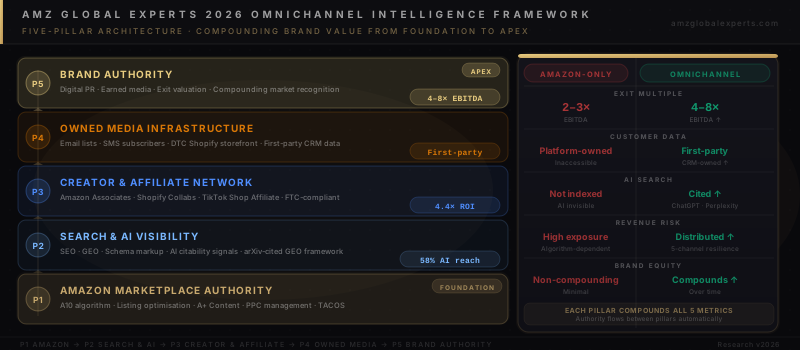
The AMZ Global Experts 2026 Omnichannel Intelligence Framework organises five channels through which ecommerce brands build durable, compounding value into a single integrated operating system. Each pillar operates independently as a revenue channel and simultaneously feeds authority signals, customer data, and brand credibility into every other pillar — creating a compounding effect that single-channel operators cannot replicate.
Pillar 1 — Amazon Marketplace Authority
Amazon remains the largest product discovery platform in the United States and the default starting point for the majority of online product searches. Marketplace authority — high organic ranking for primary commercial keywords, conversion-optimised listing copy, A+ Content, and disciplined PPC management at target TACOS — is the foundation that generates the cash flow to fund all other pillars. Without profitable Amazon operations, the capital required to build omnichannel infrastructure does not exist.
Pillar 1 is also the data source for every subsequent pillar. Amazon search keyword data informs organic SEO and GEO content strategy. Amazon customer review language feeds creator and affiliate content briefs. Amazon sales velocity data informs email and SMS retention campaign targeting. The brand that treats Amazon as a closed island rather than an intelligence source misses half the value of marketplace operations.
Pillar 2 — Search & AI Visibility
Search visibility in 2026 means two things simultaneously: traditional organic search rankings in Google (driven by domain authority, content quality, and backlink signals) and AI search citability (driven by structured content, named entity recognition, earned media, and E-E-A-T signals). These two visibility systems share significant infrastructure — content quality and authority building that improves Google rankings also improves AI citation rates — but each has distinct optimisation requirements that must be addressed explicitly.
For Amazon brands, Pillar 2 typically represents the largest infrastructure gap: brands that spent years optimising Amazon listing content have rarely invested equivalently in external web content, schema markup, or digital PR. Closing that gap within 12–24 months requires a systematic content strategy covering blog articles, FAQ schema, structured data, and earned media campaigns — not periodic blog posts or occasional press releases.
Pillar 3 — Creator & Affiliate Network
The creator and affiliate network pillar converts the trust relationship between content creators and their audiences into measurable brand revenue. Operating across Amazon Associates, the Amazon Influencer Programme, Shopify Collabs, and TikTok Shop Affiliate simultaneously — with FTC-compliant disclosure infrastructure and AI-powered partner attribution — creates a performance marketing layer that operates at fundamentally lower cost-per-acquisition than Amazon Sponsored Products for equivalent customer quality.
Creator and affiliate partnerships also generate the earned media that feeds Pillar 2. Every YouTube review, TikTok product demonstration, and newsletter recommendation creates a brand mention and potentially a backlink — building off-platform authority that improves both search rankings and AI citability without additional investment beyond the affiliate commission on actual conversions.
Pillar 4 — Owned Media Infrastructure
Owned media — email lists, SMS subscriber bases, DTC Shopify storefronts, and branded communities — represents the only customer assets in ecommerce that compound in value without ongoing acquisition spend. An email subscriber acquired today generates revenue indefinitely through retention campaigns, product launches, and referral activation. An Amazon customer acquired today generates zero direct revenue from subsequent purchases unless they re-purchase through Amazon search, where advertising costs apply again.
The mechanics of compliant Amazon customer data collection — QR codes in packaging directing to warranty registration pages, post-purchase email sequences within Amazon’s messaging system, and external traffic strategies through Amazon Attribution — are well-documented in seller communities and within Amazon’s own brand-building documentation. The brands building these lists today are accumulating an asset that compounds in value for years.
Pillar 5 — Brand Authority
Brand authority is the integrated output of the other four pillars: the accumulated recognition, trust, and credibility a brand has earned across Amazon search, organic search, AI search, creator recommendations, customer reviews, and industry coverage. It manifests as pricing power, higher conversion rates across all channels, organic word-of-mouth referral, and the editorial linkability that accelerates all authority-building activities.
Brand authority is also the metric most directly correlated with exit valuation. The brands that achieve 6–8× EBITDA multiples are the brands that a strategic acquirer can look at and say: this brand’s value is not dependent on any single algorithm, any single platform, or any single paid traffic source. The customers know this brand. The media covers this brand. The creators recommend this brand. This is an asset we can own and compound.
| Metric | Amazon-Only Brand | Omnichannel Operator |
|---|---|---|
| Customer acquisition cost | PPC-only, rising with CPC inflation | Distributed across 5+ owned channels |
| Customer data ownership | Amazon-owned, inaccessible to brand | First-party CRM, brand-controlled |
| Revenue stability | Algorithm and ad-platform dependent | Multi-channel resilience |
| AI search presence | None — Amazon listings not indexed by AI | Active citations in ChatGPT/Perplexity |
| Brand equity | Minimal, non-compounding | Compounding with each channel added |
| Exit valuation multiple | 2–3× EBITDA (single-channel discount) | 4–8× EBITDA (owned channel premium) |
Research Sources Informing This Report
The findings, strategic frameworks, and market observations in this report are informed by publicly available industry research, ecommerce trends, creator economy studies, affiliate marketing benchmarks, AI search optimisation research, regulatory guidance, marketplace developments, and practitioner discussions.
Affiliate & Creator Economy Research
Upfluence Research Center (upfluence.com/research) is the primary source for creator economy performance benchmarks in this report, including creator pricing, engagement rate analysis, ecommerce influencer strategy, and partnership marketing outcomes. Upfluence maintains one of the largest verified creator databases globally, with performance data across YouTube, Instagram, TikTok, Pinterest, and Twitter/X for more than 3 million creators.
Performance Marketing Association (PMA) (thepma.org) is the primary industry trade association for affiliate and partnership marketing professionals. The PMA’s annual industry research provides the affiliate ROI benchmarks (4.4× vs. display advertising), programme maturity data, and compliance standards referenced throughout this report.
Consumer Protection & Compliance
Federal Trade Commission (FTC) official guidance — specifically the Endorsements, Influencers, and Reviews section (ftc.gov/business-guidance/advertising-marketing/endorsements-influencers-reviews) — provides the regulatory framework for affiliate disclosure requirements, material connection standards, and brand liability obligations referenced in the creator economy and affiliate marketing sections of this report. All compliance recommendations reference current FTC guidance as of 2026.
AI Search & Academic Research
arXiv Research Library (arxiv.org) is the primary source for academic research on Generative Engine Optimization (GEO), AI search systems, information retrieval, and the algorithmic selection criteria that determine which sources AI systems cite in generated responses. The foundational GEO paper — Aggarwal et al. (2024) — is directly referenced in the AI Search section of this report. arXiv’s broader coverage of recommendation systems, ecommerce analytics, and machine learning applied to digital marketing informs the technical analysis throughout.
Industry News & Market Intelligence
Google News (news.google.com) is the monitoring source for ecommerce developments, AI search announcements, digital marketing trends, consumer behaviour changes, and technology adoption patterns referenced throughout this report. AI search product launches from Google, OpenAI, Perplexity, and Microsoft were tracked through Google News as primary coverage events.
Amazon News (aboutamazon.com/news) is the official source for Amazon marketplace announcements, seller programme updates, advertising product developments, and ecommerce ecosystem changes. All Amazon-specific data in this report — GMV figures, advertising revenue, third-party seller percentage — is sourced from Amazon’s Annual Reports and official news communications.
Community & Practitioner Research
This report incorporates qualitative intelligence from eight Reddit communities: r/AmazonSeller, r/FulfillmentByAmazon, r/Ecommerce, r/DigitalMarketing, r/Marketing, r/Entrepreneur, r/SEO, and r/Shopify. These communities collectively represent hundreds of thousands of active practitioners across Amazon selling, DTC brand-building, digital marketing strategy, and ecommerce operations. The practitioner intelligence derived covers Amazon PPC cost trends, brand-building strategies, influencer and affiliate marketing ROI experiences, customer acquisition costs, omnichannel growth strategy, and AI search visibility concerns. All Reddit-sourced observations are treated as practitioner sentiment data, not statistically validated research.
How AMZ Global Experts Builds Your Omnichannel Intelligence System
AMZ Global Experts designs and implements the full five-pillar omnichannel intelligence infrastructure for Amazon and Shopify brands operating at $500K–$50M in annual revenue. Our work spans all five framework pillars: Amazon listing optimisation and PPC management (Pillar 1), GEO infrastructure and AI citability development (Pillar 2), affiliate and influencer programme design using the Partner Growth Model™ (Pillar 3), DTC Shopify buildout and email/SMS retention architecture (Pillar 4), and digital PR and earned media campaigns that build brand authority over time (Pillar 5).
Our free tools suite provides immediate access to Domain Authority checking, page speed analysis, global SEO performance scoring, and the Amazon Enterprise Growth Engine — tools that quantify where your brand currently stands across each of the five framework pillars and identify the highest-leverage investments for your specific stage and category.
To build your omnichannel intelligence system, book a strategy session with our team. We map your current channel infrastructure, benchmark your position against omnichannel operators in your category, and deliver a 90-day prioritised implementation plan in a single working session — direct operator access, no account management layers.
Suggested Citation
To cite this report:
AMZ Global Experts Research Team. (June 2026). Why the Future’s Most Valuable Brands Won’t Be Built on Amazon Alone: Why Amazon Sellers Must Master Omnichannel Digital Marketing in 2026. AMZ Global Experts Market Research Report. Retrieved from https://www.amzglobalexperts.com
References & Sources
- Upfluence Research Center. Creator Economy & Influencer Marketing Benchmarks. upfluence.com/research
- Performance Marketing Association (PMA). 2025 Affiliate Industry Report. thepma.org
- Federal Trade Commission. Endorsements, Influencers & Reviews — Business Guidance. ftc.gov/business-guidance/advertising-marketing/endorsements-influencers-reviews
- arXiv Research Library. GEO: Generative Engine Optimization (Aggarwal et al., 2024). arxiv.org
- Google News. Ecommerce, AI Search & Digital Marketing Intelligence. news.google.com
- Amazon. Annual Report 2024; Amazon News. aboutamazon.com/news
- eMarketer / Insider Intelligence. AI Search Adoption in US Consumer Research, 2025. emarketer.com
- SignalFire. Creator Economy Report, 2024. signalfire.com
- Reddit communities: r/AmazonSeller, r/FulfillmentByAmazon, r/Ecommerce, r/DigitalMarketing, r/Marketing, r/Entrepreneur, r/SEO, r/Shopify (2024–2026 threads)
- Rakuten Advertising / Forrester Research. The ROI of Affiliate Marketing. rakutenadvertising.com