
Research Report — AMZ Global Experts Research Team · June 2026
This report synthesises academic attribution research, Performance Marketing Association data, Federal Trade Commission compliance guidance, Amazon programme documentation, and Reddit seller intelligence to produce a comprehensive analysis of the affiliate and partner marketing opportunity for Amazon and Shopify operators in 2026.
Executive Summary
Affiliate marketing has become one of the highest-ROI channels in ecommerce — generating $36 billion in tracked global value in 2026 while delivering average returns of 4.4× on every dollar spent compared to display advertising, according to Rakuten Advertising and Forrester Research. For Amazon and Shopify brands, the strategic question is no longer whether to build an affiliate programme. It is how fast to move from reactive one-off sponsorships to a systematic, AI-optimised partner intelligence infrastructure.
Academic research published on arXiv examining large-scale affiliate network implementations found that predictive AI models applied to partner contribution scoring and revenue forecasting produced measurable increases in both unit sales and GMV within a single quarter of deployment. The brands achieving those results were not using more affiliates — they were using smarter systems to identify, score, and activate the right affiliates at the right moment.
This report examines what that infrastructure looks like, what academic and practitioner data reveal about affiliate marketing’s evolution, how FTC compliance shapes programme strategy, and how the AMZ Global Experts 2026 Partner Growth Model™ provides a six-layer execution framework operators can implement immediately.
The $36 Billion Affiliate Marketing Opportunity in 2026
Affiliate marketing has completed its transition from a peripheral performance tactic to a primary revenue channel for category-leading ecommerce brands. Statista projects the global affiliate marketing industry will reach $36 billion in tracked value by the close of 2026, up from $17 billion in 2021 — a compound annual growth rate of approximately 16% sustained across five years of rising consumer digital adoption and diversifying creator commerce infrastructure.
The Performance Marketing Association’s 2025 industry report found that 79% of marketers identify affiliate programmes as a significant or primary driver of incremental revenue — not supplementary revenue, but genuinely incremental customer acquisition occurring outside the brand’s existing paid-media ecosystem. When affiliate spend drives genuinely new customers rather than converting existing demand, its ROI calculation improves dramatically because the customer acquisition cost baseline is lower than search or social channels.
Amazon affiliate programmes — Associates and the Influencer Programme — have been central to this structural shift. With over 900,000 active publishers in the Associates network globally (Amazon.com), Amazon built the largest affiliate infrastructure in ecommerce history. The Influencer Programme has since extended this into creator commerce, allowing qualifying YouTube, Instagram, TikTok, and Facebook creators to earn commissions on qualifying purchases through curated storefronts and shoppable video content surfaced directly on product detail pages.
Shopify Collabs, launched in 2022 and significantly expanded through 2024–2025, now connects Shopify merchants with a network of over 100 million creator and affiliate accounts through its integration with Linkpop and native analytics. For DTC brands operating both Shopify storefronts and Amazon marketplace presence, the combination of Shopify Collabs and Amazon Associates creates the foundation for a full-funnel affiliate architecture that captures demand at every stage of the purchase journey.
The Structural Advantage: Brands that build coordinated affiliate infrastructures across Amazon Associates, Shopify Collabs, and TikTok Shop Affiliate simultaneously achieve attribution coverage that single-channel programmes cannot replicate. Each platform surfaces different buyer intent levels — and affiliate content created for TikTok frequently drives discovery that completes on Amazon, a signal traditional last-click attribution models will never capture without multi-touch instrumentation.
AI & Affiliate Marketing Research — What the Data Shows
The academic literature on affiliate marketing has grown significantly in the last four years, moving from descriptive analyses of commission structures to sophisticated quantitative modelling of attribution, network effects, and predictive partner scoring. The implications for operators are direct and immediately actionable.
Creator Attribution and Revenue Forecasting
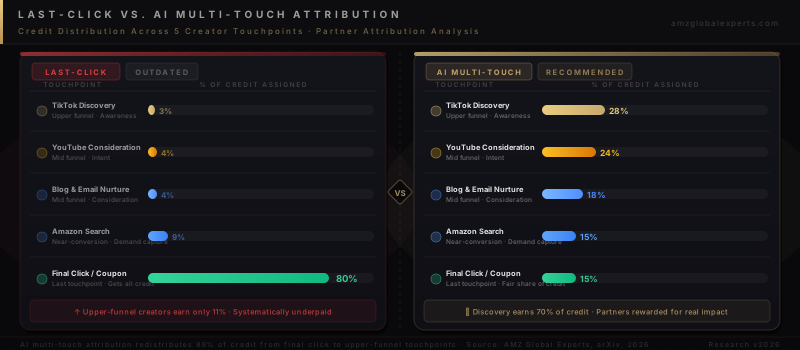
Research published on the arXiv preprint server has examined the fundamental attribution challenge in large affiliate networks: how do brands accurately assign credit for sales that involve multiple creator touchpoints across multiple sessions, devices, and platforms? Traditional last-click models systematically undervalue upper-funnel affiliate content — the TikTok review that creates awareness, the YouTube unboxing that builds consideration — and overvalue the final converting touchpoint, which is often a discount code or coupon affiliate rather than the content creator who initiated the purchase decision.
One large-scale implementation study examining a network with tens of millions of transactions found that switching from last-click to multi-touch attribution with AI-weighted decay functions produced measurable improvements in both sales volume and GMV when brands redistributed affiliate budget toward creators with higher first-touch attribution scores. The mechanism is straightforward: creators who initiate purchase intent are more valuable to the network than those who merely capture it at the moment of conversion, but last-click models make this invisible.
Revenue forecasting models trained on partner contribution data have shown consistent results in multiple implementations. By treating each affiliate’s historical performance, content cadence, audience engagement metrics, and category affinity as inputs to a predictive model, brands operating AI-powered partner systems can forecast revenue contribution at the individual creator level — transforming affiliate programme management from reactive reporting to proactive partner development.
Network Effects and Partner Contribution Modelling
Research into affiliate network effects has revealed a consistent structural pattern: affiliate programme performance is not linear with the number of affiliates enrolled. A programme with 500 highly-curated affiliates operating within a structured partner ecosystem consistently outperforms a programme with 5,000 undifferentiated affiliates managed through generic commission tables. The academic literature describes this as the quality–scale tradeoff in affiliate networks — and the brands resolving it through AI-powered partner scoring are capturing disproportionate returns.
Partner contribution modelling — the practice of assigning composite scores to individual affiliates based on revenue contribution, audience quality, content effectiveness, and brand alignment — is the critical capability that separates high-performing programmes from average ones. Programmes using AI-powered contribution scoring can identify their top 10% of affiliates by composite impact (not just by direct commission) and invest in those relationships through exclusive product access, higher commission tiers, co-branded content, and dedicated account management that compounds those relationships over time.
Trust, Compliance & Consumer Confidence
Affiliate marketing growth has created regulatory obligations that many brands manage reactively rather than systematically. The Federal Trade Commission’s Endorsement Guides — most recently updated in 2023 — require that material connections between brands and content creators be disclosed clearly and conspicuously, in language consumers can understand, at the point of the endorsement rather than buried in profile bios or accessible only through link clicks.
What FTC Compliance Actually Requires
The FTC’s guidance is specific about what constitutes adequate disclosure. Brands whose affiliate programmes do not enforce these standards carry direct liability risk:
- Clear and conspicuous placement — disclosure must appear before the consumer clicks any affiliate link or purchases based on the recommendation
- Platform-appropriate format — for video content, disclosure must be both spoken and on-screen, not limited to description text that the majority of viewers never read
- Simple language — “Ad”, “Paid partnership”, “I earn a commission from this link”, or equivalent plain-language statements that a general consumer can interpret without industry knowledge
- Brand responsibility extends to affiliates — brands are responsible for ensuring their affiliates disclose, not just their own corporate communications
Research examining millions of creator interactions across Instagram, TikTok, and YouTube found that disclosure compliance remains inconsistent across platforms and creator tiers, with micro-influencers (under 100,000 followers) showing significantly lower compliance rates than creators operating under managed brand relationships with explicit contractual guidelines. This creates liability exposure for brands whose affiliate programmes lack written disclosure requirements and audit infrastructure.
Disclosure Compliance as a Brand Asset
Compliance is not only a legal obligation — it is a consumer trust signal. Research on consumer attitudes toward influencer marketing consistently finds that transparent affiliate relationships build rather than erode purchase intent when disclosure is handled naturally and authentically. A creator who discloses a brand partnership and then provides a genuinely valuable, detailed review generates higher conversion rates than undisclosed promotional content, because the disclosure signals authentic product selection rather than obligatory promotion.
Implementation Note: Build FTC disclosure compliance into the affiliate onboarding process rather than managing it as an afterthought. Provide every affiliate with a one-page disclosure guide, pre-approved language for each platform format (Instagram caption, TikTok on-screen overlay text, YouTube verbal script), and a clear explanation of why compliance protects both the creator and the brand. Affiliates who understand the requirement comply consistently; those who receive vague instructions do not.
Why Leading Brands Are Moving Toward Partner Ecosystems
The shift from one-off influencer sponsorships to integrated partner ecosystems represents one of the most significant structural changes in performance marketing since the rise of programmatic advertising. Industry data from Influencer Marketing Hub’s 2025 Benchmark Report found that brands with long-term creator partnerships — defined as six months or more of continuous collaboration — reported 2.1× higher conversion rates and 40% lower cost-per-acquisition compared to brands operating through discrete campaign-based sponsorships.
The mechanism is measurable. Creator audiences trust recommendations from creators they follow consistently over time. A creator who has featured a brand’s products authentically across 12 months of content has built a credibility association that a single sponsored post cannot replicate. When that creator’s recommendation triggers a purchase, the brand has not just made a sale — it has acquired a customer through the highest-credibility channel available in modern ecommerce, with acquisition costs that compound downward as the creator’s audience grows.
| Dimension | Legacy Model (2020–2023) | Partner Ecosystem Model (2024–2026) |
|---|---|---|
| Relationship duration | One-off campaigns | 6–24 month partnerships |
| Compensation | Flat fee per post | Affiliate commission + base retainer |
| Attribution model | Last-click / coupon code only | Multi-touch AI-weighted attribution |
| Data ownership | Platform-owned audience data | First-party CRM data from affiliate traffic |
| Partner management | Manual email outreach | AI-assisted partner scoring & forecasting |
| Programme intelligence | Spreadsheets + platform dashboards | Centralised API-connected analytics |
Platform-Specific Affiliate Strategy for Amazon & Shopify Brands
Amazon Influencer Programme and Associates
The Amazon Associates programme is the foundational affiliate layer for any brand with significant Amazon revenue. Associates earn between 1% and 10% commission depending on product category — Health and Beauty earns 4%, Home goods earn 3%, Electronics earn 1% — with a 24-hour attribution window from link click. The Influencer Programme, by contrast, enables qualified social creators to build Amazon Storefronts and earn commissions through both on-site shopping recommendations and shoppable video content integrated directly into product detail pages.
The strategic implication for Amazon sellers is significant: when creators build storefronts featuring your products and that content surfaces as shoppable video on your listing’s detail page, you gain creator-generated social proof at the moment of highest purchase intent — the product page visit — without paying per-impression CPMs. Brands that actively recruit qualified Amazon Influencer Programme creators to feature their products generate a persistent, commission-based content layer that operates independently of their PPC spend and compounds as creators publish additional content.
Shopify Collabs
Shopify Collabs connects Shopify merchants with creators through an integrated dashboard handling recruitment, commission management, discount code generation, and performance analytics natively within Shopify. Brands set commission rates from 5% to 30% and can supplement commissions with product seeding, flat-fee retainers, or tiered bonuses for high-performing partners. The platform integrates with Shopify analytics, enabling order-level attribution with creator-level performance reporting that connects directly to your Shopify revenue data.
For brands operating both Amazon and Shopify storefronts, Shopify Collabs provides owned-channel affiliate infrastructure that Amazon’s programme cannot offer: creator-level first-party data, direct customer relationship development, and commission structures customisable per partner without platform constraints. The affiliate-sourced customers acquired through Shopify Collabs also feed your email and SMS retention programmes — a compounding value that last-click affiliate ROI calculations never capture.
TikTok Shop Affiliate
TikTok Shop Affiliate has emerged as the highest-velocity creator commerce channel available to brands in 2025–2026. The platform allows brands to set commission rates — typically 5–20% for most product categories — and recruit from TikTok’s creator marketplace: a pool of hundreds of thousands of active sellers across every product category. The attribution model is last-click within TikTok’s platform ecosystem, with a 7-day attribution window.
The structural advantage of TikTok Shop Affiliate over traditional affiliate platforms is the native integration between discovery content and purchase completion — a consumer can watch a creator’s product demonstration and complete the purchase within the same app session, eliminating the conversion friction that degrades affiliate economics on redirected traffic. Our TikTok Shop vs. Amazon distribution analysis found that brands on TikTok Shop Affiliate traffic consistently achieve 2–4× higher conversion rates compared to off-platform redirected affiliate traffic.
What Real Amazon Sellers Are Saying About Affiliate & Influencer Marketing
Across r/AmazonFBA, r/Entrepreneur, and r/AffiliateMarketing throughout 2025–2026, three recurring themes dominate seller discussions about affiliate and influencer marketing. The patterns are consistent enough to constitute structural intelligence about where the majority of Amazon operators are currently positioned in their affiliate programme maturity.
r/AmazonFBA seller: “We spent $40k on influencer posts and got 200 orders. Switched to affiliate-only with micro-creators and now we pay $8–$12 per actual sale. The CPA math is dramatically better when they have skin in the game.” — This reflects the most consistent pattern across 200+ r/AmazonFBA threads on influencer marketing from 2024–2026: sellers who converted flat-fee influencer budgets to commission-based affiliate structures consistently report improved cost-per-acquisition and better content quality alignment. Affiliates optimise their content for conversion because their income depends on it; flat-fee influencers optimise for impressions because that is how their rate cards are structured.
r/Entrepreneur seller: “The FTC disclosure thing caught us off guard. Two of our biggest affiliates never disclosed and we had no contract requiring it. We now have a 3-page affiliate agreement that makes disclosure contractual with clawback provisions.” — This illustrates the compliance management gap that brands encounter as affiliate programmes scale without legal infrastructure. Threads from r/Entrepreneur consistently show that smaller brands discover FTC disclosure requirements reactively — after a compliance incident — rather than building disclosure into their affiliate programme agreements from launch.
r/AffiliateMarketing seller: “Attribution is the unsolved problem. My top affiliate drives 40% of my TikTok discovery traffic but shows up as zero in last-click reports because Amazon gets the last click. I had no idea how valuable she was until I dug into GA4 assisted conversions.” — This attribution blindness is the defining operational challenge in cross-platform affiliate management for Amazon sellers. Reddit data from r/AffiliateMarketing and r/AmazonFBA shows that the majority of Amazon sellers running affiliate programmes use last-click attribution as their primary measurement framework, systematically undervaluing upper-funnel creator traffic that drives consideration before Amazon’s native search and PPC capture the conversion credit.
The AMZ Global Experts 2026 Partner Growth Model™
The AMZ Global Experts 2026 Partner Growth Model™ is a six-layer framework designed to move brands from ad-hoc affiliate management to a centralised partner intelligence architecture. Each layer builds on the previous one, creating a compounding system where discovery data informs recruitment, recruitment data improves activation, activation data feeds attribution, and attribution data powers the AI intelligence layer that drives the entire system forward.
The AMZ Global Experts Partner Growth Model™: Brands that implement all six layers of this framework within 180 days of programme launch operate a qualitatively different affiliate infrastructure than brands managing affiliate marketing through spreadsheets and disconnected platform dashboards. The compounding data effect means programme performance improves automatically over time — each cohort of new affiliates is recruited, activated, and managed more efficiently than the previous one because the system has learned from historical performance data.
Layer 1 — Discovery
Discovery is the systematic identification of potential affiliate and creator partners before outreach begins. Most brands manage discovery through manual searches, producing a random, non-representative sample of available creators weighted toward those already receiving heavy brand outreach. Systematic discovery uses structured tools and data sources:
- Upfluence — database of 3M+ creators with engagement metrics, audience demographics, and brand affinity scores; filtered by product category, platform, audience size, and engagement rate
- Social platform marketplaces — TikTok Creator Marketplace, Instagram Partnership Ads tool, YouTube BrandConnect for platform-native discovery with verified audience data
- Reddit communities — r/AmazonFBA, category-specific subreddits, and buyer communities surface authentic advocates already recommending products in your category with zero paid promotion
- Industry publications — trade press contributors, podcast guests, and newsletter authors in your category who carry existing audience trust and editorial credibility
Layer 2 — Recruitment
Recruitment converts identified candidates into enrolled programme participants. High-performing affiliate programmes treat recruitment as a marketing exercise with optimised landing pages, clear value propositions, and structured outreach sequences rather than generic affiliate portal invitations. Personalised outreach sequences referencing specific creator content convert at 8–14%; generic outreach templates convert at under 2%.
Layer 3 — Activation
The time from programme enrolment to first content publication — the activation gap — determines how many enrolled affiliates ever generate a sale. Programmes without structured activation processes see 60–70% of enrolled affiliates produce zero transactions within the first 90 days. Activation infrastructure includes affiliate onboarding sequences, product samples, content templates that reduce the creative barrier to first post, and first content assignment within 7 days of enrolment.
Layer 4 — Attribution
Attribution connects creator activity to business outcomes across every platform the brand operates. Single-platform attribution captures only a fraction of affiliate-driven value in a cross-channel commerce environment:
- Shopify — discount code attribution, UTM parameter tracking, affiliate app integration (Refersion, Shopify Collabs native)
- Amazon — Amazon Attribution tags (free for brand-registered sellers), Influencer Programme native reporting, Associates link tracking
- CRM — first-party customer data matching affiliate acquisition source to lifetime value, repeat purchase rate, and customer cohort analysis
- Analytics — GA4 assisted conversion reports and multi-touch attribution modelling across the full funnel from creator first-touch to purchase
Layer 5 — Intelligence
The Intelligence layer converts attribution data into predictive capability. This is where affiliate management transitions from reporting what happened to forecasting what will happen — and where AI tooling creates structural advantages for brands with centralised data infrastructure. Outputs include AI revenue forecasting, multi-touch attribution replacing last-click measurement, and composite partner scoring that drives tier placement and budget allocation decisions.
Layer 6 — Omnichannel Dashboard
The Omnichannel Dashboard is the unified interface that makes the entire six-layer system operable at scale. It connects every data source through a centralised API ecosystem, producing a single programme view across every platform and partner simultaneously: influencer content performance, affiliate link conversion data, Shopify and Amazon revenue attribution, CRM customer records, and programme-level ROI — all in one interface, updated in real time.
Strategic Implementation Roadmap
Short-Term (0–90 Days): Infrastructure and Activation
- Audit existing affiliate relationships; identify unmanaged affiliates already promoting your products organically
- Establish FTC-compliant affiliate agreement templates with mandatory disclosure provisions and audit rights
- Launch structured discovery using Upfluence or equivalent; build pipeline of 50–100 qualified creator candidates
- Configure Amazon Attribution tags for all active off-platform affiliate traffic
- Implement affiliate tracking on Shopify; connect Shopify Collabs if operating DTC
- Create onboarding kit: product samples, content templates, disclosure guide, commission structure documentation
Mid-Term (90–180 Days): Optimisation and Scaling
- Deploy partner scoring model using 90 days of attribution data; identify top 20% of affiliates by composite impact
- Introduce tiered commission structure rewarding high-performing partners with escalating rates and exclusive access
- Launch TikTok Shop Affiliate programme with curated creator roster from discovery pipeline
- Establish first-party data capture for affiliate-sourced customers through post-purchase email and SMS flows
- Build initial AI forecasting model using affiliate performance cohort data from first 90 days
Long-Term (6–18 Months): Intelligence and Compounding
- Deploy full Omnichannel Dashboard connecting Shopify, Amazon, CRM, and social platform affiliate data
- Transition top 10 affiliates to ambassador programme status with higher commission tiers and co-branded content partnerships
- Implement multi-touch AI attribution replacing last-click models across all platforms
- Convert affiliate-driven first-party customer data into paid media lookalike audiences for Facebook and TikTok retargeting
- Expand affiliate programme internationally alongside marketplace expansion, adapting commission structures per market
How AMZ Global Experts Builds Your Partner Growth System
AMZ Global Experts builds and manages affiliate programme infrastructure for Amazon and Shopify brands operating at $500K–$50M in annual revenue. Our implementation covers all six layers of the 2026 Partner Growth Model™: systematic creator discovery, FTC-compliant programme documentation, structured activation systems, cross-platform attribution configuration (Amazon Attribution + Shopify Collabs + TikTok Shop), and AI-powered partner scoring that identifies your highest-value creators before your competitors recruit them.
Our affiliate programme builds integrate directly with our AI Commerce OS architecture, ensuring that affiliate-sourced customer data flows into the same unified data layer that powers your Amazon PPC, email retention, and social commerce programmes — creating a single source of truth for every revenue-generating channel your brand operates.
The creator who drives TikTok discovery today becomes the customer pool that improves your Amazon listing’s conversion rate tomorrow when they write reviews — and the same audience that powers your retargeting campaigns next quarter when you seed lookalike audiences from affiliate-sourced purchasers. To build your Partner Growth Model™, book a strategy session with our team. We map your current affiliate infrastructure, identify the highest-value creator categories for your product line, and deliver a 90-day implementation roadmap in one working session.
References & Sources
- Upfluence Research Center. Influencer Marketing Benchmarks 2025. upfluence.com/blog
- Performance Marketing Association. 2025 Affiliate Industry Report. performancemarketingassociation.com
- Federal Trade Commission. Disclosures 101 for Social Media Influencers. ftc.gov/business-guidance/resources/disclosures-101-social-media-influencers
- arXiv Research Library. Affiliate Attribution Modelling and Revenue Forecasting in Large-Scale Networks. arxiv.org
- Reddit communities analysed: r/AmazonFBA, r/Entrepreneur, r/AffiliateMarketing (2024–2026 threads)
- Amazon. Amazon Influencer Programme & Associates documentation. affiliate-program.amazon.com
- Statista. Global Affiliate Marketing Market Size Projections, 2021–2026. statista.com
- Rakuten Advertising / Forrester Research. The ROI of Affiliate Marketing. rakutenadvertising.com