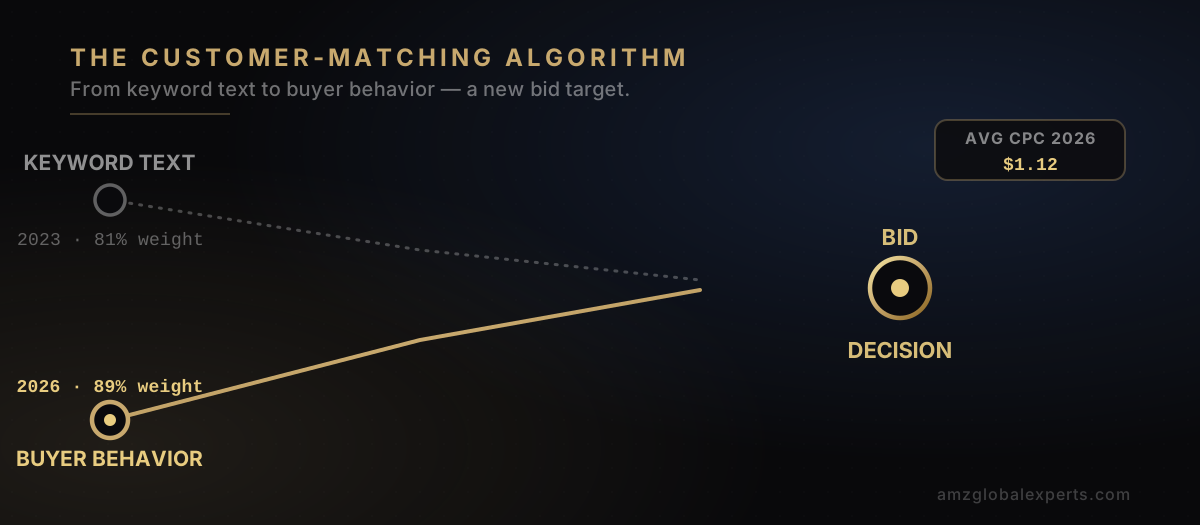
For a decade, Amazon PPC ran on a simple premise: match a shopper's search query to a listing's keywords, rank the closest matches, and let bid amount settle the tiebreak. That premise no longer describes how the auction works. Sellers comparing 2023 campaign structures to 2026 performance are seeing the same manual, exact-match campaigns that used to carry an account now underperform broad and auto campaigns they'd normally treat as a discovery tool, not a scaling engine — and the threads on r/FulfillmentByAmazon and r/AmazonSeller are full of the same confused question: why is my worst-targeted campaign suddenly my best performer?
The answer is that Amazon's ad-ranking model has quietly become a recommendation engine. It no longer asks "does this listing's text match this query." It asks "which listing is this specific shopper, based on their browsing history and purchase pattern, most likely to buy right now." That's a fundamentally different optimization target, and it rewards a different campaign structure than the one most PPC playbooks still teach.
What Actually Changed in the Ranking Model
Three shifts explain almost everything sellers are experiencing this year.
1. The auction now prices predicted conversion, not query match
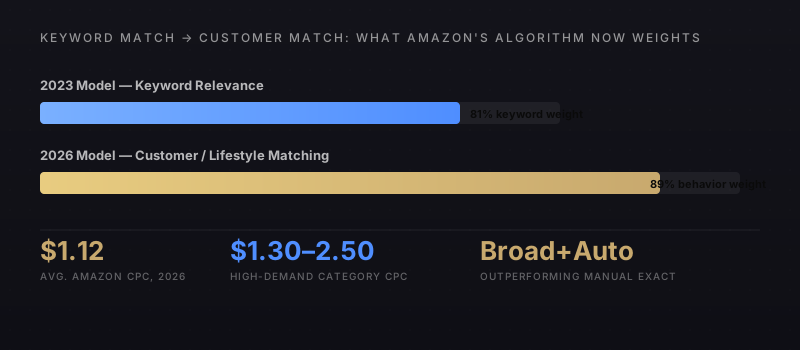
Amazon's bidding system increasingly auctions impressions based on a predicted probability of purchase for that specific shopper, built from browsing history, purchase cadence, and category affinity, rather than a static relevance score between query and listing. A shopper who's browsed three competing listings in your category in the last 48 hours is worth more to Amazon than a first-time searcher typing your exact keyword, even if that searcher's query matches your title word-for-word. That's why average Amazon CPC has climbed to $1.12, with categories like supplements running $1.30–$2.50 per click. The platform is pricing intent, not text match.
2. Auto and broad campaigns now access an audience manual exact match can't reach
Manual exact-match campaigns constrain the algorithm to the literal keyword list you provide. That was an advantage when relevance was keyword-driven. It's now a ceiling. The customer-matching model surfaces high-converting shoppers whose queries don't map cleanly to the keyword phrases sellers predict in advance. Auto campaigns let Amazon's model find those shoppers directly, and that's the mechanism behind the pattern more sellers are reporting: broader, less restrictive targeting surfacing high-performing keywords traditional keyword research would never have suggested.
3. Listing content now functions as a matching signal, not just a relevance signal
Because the model weighs lifestyle and use-case fit, the words and imagery in your listing matter beyond keyword density. A listing clearly signaling "for new parents traveling with a newborn" gets matched against shoppers whose behavior indicates that context, independent of whether "traveling with a newborn" ever appears in your backend search terms.
How to Restructure Your Account Around Customer Matching
The playbook doesn't discard manual exact match — it changes its job. Manual campaigns become the layer where you capture and defend proven converters; auto and broad campaigns become your discovery and volume engine.
Rebalance budget toward auto and broad, deliberately
Rather than treating auto campaigns as a small discovery-budget line item, allocate a meaningfully larger share — many operators are now running 30–45% of total PPC spend through auto and broad campaigns, up from the 10–15% that was standard two years ago. The auto campaign's job shifts from "find a few new keywords each month" to "let Amazon's customer-matching model find the shoppers I can't predict."
Harvest aggressively, promote what proves itself
Every converting search term surfaced by auto or broad campaigns should be reviewed weekly and, once it clears a minimum order threshold (typically 3–5 orders at acceptable ACOS), promoted into a manual exact-match campaign where you control bid and placement precisely. This keeps manual campaigns as a defensive, high-control layer while auto campaigns absorb the exploratory risk.
Add negative keywords faster than you used to
Because broad and auto campaigns now carry more of your budget, wasted spend compounds faster if you're slow to exclude irrelevant search terms. Move search term report review from monthly to weekly, and treat negative-keyword hygiene as a core weekly task rather than a monthly cleanup.
Rewrite listings for lifestyle fit, not just keyword density
Audit your title, bullets, and A+ Content for whether they communicate a clear use-case and buyer context — not just whether they contain your top 10 keywords. A10-era listings optimized purely for keyword stuffing are now working against the model's actual matching logic.
The core shift: Amazon's algorithm stopped asking "does this query match this listing" and started asking "does this shopper's behavior match this listing's buyer." Every PPC structure decision in 2026 should be evaluated against that question, not the keyword-relevance logic that governed campaigns through 2023.
What This Means for Budget Planning Going Into Q4
Rising CPCs aren't a temporary spike to wait out — they reflect a structurally more competitive, more accurately-priced auction. Sellers who keep fighting the old battle (tight exact-match control, minimal auto spend) are bidding against an algorithm optimized for a different objective than the one their campaign structure assumes. The sellers pulling ahead in 2026 aren't spending more; they're spending in the layer — auto and broad — where Amazon's own model is doing the targeting work for them, and using manual campaigns to lock in and defend what that discovery process proves out.
Frequently Asked Questions
Amazon's 2026 ad-ranking model prioritizes lifestyle data, browsing behavior, and purchase-pattern signals over simple keyword relevance. Instead of matching a search query to a listing's keywords, the algorithm matches a shopper's behavioral profile to the listing most likely to convert for that shopper — functioning more like a recommendation engine than a keyword engine.
Because the algorithm now surfaces high-converting customer segments that don't map cleanly to predictable keyword phrases. Auto and broad-match campaigns let Amazon's customer-matching model find those segments directly, while manual exact-match campaigns restrict the algorithm to a narrower, keyword-defined audience that increasingly misses the shoppers Amazon's model has identified as high-intent.
Rising CPCs reflect both increased seller competition for ad inventory and the algorithm's shift toward auctioning impressions based on predicted conversion probability rather than keyword rank. High-demand categories like supplements now see $1.30–$2.50 per click because the customer-matching model concentrates bids around shoppers it predicts are near a purchase decision.
Shift a larger share of budget into auto and broad-match campaigns paired with aggressive negative-keyword harvesting, use search term reports to feed manual campaigns only with proven converters, and prioritize listing content (main image, title, A+ content) that speaks to lifestyle and use-case rather than keyword stuffing — since the algorithm now weighs behavioral fit as heavily as textual relevance.