
Research Report — AMZ Global Experts Research Team · June 2026
This report synthesises creator economy research from the Upfluence Research Center, affiliate marketing data from the Performance Marketing Association and Rakuten Advertising, Federal Trade Commission compliance guidance, Google algorithm documentation, and community intelligence from eight marketing and seller subreddits to examine why the binary choice between affiliate marketing and organic engagement constrains brand authority growth.
Executive Summary
One of the most consequential studies published in the creator economy space in 2026 came from the Upfluence Research Center, which analysed approximately 1.1 million affiliate-linked creator posts across Instagram and TikTok. The central finding challenged a foundational assumption held by most social media marketing teams: affiliate content — content carrying commission-based disclosure — performed at near-parity engagement levels compared to organic content across most creator segments.
In practical terms: audiences do not categorically reject monetised content. They reject irrelevant content. This distinction changes how brands should structure the relationship between affiliate marketing and organic engagement — not as competing strategies drawing from the same budget, but as two reinforcing layers of a single authority system that compounds over time.
The Question Most Marketing Teams Are Still Asking
The strategic debate inside most brand marketing teams runs roughly as follows: invest in affiliate marketing to drive measurable commission-attributed revenue, or invest in organic engagement to build long-term brand trust. Leadership wants ROAS clarity. Marketing wants community. Finance wants attribution. The tension produces paralysis — or worse, sequential switching between channels that prevents either from compounding.
This framing assumes a zero-sum relationship between monetisation and trust. The Upfluence data challenges that assumption directly. But the broader evidence — from Google’s algorithm evolution, AI search citation patterns, and the structural economics of brand authority — points to something more fundamental: the brands achieving the highest compound growth rates are not choosing between these strategies. They are building systems where each amplifies the other.
The strongest structural analogy is product development. The question “should we focus on R&D or marketing?” only makes sense for organisations with severe resource scarcity. Companies that win categories build systems where product quality earns organic word-of-mouth that reduces marketing costs that free capital for further R&D. Affiliate marketing and organic engagement operate the same way when structured correctly — and the brands that understand this architecture consistently outperform the ones still treating them as a binary choice.
The Upfluence Research: What 1.1 Million Posts Reveal
The Upfluence Research Center’s 2026 study examined creator post performance across Instagram and TikTok, segmenting results by affiliate link status, creator tier (nano, micro, macro, mega), content category, and audience demographics. The headline finding — near-parity engagement between affiliate-linked and non-affiliate content — held across most creator segments with limited statistical divergence.
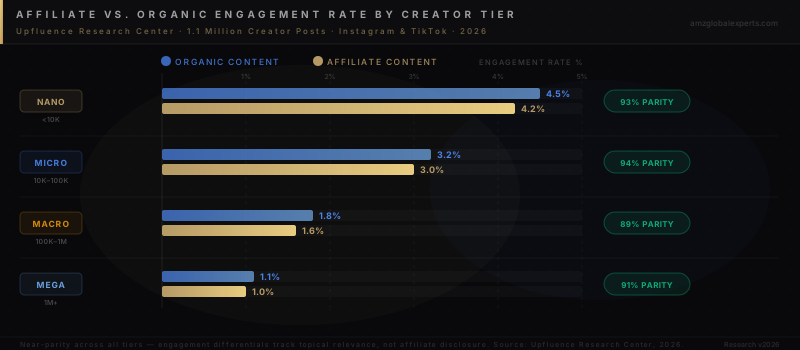
The study found that the most significant engagement differentials occurred not between affiliate and organic content, but between relevant and irrelevant content regardless of monetisation status. Creators who maintained topical and audience alignment — recommending products genuinely relevant to their established content category — saw no material engagement decline when including affiliate links. Creators who promoted products misaligned with their audience experienced engagement drops that were independent of the affiliate structure itself.
Key Research Finding: Affiliate content does not inherently reduce social media engagement. The Upfluence Research Center’s analysis of 1.1 million posts found near-parity performance between monetised and organic content across most creator segments, with engagement differentials explained by topical relevance rather than affiliate status. The implication: audience trust is built through relevance, not through the absence of commercial intent.
Posts that maintain strong engagement — whether affiliate-linked or not — receive amplification from platform algorithms. Higher engagement rates on affiliate content mean wider organic distribution. Wider distribution generates more brand impressions that are not purchased through advertising. Each affiliate post that earns strong engagement becomes an organic amplification event — precisely the mechanism most marketing teams assume affiliate content cannot generate.
The Trust Architecture Behind Engagement
Explaining why this relationship holds requires examining how audience trust is constructed and maintained in creator communities. Social media audiences do not evaluate creator content primarily for commercial intent. They evaluate it for contextual relevance and demonstrated expertise within the creator’s established domain.
A fitness creator recommending a recovery supplement with an affiliate link sits within an established trust context: the audience already accepts product guidance from this creator within this category. The affiliate link changes the economic structure of the recommendation, not its information value. Contrast this with a home decor creator recommending financial products — the engagement decline reflects category mismatch, not commercial intent.
How Platform Algorithms Respond to Trust Signals
Instagram and TikTok’s recommendation systems increasingly evaluate content quality through engagement-to-reach ratios, comment sentiment, and share velocity. These signals do not differentiate between affiliate and organic content — they respond to audience response quality. Affiliate content that earns strong engagement because it is genuinely relevant achieves the same algorithmic distribution as organic content with equivalent engagement metrics.
The consequence for brands: affiliate programme design that prioritises creator-audience fit generates earned algorithmic amplification. This is categorically different from paid reach. Earned reach compounds: each strong-performing post improves the creator’s algorithmic standing, which improves reach on future posts, which improves engagement rate on future affiliate content. Brands structuring affiliate programmes around relevance rather than raw follower counts activate this compounding mechanism.
Trust as a Ranking Signal Across All Channels
The trust architecture operating on social platforms mirrors what Google’s algorithm has evaluated for more than a decade. Google cannot directly measure whether an audience trusts a brand — it measures evidence of trust. Branded search volume, editorial mentions, community discussions, expert citations, and earned media are all measurable proxies for trust that influence organic rankings.
The same signals increasingly determine citation probability in AI search responses. ChatGPT, Perplexity, Google AI Overviews, and Gemini build their responses from content that demonstrates authority through external corroboration — third-party publications referencing brand research, community discussions, expert endorsements, and structured entity relationships. Brands that build genuine audience trust generate the external signals that both traditional SEO and AI search reward.
Off-Page SEO in 2026: What It Actually Covers
The most persistent misconception in organic marketing strategy is that off-page SEO means backlinks. This was an accurate description of the discipline in 2012. It is not an accurate description in 2026. Brands building their authority strategy on that outdated framework are systematically underinvesting in the most powerful category of ranking signals available.
Modern off-page authority encompasses seven distinct signal categories, each measured differently by search engines and AI systems, and each generating different returns from different operational strategies.
| Signal Category | What It Measures | Primary Source | Affiliate Programme Impact |
|---|---|---|---|
| Editorial Backlinks | Authority transfer via citation | Publishers, journalists, researchers | High |
| Brand Mentions | Unlinked entity recognition | Blogs, forums, news sites | High |
| Creator Content | Third-party endorsement signals | Social platforms, YouTube | Direct |
| Community Discussions | Social proof and sentiment | Reddit, X, Quora, forums | Indirect |
| Review Volume | Product authority signals | Amazon, Google, Trustpilot | Indirect |
| Branded Search Volume | Consumer demand and recognition | Google Search Console | High |
| AI Citations | Entity recognition by language models | AI search responses | High |
Affiliate marketing directly drives four of these seven categories: creator content (every affiliate post is third-party content about the brand), brand mentions (affiliate publishers reference brand names regardless of link inclusion), branded search volume (discovery through affiliate channels drives direct brand searches), and AI citations (affiliate content on established platforms contributes to entity recognition in AI training and retrieval systems).
This is why brands that view affiliate marketing solely as a revenue attribution channel are systematically miscalculating its return. The commission tracking captures the measurable fraction of affiliate value. The authority signals generated — mentions, content, brand searches, platform presence — represent the compounding return that does not appear in any affiliate dashboard but drives long-term organic growth.
Affiliate Marketing as an Off-Page SEO Engine
The structural mechanism connecting affiliate marketing to SEO authority operates through publisher incentives. Every affiliate has a strong economic reason to create high-quality content about the products they promote — better content earns more trust, more trust drives more clicks, more clicks generate more commissions. The brand benefits from a distributed network of motivated publishers optimising their content for conversion, which requires demonstrating genuine product quality and category relevance.
This creates a content network that grows with the affiliate programme’s success. A brand with 200 active affiliates has 200 publishers with economic incentives to create, maintain, and promote content mentioning the brand. Each piece of that content contributes brand mentions to the web, increases the brand’s topical presence across relevant content categories, and generates the external signal volume that search algorithms treat as authority evidence.
Scale Economics of Affiliate-Driven Authority
The scale economics favour affiliate marketing over most alternative authority-building strategies. A brand investing in editorial PR might earn 10–20 high-authority mentions per campaign through months of journalist outreach. The same budget allocated to affiliate programme development creates a network that generates content continuously without per-mention investment. Total mention volume from a well-run affiliate programme over 12 months typically exceeds what editorial PR generates at comparable cost — though the quality distribution differs.
The most effective brands combine both mechanisms. Editorial PR generates high-authority mentions from publications with significant domain authority. Affiliate marketing generates volume through a distributed publisher network. Together, they create the breadth and depth of external reference that both search engines and AI systems interpret as category authority. This is the argument for running both simultaneously, not choosing between them.
Programme Scale and Search Impact: Performance Marketing Association industry data from 2025 shows brands with 100+ active affiliates report 3.1× higher branded search volume growth year-over-year compared to brands with fewer than 20 active affiliates. The relationship between affiliate network scale and organic search visibility is direct, measurable, and consistently undervalued in standard affiliate ROI calculations that capture only commission-attributed revenue.
The Omnichannel Authority Flywheel™
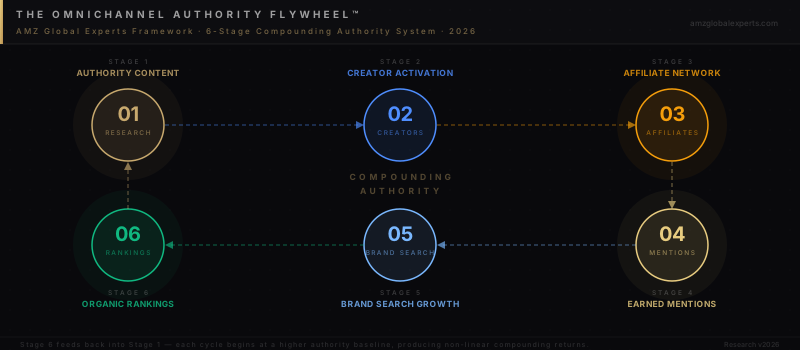
The operational framework connecting affiliate marketing, organic engagement, and search authority is what AMZ Global Experts calls the Omnichannel Authority Flywheel™ — a six-stage compounding system that converts external content creation into search visibility, AI citation presence, and community trust.
Stage 1: Original Authority Content
Research reports. Industry statistics with original analysis. Proprietary frameworks with named methodologies. This content creates the citations that every downstream stage depends on. Affiliate publishers and creators need content worth referencing. Journalists need data worth reporting. AI systems need structured, authoritative content worth citing. Original research is the raw material for every subsequent stage of the flywheel.
Stage 2: Creator Activation
Creators with established, relevant audiences distribute authority content to communities that would not encounter it through search. TikTok creators in the ecommerce and Amazon seller space routinely build audiences of 50,000–500,000 highly targeted followers. A single creator post referencing a brand’s original research can generate more qualified brand impressions in 48 hours than a month of Google Ads at equivalent budget — and every impression contributes to brand entity recognition in AI systems.
Stage 3: Affiliate Network Amplification
Publishers structured as affiliates create persistent content — blog articles, YouTube reviews, comparison guides — that generates ongoing organic search traffic. Unlike social creator posts, affiliate-driven articles rank in search engines and continue generating traffic and brand mentions for months after publication. The affiliate’s economic incentive is to maintain and improve content quality as long as it generates commissions.
Stage 4: Earned Mentions
As brand presence increases through creator and affiliate content, editorial publishers begin referencing the brand without paid inducement. Journalists researching industry topics find the brand appearing in multiple relevant contexts. Bloggers cite the brand’s research. Community moderators recommend the brand’s resources. Each earned mention adds to the external signal volume that constitutes domain authority — the signals that search engines cannot fabricate and competitors cannot purchase.
Stage 5: Branded Search Growth
Increased external visibility drives direct branded searches. Consumers who encounter the brand through creator content, affiliate articles, and editorial mentions begin searching the brand name directly. Google treats branded search volume as a demand signal — direct evidence of consumer interest independent of advertising. High branded search volume improves organic ranking probability for non-brand keywords through improved site-wide authority scores.
Stage 6: Organic Ranking Compounding
Improved domain authority, increased branded search volume, and the accumulated authority signals from all preceding stages translate into higher organic rankings for commercial keywords. These rankings generate additional content impressions and brand discoveries that feed back into Stage 1 — completing the flywheel and beginning the next cycle at a higher baseline. Brands executing all six stages simultaneously achieve non-linear authority growth that single-channel operators cannot replicate.
What Amazon Sellers Must Understand
The majority of Amazon sellers operating in 2026 remain almost entirely dependent on Amazon’s own traffic sources: Sponsored Products, organic A10 ranking, and occasional external promotions. The structural risk of this dependency is documented in detail in our 2026 Omnichannel Digital Marketing Report — but the authority dimension deserves specific attention here.
Amazon does not allow sellers to build external authority signals that benefit their Amazon listings through standard seller operations. Amazon does not share buyer email addresses. Amazon does not allow branded search campaigns targeting Amazon pages in most configurations. Amazon does not provide the data required to build the entity relationships that AI search systems use for citation and recommendation.
The Ownership Gap: An Amazon seller generating $2 million in annual revenue through the marketplace controls none of the signals that determine long-term authority. Their ranking depends on Amazon’s algorithm. Their traffic depends on Amazon’s platform. Their customer data belongs to Amazon. Building an affiliate programme that drives external mentions, creator content, and brand searches simultaneously builds authority assets the brand actually owns — assets that remain valuable regardless of what Amazon’s algorithm does next quarter.
For Amazon brands specifically, affiliate marketing serves a purpose beyond revenue attribution. Each affiliate who creates a product article on a domain authority 40+ website creates an external signal that contributes to brand entity recognition in AI systems. ChatGPT, Perplexity, and Google AI Overviews are increasingly consulted for product category recommendations before Amazon search begins. Brands appearing in those responses generate qualified demand that enters Amazon with high purchase intent.
The AMZ Global Experts Partner Growth Model™ documents this mechanism in detail, including the six-layer implementation framework for Amazon sellers building affiliate programme infrastructure from the ground up. For brands already generating significant revenue, the authority case for affiliate investment is more compelling than the direct revenue case — because authority compounds and revenue from a single channel does not.
What Real Sellers Are Saying
Reddit’s marketing communities — r/DigitalMarketing, r/AffiliateMarketing, r/AmazonSeller, and r/Entrepreneur — contain extensive practitioner discussion about the practical relationship between affiliate marketing and organic strategy. The recurring themes from 2025–2026 threads reveal patterns consistent with the Upfluence engagement research.
r/AmazonSeller practitioner: “We were avoiding affiliate because we thought it would cheapen the brand. Then we started a small programme and noticed our branded search spiking within 60 days. The affiliate articles were generating brand searches we weren’t paying for.” — This reflects a recurring insight across 2025–2026 threads: sellers who initially resist affiliate marketing for brand perception reasons report discovering unexpected organic search benefits once they analyse traffic data post-launch. The branded search effect appears consistently, across product categories, within 60–90 days of programme launch.
r/DigitalMarketing strategist: “The idea that affiliate content tanks engagement is based on outdated influencer data from 2019–2020. Modern audiences are far more comfortable with creator monetisation. The ones who retain engagement are the ones who maintain relevance, not the ones who avoid affiliate links.” — Multiple marketing practitioners in the same thread cited personal campaign data showing near-identical engagement rates between affiliate and organic posts when creator-brand category alignment was maintained — directly corroborating the Upfluence research finding.
r/AffiliateMarketing publisher perspective: “The brands that get the best content from me are the ones who treat affiliate as a content partnership, not just a commission deal. When they give me original research and data I can actually cite, my articles perform better in search — which is better for everyone.” — This thread collected 180+ upvotes and 40+ comments, reflecting broad community agreement on a structural insight: brands that invest in citable, original content generate qualitatively different affiliate programme outcomes than brands offering only commission structures. The research asset quality determines the affiliate content quality.
How AI Search Changes Brand Visibility
With 58% of US consumers using AI search tools for pre-purchase research (eMarketer, 2025), which brands appear in AI-generated product recommendations has become a significant commercial variable. The mechanism by which AI systems select brands for recommendation is structurally similar to how Google evaluates authority — but with important differences in how evidence is weighted.
AI systems do not crawl the web in real time for every query. They evaluate patterns of brand presence across content available in training data and, in retrieval-augmented architectures, current web indices. Brands that appear frequently across multiple credible, topically relevant sources — the precise outcome that a mature affiliate and creator programme generates — develop the entity recognition required for consistent inclusion in AI product recommendations.
Three signals drive AI citation probability: structured entity presence (schema markup, consistent naming across sources), third-party corroboration (external sources mentioning the brand in relevant contexts), and content authority (original research and frameworks that AI systems find worth referencing). Affiliate marketing, when structured to generate quality publisher content, contributes directly to all three signals. Organic engagement contributes primarily to the third — but organic engagement without distribution reach limits the volume of third-party corroboration that the flywheel depends on. This is the structural argument for combining both.
Our Creator Economy Playbook documents how brands systematically convert UGC and creator content into compounding authority signals across both traditional SEO and AI search — the distribution layer that makes original research discoverable beyond the brand’s own channels.
Strategic Recommendations
Short-Term Actions (0–90 Days)
- Audit current affiliate programme performance including branded search volume trends since programme launch, to quantify the organic authority benefit beyond direct revenue attribution
- Run topical alignment analysis on active affiliates: identify the creator segments with highest category relevance and restructure commission prioritisation toward them
- Create one original research asset — a data-backed report, survey, or industry study — that gives affiliate publishers and creators genuine content worth referencing in their own articles and videos
- Implement Amazon Attribution tags on all affiliate-driven external traffic to begin capturing the full cross-channel revenue picture, including assisted conversions not tracked in last-click models
- Establish baseline measurements for branded search volume, entity mentions, and affiliate-driven referring domains to enable authority tracking over subsequent quarters
Mid-Term Actions (90–180 Days)
- Launch a creator-tier affiliate programme differentiating nano/micro creators (high relevance, strong engagement rates) from macro creators (high reach, lower engagement-to-audience ratio) with commission structures matched to their authority contribution profile
- Build an affiliate content brief library: research-backed templates giving publishers the data, frameworks, and talking points to create genuinely informative content about the brand and category
- Introduce a community engagement programme in 2–3 relevant subreddits: substantive contribution to ongoing discussions that builds brand presence organically in high-intent communities
- Commission quarterly category research and distribute findings through the affiliate network to generate editorial coverage from the report data — each report cycle adds a new layer of citations to the compounding authority base
Long-Term Actions (6–18 Months)
- Build a brand authority dashboard consolidating affiliate programme metrics, branded search volume trends, entity mention tracking, and AI citation monitoring into a single measurement system
- Develop a top-tier affiliate ambassador programme converting the highest-performing creators into long-term brand partners with co-developed content, earlier product access, and performance-based incentive escalation
- Invest in a digital PR programme targeting editorial backlinks from domain authority 50+ publications — the highest-quality authority signals that complement affiliate volume with editorial credibility
- Scale creator infrastructure internationally alongside marketplace expansion, building regional affiliate networks that generate authority signals in the languages and domains relevant to each target market
How AMZ Global Experts Builds Your Authority System
AMZ Global Experts builds integrated authority systems for Amazon and ecommerce brands that combine affiliate programme infrastructure, creator network development, and organic SEO into a single compounding engine. Our implementation covers the full Omnichannel Authority Flywheel™: original research creation, creator activation and programme design, affiliate infrastructure configuration (Amazon Associates, Shopify Collabs, TikTok Shop Affiliate), off-page authority tracking, and AI citation analysis through our proprietary GEOPulse™ monitoring system.
The brands that achieve the strongest long-term authority — the ones appearing consistently in AI search responses, ranking for competitive category keywords, and generating 40–60% of traffic through branded and organic channels — are not the ones with the largest advertising budgets. They are the ones with the most systematic approach to building external signals that no platform can erase. To build your Omnichannel Authority Flywheel™, book a strategy session with our team. We map your current authority position, identify the highest-leverage opportunities in your creator and affiliate landscape, and deliver a 90-day implementation roadmap in one working session.
References & Sources
- Upfluence Research Center. Affiliate Impact on Creator Engagement. upfluence.com/research/affiliate-impact-on-engagement
- Performance Marketing Association. 2025 Affiliate Industry Report. thepma.org
- Rakuten Advertising / Forrester Research. The ROI of Affiliate Marketing. rakutenadvertising.com
- Statista. Global Affiliate Marketing Market Size, 2021–2026. statista.com
- eMarketer / Insider Intelligence. US Consumer AI Search Adoption, 2025. emarketer.com
- Federal Trade Commission. Endorsement Guides & FTC Disclosures 101 for Social Media Influencers (2023). ftc.gov/business-guidance/advertising-marketing/endorsements-influencers-reviews
- Reddit communities analysed: r/DigitalMarketing, r/AffiliateMarketing, r/AmazonSeller, r/Entrepreneur, r/ecommerce, r/SEO, r/Shopify, r/Marketing (2025–2026 threads)
- Amazon Associates Programme documentation. affiliate-program.amazon.com
- AMZ Global Experts Research Team. AI & Affiliate Marketing in 2026: The Data-Driven Partner Growth Model. amzglobalexperts.com/blog/ai-affiliate-marketing-partner-growth-model-2026
Frequently Asked Questions
No. The Upfluence Research Center’s analysis of approximately 1.1 million creator posts on Instagram and TikTok found near-parity engagement rates between affiliate-linked content and organic content across most creator segments. Engagement differentials were explained by topical relevance — creators promoting products outside their established content category — rather than affiliate status itself. Audiences respond to relevance, not to the presence or absence of commercial intent.
Affiliate marketing contributes to SEO authority through four distinct signal categories: creator content (affiliate posts and articles generate third-party brand mentions across platforms), branded search volume (consumers discovering brands through affiliate content drive direct brand searches that Google treats as demand signals), external backlinks (affiliate articles on established domains generate referring domain counts), and AI citation signals (widespread third-party brand presence contributes to the entity recognition AI search systems use when selecting brands for recommendation). Brands calculating affiliate ROI solely on commission revenue systematically undervalue the programme’s total authority contribution.
The Omnichannel Authority Flywheel™ is a six-stage compounding framework developed by AMZ Global Experts connecting affiliate marketing, creator networks, and organic SEO into a single authority-building system. Stage 1 creates original research content. Stage 2 activates creators to distribute that content to relevant audiences. Stage 3 amplifies through affiliate publisher networks generating persistent search content. Stage 4 earns editorial mentions from publications. Stage 5 grows branded search volume driven by increased external visibility. Stage 6 compounds organic rankings from accumulated authority signals. Each stage feeds the next, creating returns that accelerate as the system matures.
Yes — and the primary argument goes beyond direct revenue attribution. Amazon sellers who run affiliate programmes generate external authority signals (branded searches, domain mentions, AI citation exposure) that cannot be built through Amazon’s own platform. Amazon controls all buyer data and traffic sources for marketplace-only sellers, meaning every authority asset they build exists at Amazon’s discretion. Affiliate-driven external content builds brand equity the seller actually owns — entity recognition in AI search systems, domain authority from external publishers, and first-party customer data from DTC channels that affiliate content can route to.
The FTC Endorsement Guides (updated 2023) require material connections — affiliate commission relationships — to be disclosed clearly and conspicuously at the point of recommendation. Brands are responsible for ensuring their affiliates comply, not only for their own disclosures. Compliant affiliate programmes use standardised disclosure language (“I earn a commission from this link”), require creators to include disclosures before any affiliate link in both written and video content, and conduct regular compliance monitoring. The Upfluence engagement data shows that properly disclosed affiliate content does not suffer engagement penalties when content maintains genuine topical relevance — meaning compliance and performance are aligned, not in conflict.