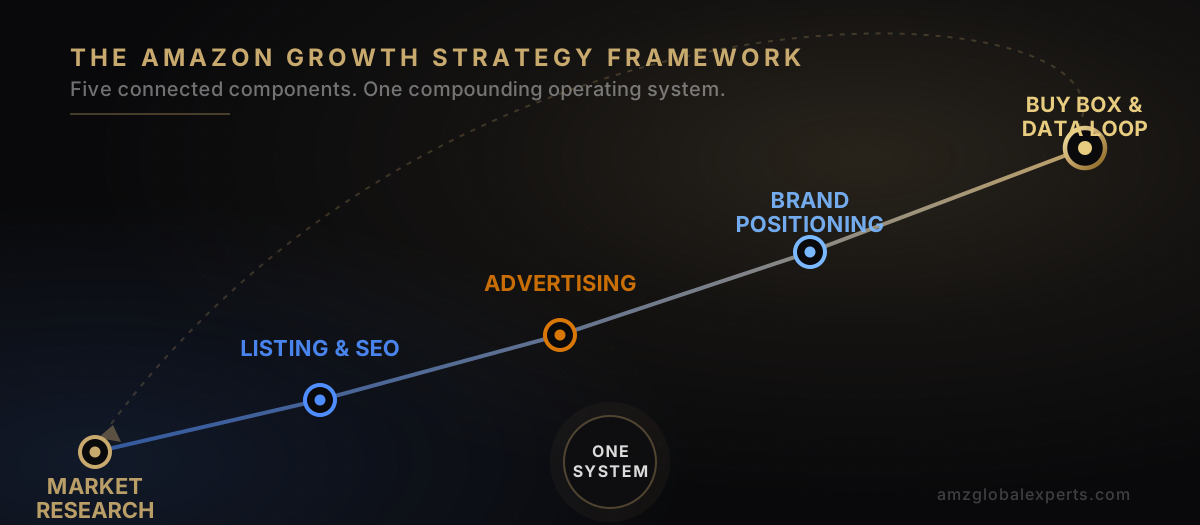
Launching a product on Amazon is not a growth strategy. It is a single event inside one. Brands that plateau after an initial launch spike almost always share the same root cause: they built a listing, not a system. A genuine Amazon growth strategy connects market research, competitive intelligence, listing architecture, advertising, brand positioning, review velocity, Buy Box performance, and continuous optimization into a single operating framework — where each part strengthens the others instead of operating in isolation.
This guide is the complete framework AMZ Global Experts uses with growth-stage Amazon brands and sellers. If you're looking for the tactical, ten-item version of this framework, see our companion piece: Amazon Strategy for Sellers: 10 Proven Ways to Increase Sales and Profitability in 2026. This article is the strategic layer underneath those ten levers — why they exist, how they connect, and how to sequence them as a brand scales past its first six figures.
The Current State of Amazon Growth Strategy in 2026
The marketplace has consolidated around a smaller number of sophisticated, well-capitalized sellers competing for the same search real estate. Amazon's A10 ranking algorithm has shifted weight toward conversion velocity and off-Amazon traffic signals, meaning listings that only optimize for on-platform keyword density are losing ground to brands running integrated advertising, content, and traffic strategies. At the same time, fewer than 15% of active sellers operate in more than one marketplace, leaving significant headroom for brands willing to build genuine cross-market infrastructure rather than treating international expansion as an afterthought.
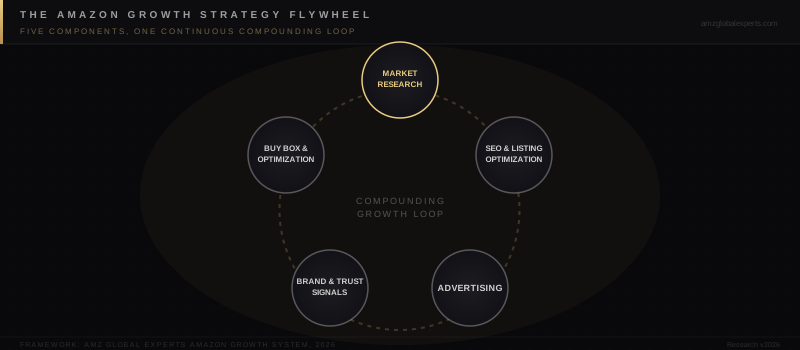
This has changed what "strategy" means in practice. It is no longer a launch checklist. It is an operating system with five interdependent components: market and competitor intelligence, on-page optimization, advertising, brand positioning and trust signals, and a continuous data-driven feedback loop that feeds all four back into each other.
Market Statistics and Industry Trends
| Trend | What Changed | Strategic Implication |
|---|---|---|
| A10 algorithm weighting | Conversion velocity and off-Amazon traffic weighted more heavily than keyword density alone | Listing CVR and external traffic sources are now ranking factors, not just sales levers |
| PPC cost inflation | Competitive-category CPCs have risen steadily since 2022 | Advertising can no longer be the sole growth engine — organic and brand-driven demand matter more |
| Seller saturation | 9.7M+ active sellers, with most categories showing 8–12 near-identical top-10 listings | Differentiation and brand positioning are now required, not optional |
| International expansion gap | Fewer than 15% of sellers operate in more than one marketplace | Significant headroom exists for brands building genuine multi-marketplace infrastructure |
What Wikipedia and Historical Data Reveal
Amazon Marketplace opened to third-party sellers in 2000, initially as a small addition to Amazon's own retail catalogue. Third-party sellers now account for the majority of units sold on the platform — a structural shift from Amazon-as-retailer to Amazon-as-marketplace-operator that reshaped the platform's entire incentive structure. Understanding this history matters strategically: Amazon's algorithm, fee structure, and policy changes consistently favor sellers who behave like retail operators — investing in supply chain reliability, customer experience, and brand equity — over sellers treating the platform as a pure arbitrage channel.
What Government Data Shows
The U.S. Census Bureau's ongoing ecommerce retail sales data continues to show online retail capturing a growing share of total U.S. retail spend year over year, with Amazon holding the largest single share of that online retail volume among U.S. marketplaces. This macro trend underpins the case for treating Amazon as core retail infrastructure rather than a secondary sales channel — the buyers are there, in growing numbers, and the strategic question is how to capture that demand profitably rather than whether the demand exists.
What Real Amazon Sellers Are Saying
Recurring patterns across r/AmazonFBA, r/AmazonSeller, and r/ecommerce in 2025–2026 surface three consistent themes that map directly onto this framework.
r/AmazonFBA seller: "We tried to expand into the UK and Germany within the same month and it was chaos — VAT registration, different compliance rules per country, and our listings weren't even properly localized. Should have staged it one market at a time." — VAT, compliance, and customs complexity are the most commonly cited barriers to international expansion across these communities, and under-preparation on regulatory requirements — not lack of demand — is the most frequently cited cause of failed expansion attempts.
r/AmazonSeller seller: "Our reviews were fine, our images were fine, but our PPC ACOS kept climbing every quarter and I couldn't figure out why until I realized three new competitors had entered the category with near-identical products at a lower price. Strategy isn't a one-time thing, it has to keep responding to what competitors are doing." — Competitive dynamics shifting after launch, rather than staying static, is a consistently underestimated factor in seller strategy discussions.
r/ecommerce seller: "The sellers in my category who are actually growing aren't the ones with the cheapest price, they're the ones who look like an actual brand — consistent photography, a real logo, Amazon Storefront, reviews that read like real feedback. Buyers can tell the difference now." — Brand positioning and perceived legitimacy increasingly influence buyer trust and conversion, not just price and star rating.
The Five-Component Amazon Growth Strategy Framework
1. Market Research and Competitor Analysis
Every durable Amazon growth strategy starts with structured market research: search volume validation for target keywords, margin modeling against Amazon's fee structure, and a systematic review of the top 10–20 competing listings in the category — not just their main image and price, but their review sentiment, their A+ Content strategy, and their apparent advertising intensity. Competitor research is not a one-time pre-launch exercise. Category dynamics shift as new entrants arrive and existing competitors iterate, which is why our Reddit Intelligence research report covers a systematic, ongoing methodology for extracting competitive and consumer-language intelligence from seller and buyer communities rather than treating competitive research as a launch-phase checklist item.
2. Amazon SEO and Listing Content Optimization
Listing architecture is the layer that determines whether every other investment — PPC spend, review generation, brand positioning — actually converts into revenue. Title structure, bullet-point objection handling, A+ Content, backend keyword coverage, and main image quality all compound into the CTR and CVR numbers that Amazon's A10 algorithm weighs when deciding organic placement. This is covered in full operational depth in our Amazon Listing Optimization guide for CTR and CVR, which maps the complete listing-optimization system referenced throughout this framework.
3. Advertising as a Sequenced System, Not a Constant Spend Lever
PPC's role changes across a listing's lifecycle. In the launch and discovery phase, its job is generating the sales velocity and review count that unlocks organic ranking — profitability is a secondary objective. Once organic ranking stabilizes, PPC's role shifts toward defending category share and testing new keyword territory. Brands that apply the same bidding logic across both phases consistently misallocate budget. The complete phase-by-phase campaign architecture, including the 4-campaign structure and weekly audit protocol, is detailed in the 2026 Amazon PPC Playbook.
4. Brand Positioning, Trust Signals, and Reviews
Amazon buyers increasingly evaluate brand legitimacy signals beyond star rating alone: Amazon Storefront presence, consistent photography style across the catalogue, A+ Content quality, and review sentiment depth (not just count). Brands competing purely on price in a saturated category are structurally vulnerable to the next lower-cost entrant. Brands that build genuine positioning — a defensible quality tier, a specific audience, a recognizable visual identity — compound pricing power over time instead of racing toward margin compression. Our research report on private label brand-building and premium pricing covers the four pillars of this positioning work in detail.
5. Buy Box Performance and Data-Driven Optimization
Buy Box win-rate is a composite signal: price competitiveness, fulfillment method, seller performance metrics (order defect rate, late shipment rate, valid tracking rate), and price stability all factor in. Brands that monitor Buy Box win-rate as a distinct metric — separate from raw sales — catch performance-metric problems before they compound into lost visibility. This closes the loop back to component 1: Buy Box and ranking data is itself market intelligence that should feed back into the next research and optimization cycle.
Country-by-Country Expansion Considerations
For brands considering multi-marketplace expansion as part of their growth strategy — a path fewer than 15% of active sellers currently pursue — the barriers are consistent across markets: VAT or equivalent tax registration, product compliance and labeling requirements specific to each region, and listing localization beyond simple translation. Sellers in community discussions consistently report that under-preparation on these regulatory requirements, not lack of consumer demand, is the primary cause of failed or stalled international launches. A staged, one-market-at-a-time expansion approach — fully compliant and localized in each market before adding the next — consistently outperforms simultaneous multi-market launches in seller-reported outcomes.
Strategic Recommendations
Short-Term Actions: 0–90 Days
- Run a structured competitor audit across the top 10–15 listings in your category, documenting review sentiment patterns and apparent content investment.
- Audit current listings against A10-aligned title, bullet, and A+ Content structure.
- Separate PPC campaign structure by lifecycle stage — launch/discovery campaigns versus mature defensive campaigns.
- Establish a Buy Box win-rate tracking dashboard separate from raw sales reporting.
Mid-Term Actions: 90–180 Days
- Build out Amazon Storefront and A+ Content to establish consistent brand visual identity across the catalogue.
- Formalize a quarterly competitive research cycle rather than treating it as a launch-only task.
- If pursuing international expansion, select one additional marketplace and complete full compliance and localization before considering a second.
Long-Term Actions: 6–18 Months
- Build the five-component framework into standard operating procedure with defined ownership for each component.
- Layer retention and post-purchase infrastructure (email/SMS where compliant) to increase repeat-purchase rate and lifetime value.
- Expand into additional marketplaces sequentially, applying the same staged compliance-first approach validated in the first expansion.
Key Finding: Amazon brands that treat these five components as a connected system — where Buy Box and performance data continuously feeds back into market research — consistently outperform brands that run each component as an isolated, disconnected initiative. The framework is not a checklist to complete once. It is an operating loop that should never fully stop.
How AMZ Global Experts Helps
AMZ Global Experts builds and operates this five-component framework directly with growth-stage Amazon brands and sellers: structured market and competitor intelligence, A10-aligned listing architecture, lifecycle-sequenced PPC management, brand positioning and Storefront build-out, and Buy Box performance monitoring that feeds continuously back into strategy. Rather than treating these as separate service lines, our team runs them as the single connected system this guide describes — because that is the only way any one of them compounds instead of stalling.
Conclusion
A winning Amazon growth strategy is not a bigger PPC budget or a prettier listing. It is five components — market research, listing optimization, advertising, brand positioning, and data-driven feedback — operating as one connected system instead of five disconnected initiatives. Brands that build this system compound growth. Brands that don't plateau after their initial launch spike, regardless of how much they spend trying to force it. If you want a structured assessment of where your current Amazon strategy has gaps, book a growth strategy session with our team.
Frequently Asked Questions
An Amazon growth strategy is a connected operating framework spanning market research and competitor analysis, listing content optimization, advertising sequenced by lifecycle stage, brand positioning and trust signals, and continuous data-driven optimization — as opposed to a one-time product launch checklist. The five components reinforce each other, and brands that treat them as an ongoing system rather than isolated tactics compound growth more reliably.
A basic selling strategy typically focuses on launching a listing and running ads. A growth strategy adds brand positioning, systematic competitive intelligence, lifecycle-based advertising sequencing, and a continuous feedback loop where Buy Box and performance data informs ongoing decisions — designed for sustained, compounding growth rather than a single launch spike.
Amazon buyers increasingly evaluate legitimacy signals beyond price and star rating — Storefront presence, consistent photography, A+ Content quality, and review sentiment depth all influence conversion. Sellers competing purely on price in saturated categories are structurally vulnerable to the next lower-cost entrant, while sellers with genuine brand positioning retain pricing power as competition increases.
VAT or equivalent tax registration, country-specific product compliance and labeling requirements, and listing localization are the most commonly cited barriers in seller communities. Under-preparation on regulatory compliance, not lack of consumer demand, is the most frequently cited cause of failed international expansion attempts — which is why a staged, one-market-at-a-time approach consistently outperforms simultaneous multi-market launches.
Amazon consulting compresses the trial-and-error most brands go through building each of the five framework components independently — structured competitor and market research, A10-aligned listing architecture, lifecycle-sequenced PPC management, brand positioning build-out, and Buy Box monitoring — into a single coordinated system from the outset, rather than assembling it reactively after early mistakes in each area.