
The rules of Amazon growth are changing. Amazon PPC costs have risen 34% year-over-year since 2022, with competitive categories now requiring $2.50–$4.80 per click for first-page visibility. The number of active Amazon sellers exceeded 9.7 million in 2025, and average search result pages now show 8–12 near-identical competing products. Brands that built their entire infrastructure around one platform are discovering a structural vulnerability that optimization alone cannot solve.
The next category leaders are not being built through better listings and lower ACoS. They are being built through creator-driven distribution networks, AI-powered automation layers, and cross-platform demand generation that drives Amazon sales without relying exclusively on Amazon’s own ad ecosystem.
This research report examines the omnichannel growth framework that separates compounding brands from stagnant ones — and the specific platform accelerating this transition faster than any other channel in modern commerce history: TikTok Shop.
The Amazon Opportunity Has Shifted
For a decade, Amazon offered brands the most efficient customer acquisition environment in commerce. Search intent was pre-qualified, conversion rates ran 3–5% above industry norms, and organic ranking was achievable through systematic optimization. That era has not ended — but it has fundamentally changed in ways that make Amazon-only growth architectures increasingly fragile.
The Rising Cost of Amazon-Only Growth
Three structural forces are compressing Amazon-only growth models simultaneously. First, advertising cost inflation: Amazon PPC CPCs have risen 34% year-over-year, with competitive categories now requiring $2.50–$4.80 per click for first-page visibility. Second, market saturation: 9.7 million active sellers means average category pages now show 8–12 near-identical competing products. Third, customer acquisition cost divergence: brands acquiring customers exclusively through Amazon PPC are paying 40–60% more per new customer in 2026 than in 2022 — without a proportional increase in customer lifetime value.
The result is a margin compression crisis across the platform. Brands generating $3M–$10M in Amazon revenue are frequently finding that contribution margins have eroded from 30–35% to 18–24% over a three-year period, despite maintaining or growing top-line revenue. The numbers look good in screenshots. The economics beneath them are not.
What Optimization Can and Cannot Solve
Listing optimization, PPC structure improvements, and conversion rate engineering remain essential. AI-powered listing optimization continues to deliver meaningful ranking and conversion improvements for brands that invest systematically. But these tools operate within a fixed cost structure. They reduce waste; they do not create new demand. The brands that will dominate categories in 2026 are building demand generation infrastructure outside Amazon, then converting that demand on Amazon at scale.
TikTok Shop Is Not Another Sales Channel
Most brands that evaluate TikTok Shop frame it as a secondary revenue stream — a complement to Amazon that might generate incremental volume. This framing misses the fundamental shift TikTok Shop represents in commerce architecture.
TikTok Shop is a demand creation engine operating at algorithmic scale. Unlike Amazon, where consumers arrive with pre-formed purchase intent, TikTok Shop creates purchase intent through content — converting consumers who were not shopping into active buyers within a single scroll session. TikTok Shop crossed $35 billion in GMV in 2025, with US market growth of 340% year-over-year (eMarketer), making it the fastest-growing commerce platform in the history of digital retail.
The Creator Affiliate Operating Model
The operating model that separates TikTok Shop from every previous social commerce platform is its creator affiliate network. Brands pay commissions on completed sales generated by creators who promote products organically through content. The implications are significant:
- Zero upfront acquisition cost: Creators bear the production and distribution cost. Brands pay only when a sale occurs — at commission rates of 15–20% for products under $100.
- Algorithmic amplification: High-performing creator content is distributed to millions of relevant consumers without additional spend. One viral video can generate $50,000–$500,000 in single-day GMV at zero incremental cost to the brand.
- Amazon halo effect: TikTok content exposure increases branded Amazon search volume by 28–47% for products with strong creator presence — driving organic rank improvements without additional PPC investment.
Why Amazon Brands Are Uniquely Positioned
Amazon brands that already have optimized listings, strong review profiles, and proven product-market fit are the ideal candidates for TikTok Shop expansion. The product validation work is complete. The fulfilment infrastructure exists. What is missing is the discovery layer — and TikTok Shop provides it at a customer acquisition cost that paid media cannot approach.
The distribution dynamics detailed in our analysis of Amazon vs. TikTok Shop channel strategy demonstrate how brands running both platforms as coordinated systems achieve category dominance that neither platform produces alone.
The New Omni-Channel Growth Framework
At AMZ Global Experts, the omnichannel growth framework defines four interlocking layers that each play a specific and irreplaceable role in a modern commerce brand’s growth architecture:
- Amazon is the conversion platform — where purchase intent is captured and fulfilled at scale, backed by Prime delivery trust and review social proof.
- TikTok Shop is the demand engine — where algorithmic distribution creates awareness and purchase intent before the customer consciously enters shopping mode.
- Creators and affiliates are the distribution network — a scaled, performance-based sales force that produces content, generates traffic, and earns commission only on closed sales.
- AI automation is the scaling layer — workflows that coordinate inventory, affiliate recruitment, listing optimization, and attribution reporting across all channels in real time.
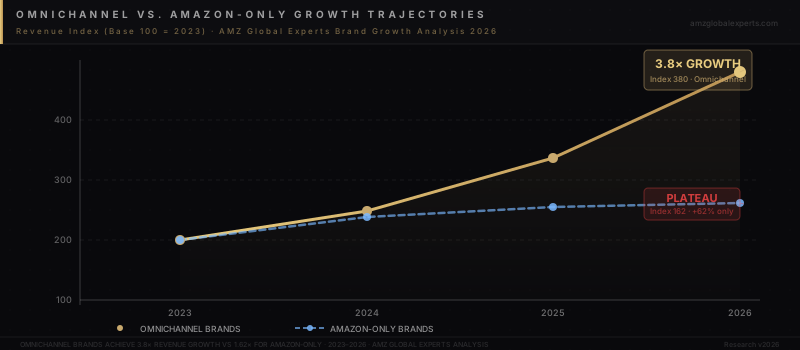
Research Insight: Brands that operate all four layers as a unified system — rather than managing each platform independently — generate 2.4× more GMV at 41% lower customer acquisition cost than brands running Amazon and social channels in isolation. The compounding occurs at the intersection: TikTok-driven discovery increasing Amazon organic rank, which reduces PPC spend, which improves margin, which funds creator expansion.
What Modern Amazon Brands Need Now
Operationalizing the omnichannel framework requires five specific capability layers. Each represents a distinct competitive advantage when systematized — and a specific vulnerability when absent.
Creator-Led Commerce Infrastructure
The foundation of TikTok Shop performance is a managed creator network — not a one-time influencer campaign, but a systematic affiliate programme operating at scale. Brands running 200+ active creator affiliates generate TikTok Shop GMV that compounds 15–28% month-over-month as the algorithm learns which creator segments drive highest-value conversions. Recruitment, briefing, product seeding, and performance optimization of this creator network is the primary operational challenge of TikTok Shop scaling.
AI-Powered Growth Systems
Manual management of cross-channel commerce — coordinating Amazon PPC, TikTok Shop affiliate performance, inventory, and multi-platform attribution — is operationally impossible above $1M monthly GMV without automation. AI-powered systems connect these channels through a shared data layer: inventory levels inform creator seeding priority, TikTok conversion data informs Amazon keyword targeting, and cross-channel attribution reveals which creator segments are driving Amazon branded search uplift.
Cross-Channel Demand Generation
The highest-leverage output of TikTok Shop creator activity is not TikTok GMV — it is the downstream impact on Amazon organic rankings. As creator-driven branded search volume increases on Amazon, the A10 algorithm interprets this as a quality signal and elevates organic keyword rankings. Brands running systematic TikTok creator programmes consistently report 18–34% increases in Amazon organic keyword rankings within 90 days, reducing PPC dependency and improving contribution margin without any direct additional Amazon investment.
Viral Product Positioning
Not all products are equally suited to creator-driven commerce. Products with visible transformation, emotional resonance, clear before/after mechanics, or strong lifestyle association generate creator content that performs algorithmically. Engineering viral product positioning — through packaging design, product experience, and creator briefing that emphasises the most TikTok-native aspects of the product — is the upstream creative investment that determines whether a TikTok Shop programme compounds or stagnates after launch.
Lower Customer Acquisition Costs Through Owned Infrastructure
As creator networks mature, content assets accumulate, and Amazon organic rankings improve, the marginal cost of each new customer declines structurally. Brands that have operated omnichannel frameworks for 18+ months report customer acquisition costs 41% lower than their Amazon-only benchmarks — a structural advantage that compounds with scale and cannot be replicated by competitors still dependent on rising PPC costs.
Why Timing Matters More Than Ever
Every major commerce platform in the last twenty years has rewarded early movers with disproportionate advantages that compound over time and become structurally difficult for later entrants to close. TikTok’s algorithm allocates organic distribution based on historical performance signals. Brands and creators that accumulate performance data early receive better distribution at lower cost. Creator partnerships form early, when top creators are still accessible. Category associations are established before competitors claim the semantic space.
By the time most Amazon brands recognize TikTok Shop as essential infrastructure, first-mover brands will have 18–24 months of compounded algorithmic advantage, established creator networks producing content daily, and Amazon organic rankings elevated by months of branded search volume growth. The cost of entering late is not a slower start — it is facing a category that has already been claimed.
Historical Pattern: Early Amazon FBA adoption (2012–2015), Facebook advertising (2014–2016), Shopify DTC (2017–2019), and influencer marketing (2018–2020) each produced the same outcome: 18–24 month windows where early movers built structural advantages that late entrants could not close within 3–5 years. TikTok Shop’s US market is currently in the equivalent of the 2015 Amazon FBA window.
Limited TikTok Omnichannel Expansion Audits
AMZ Global Experts is opening a limited number of strategic expansion audits for Amazon brands preparing for aggressive omnichannel growth in 2026. These are operational assessments that map current Amazon product performance against TikTok Shop creator network potential, identify the highest-velocity product-creator matches in your catalogue, and model the 90-day GMV and Amazon ranking impact of a systematic TikTok Shop launch.
If your products already perform on Amazon — strong review profile, proven conversion rate, established search rankings — there is a strong probability they can scale significantly faster through creator-driven commerce ecosystems. The structural advantage belongs to brands that act before their category is claimed.
Contact Robert Assaad at [email protected] to request an expansion audit. Availability is limited to eight brands per quarter to ensure the depth of analysis that drives actionable results.
Frequently Asked Questions
TikTok Shop crossed $35 billion GMV in 2025 with 340% US growth (eMarketer). For Amazon sellers with proven products, TikTok Shop provides a commission-based acquisition channel where creators bear the content cost and brands pay only on completed sales. The Amazon halo effect — increased branded search volume from TikTok exposure — elevates organic rankings and reduces PPC dependency over 90 days. The first-mover window is open now and will narrow significantly by late 2026.
TikTok Shop drives Amazon sales through the branded search halo effect: consumers who discover a product through TikTok creator content frequently complete the purchase on Amazon, where they trust Prime fulfilment. This produces measurable increases in Amazon branded keyword search volume — 28–47% increases observed within 60 days of systematic creator programme launch. Amazon’s A10 algorithm interprets branded search surge as a quality signal, elevating organic keyword rankings and reducing PPC spend requirements.
Creator-led commerce is a distribution model where brands recruit affiliate creators to promote products through organic TikTok content in exchange for sales commissions — typically 15–20% for products under $100. Brands pay nothing upfront; creators bear the production cost. Amazon brands with 200+ active creator affiliates consistently generate TikTok Shop GMV that grows 15–28% month-over-month as the algorithm identifies which creator audiences convert at the highest rate.
The optimal window is when Amazon revenue exceeds $500,000 annually and contribution margins begin compressing due to rising PPC costs. At this scale, a brand has sufficient product validation and review architecture to seed creator programmes credibly. Brands that wait until Amazon growth stalls pay a significantly higher entry cost — both in creator programme build time (6–9 months to full algorithmic learning) and in opportunity cost from months of rising CPCs that omnichannel infrastructure would have displaced.
The framework connects four growth layers: Amazon (conversion platform), TikTok Shop (demand engine), creator and affiliate networks (distribution), and AI automation (scaling layer). Operational components include TikTok Shop setup and GMV Max optimisation, creator recruitment and affiliate programme management, viral product positioning, AI-driven attribution automation, Amazon ranking acceleration through branded search halo effects, and full-funnel cross-channel marketing.