
Research Report — AMZ Global Experts Research Team · Last Updated June 2026
This report synthesises Moz documentation, Ahrefs research, Google's public statements on ranking factors, Reddit SEO practitioner sentiment, and emerging academic research on Generative Engine Optimization (GEO) to produce the most current industry benchmark guide on Domain Authority available in 2026.
Executive Summary
A "good" Domain Authority score is not a universal number. A DA of 30 can dominate a local niche, while a DA of 70 may struggle in highly competitive industries. The only benchmark that matters is whether your website's authority exceeds the websites currently ranking for your target keywords.
Based on industry data from Moz, Ahrefs, and SEMrush, websites with DA scores between 40–50 are considered average across most industries, 50–60 are competitive at a national level, and 60+ are generally viewed as authoritative. But DA should be used as a comparative SEO metric — never as a direct Google ranking factor.
More critically, in 2026, traditional link authority represents only one layer of the authority equation. AI search engines — ChatGPT, Gemini, Perplexity, and Google AI Overviews — increasingly prioritise authoritative citations, earned media, trusted reviews, topical expertise, and structured content when selecting sources to surface. Brands optimising for DA alone while neglecting the other three authority layers are building on an incomplete foundation.
What Is Domain Authority?
Domain Authority (DA) is a predictive ranking metric developed by Moz that estimates a website's ability to rank in search engine results pages using a logarithmic scale from 1 to 100. A site moving from DA 20 to DA 30 requires proportionally less effort than moving from DA 70 to DA 80 — the logarithmic compression at the top of the scale explains why enterprise brands plateau at DA 80–90 while new DR-gains require progressively more link equity.
Moz calculates DA using a machine learning model trained on correlation data between backlink profiles and Google rankings. Key input signals include: total number of referring domains, quality and trust of linking pages, link diversity across domains, root domain and subdomain authority, and broader link graph patterns. A single backlink from a DA 90 publication contributes more to your DA than 500 links from DA 10 sites.
Moz vs Ahrefs — Two Different Metrics: Moz uses Domain Authority (DA); Ahrefs uses Domain Rating (DR). Both measure backlink-based authority on a 0–100 scale, but their calculation models differ. Neither metric is used by Google. SEO professionals typically track both alongside organic traffic as triangulated signals of competitive standing.
Does Google Use Domain Authority as a Ranking Factor?
No. Google representatives have stated repeatedly — including former Distinguished Engineer John Mueller and multiple Search Liaison communications — that Google does not use Moz Domain Authority or any equivalent third-party score as a ranking signal. Google's systems evaluate individual pages rather than domains, and they use proprietary internal signals not published to the public.
The practical implication of this distinction is often misunderstood. High DA correlates with strong rankings because sites with high DA typically possess the actual signals Google does evaluate: strong editorial backlink profiles, established brand authority, topical expertise, and high-quality content. DA is a proxy metric that correlates with those signals — it does not cause them.
This distinction matters operationally. A brand that acquires 200 low-quality backlinks from domain farms to boost DA will see DA rise without improving Google rankings, because Google evaluates the quality of those links directly — not the DA score they produce. Chasing DA through low-quality link acquisition is one of the most expensive ways to waste an SEO budget.
Critical Distinction: Google ranks pages using its own proprietary authority signals — PageRank, quality of linking pages, relevance, and content quality. Moz's DA score models those signals using publicly available data. High correlation exists between DA and rankings because the same underlying factors drive both. The DA score is an output, not a lever.
What Is a Good Domain Authority Score? Industry Benchmarks for 2026
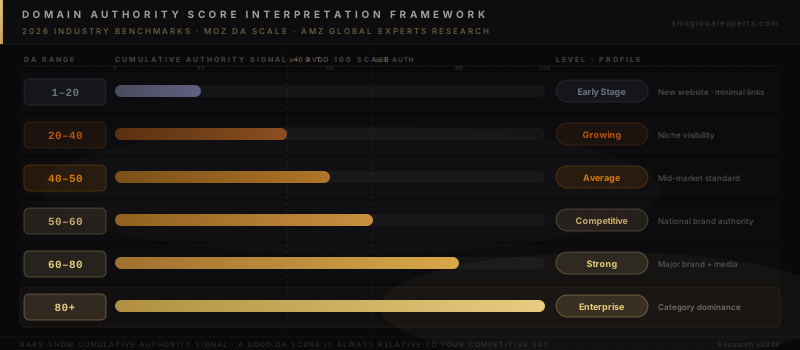
The most useful benchmark is not an absolute DA number but a relative one: the average DA of the websites currently ranking on page one for your target keywords. A DA above your competitive set is sufficient authority; a DA below it signals an authority gap that must be closed through content and link acquisition.
| DA Score | Interpretation | Typical Profile | Competitive Context |
|---|---|---|---|
| 1–20 | Early stage | New website, minimal backlinks | Local/niche long-tail keywords only |
| 20–40 | Growing | Established niche site, some editorial links | Competitive in niche; weak nationally |
| 40–50 | Average | Established brand, mixed link quality | Competitive for medium-difficulty keywords |
| 50–60 | Competitive | National brand, strong editorial coverage | Competitive for most industry keywords |
| 60–80 | Strong | Major brand, significant media coverage | Competes in most high-difficulty SERPs |
| 80+ | Enterprise | Household brand, thousands of domains linking | Dominates high-competition categories |
Industry-Specific DA Benchmarks
Industry context matters significantly. A DA of 40 is competitive in many B2B service niches where websites are smaller and editorial coverage is sparse. The same score is insufficient for e-commerce, finance, or health sectors where Amazon, Wikipedia, WebMD, and national publishers dominate the SERPs with DA 80–95.
| Industry | Avg. Page 1 DA | Minimum Competitive DA | Difficulty Level |
|---|---|---|---|
| Local Services (plumbing, dental) | 25–40 | 20+ | Low |
| B2B SaaS / Tech | 45–65 | 40+ | Medium |
| E-commerce (non-Amazon) | 50–75 | 50+ | Medium–High |
| Health & Medical | 60–85 | 55+ | High |
| Finance & Insurance | 65–90 | 60+ | Very High |
| News & Media | 70–95 | 65+ | Very High |
| Amazon & E-commerce SEO | 45–70 | 40+ | Medium–High |
What Reddit SEO Professionals Actually Say About Domain Authority
Practitioner sentiment on Reddit provides one of the most unfiltered signals available for understanding how working SEOs treat DA in 2026. Across r/SEO, r/bigseo, and r/juststart, several consistent themes emerge — and they challenge the way most businesses approach authority building.
r/SEO thread, 2025: "DA is a conversation starter, not a goal. I use it to tell clients roughly where they stand against competitors. The moment someone starts optimising for DA instead of real traffic and relevant links, they've lost the plot." — This reflects the overwhelming consensus across 2024–2026 threads: DA has value as a relative benchmark, but optimising for it directly produces low-ROI activity.
Theme 1: Relevance Consistently Outperforms Raw DA
The most frequently cited finding from Reddit's SEO community: a single relevant editorial link from a DA 35 industry publication outperforms ten generic links from DA 60 directories. Experienced practitioners increasingly weight topical relevance and anchor context over raw domain authority when evaluating a link's SEO value. A mention in a relevant trade publication — even one with modest DA — signals more relevance to Google than a generic blog post on a high-DA domain.
Theme 2: Page-Level Authority Often Matters More
Multiple r/SEO threads from 2025–2026 highlight a frequently overlooked nuance: Google evaluates individual pages, not domains. A backlink from a high-DA domain pointing to a low-traffic, irrelevant page passes less authority than a link from a DA 40 page that is directly relevant and well-linked internally. Domain authority is a summary signal; page authority and context are the granular signals Google actually processes.
Theme 3: Purchased High-DA Links Increasingly Fail
The SEO community's 2025–2026 consensus on purchased links is unambiguous: Google's Spam Brain algorithm has become highly effective at identifying unnatural link patterns, even on high-DA domains that sell links. Multiple case studies in r/bigseo show sites with DA 65–75 and purchased link profiles receiving manual penalties or algorithmic suppression. Real editorial links — earned through content, PR, and relationships — are the only durable strategy.
The Biggest Myth About Domain Authority
The most persistent and damaging misconception in SEO: "More backlinks equal higher rankings."
A website can possess 10,000 backlinks, hundreds of referring domains, and a DA of 60+ and still fail to rank competitively. The reason lies in what modern search engines actually evaluate. Google's algorithm has evolved substantially beyond link counting — it now processes relevance signals, user satisfaction metrics, content depth, structured data, EEAT (Experience, Expertise, Authoritativeness, Trustworthiness) signals, and entity graph associations that link volume alone cannot satisfy.
Thousands of low-quality or irrelevant links contribute less ranking value than a handful of highly relevant editorial mentions from authoritative sources covering the same topic cluster. A startup in the e-commerce analytics space with DA 35 and 15 links from Shopify Blog, Search Engine Journal, and relevant founder publications will frequently outrank a competitor with DA 55 and 2,000 links from generic guest post networks.
Why AI Search Is Changing the Authority Conversation
The emergence of AI-powered search as a mainstream answer engine represents the most significant shift in the authority landscape since Google's Penguin algorithm penalised low-quality links in 2012. Research into Generative Engine Optimization (GEO) — the emerging discipline of optimising content for citation by AI systems — reveals a fundamental difference between what drives Google rankings and what drives AI citations.
A 2024 study published on arXiv examining 10,000 search queries across major AI platforms found that AI search systems (ChatGPT, Perplexity, Google AI Overviews) favoured sources with: verified authorship, structured factual content, recent publication dates, citations to primary sources, and presence on trusted media platforms — even when lower-DA alternatives existed. The correlation between traditional link-based DA and AI citation probability was weaker than many SEO practitioners expected.
Key Research Finding: AI search systems frequently prefer trusted earned-media citations — a mention in Forbes, Search Engine Journal, or an academic publication — over brand-owned content with superior keyword optimisation. This means authority in AI search is increasingly determined by your reputation across the web, not just the authority of your domain itself. A brand with DA 45 cited extensively in industry media will outperform a DA 70 site with minimal earned-media presence in AI results.
The New Authority Model for 2026: 4 Layers
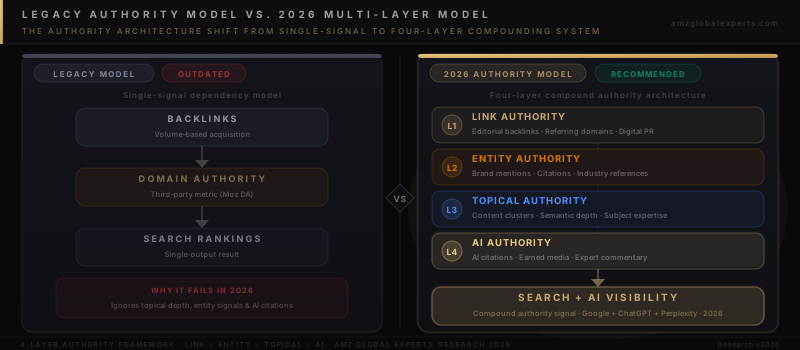
Businesses succeeding across traditional SEO and AI search in 2026 operate a four-layer authority model that addresses the full spectrum of signals both Google and AI engines evaluate. Optimising only for link authority — the traditional DA-focused approach — produces diminishing returns as AI search captures an increasing share of informational and commercial queries.
Layer 1: Link Authority
The foundation. Editorial backlinks from relevant, trusted referring domains remain the strongest signal in traditional Google SEO. The 2026 standard has shifted from quantity to quality and relevance: 20 editorial links from topically relevant publications are worth more than 500 links from generic guest post sites. Key metrics: referring domain count, average linking domain authority, percentage of editorial (non-paid) links, anchor text diversity, and link velocity trend.
Layer 2: Entity Authority
Brand and entity signals have grown in importance as Google's Knowledge Graph has expanded. A business that appears consistently as a named entity across media mentions, Wikipedia citations, industry directories, and structured business data (Google Business Profile, schema markup, Wikidata) builds entity authority that reinforces ranking confidence. Entity authority is particularly relevant for local SEO and brand-adjacent queries where Google assesses whether your business is a credible real-world entity.
Layer 3: Topical Authority
The most actionable layer for brands in 2026. Topical authority is built through content clusters — comprehensive coverage of a subject area that demonstrates deep subject-matter expertise. A site that publishes 30 interlinked articles covering every dimension of Amazon SEO (keyword research, listing optimisation, PPC, A10 algorithm, review strategy, international expansion) will rank for more Amazon SEO keywords than a site with higher DA but sparse, unrelated content. Semantic depth — the breadth and depth of vocabulary, entities, and concepts covered in a content cluster — is a measurable signal Google's natural language processing evaluates.
Layer 4: AI Authority
The newest and fastest-growing layer. AI authority is your citability in AI search results — how often ChatGPT, Perplexity, Gemini, and Google AI Overviews surface your content as a source. Building AI authority requires: publishing original research with citable statistics, creating structured definitions and benchmark resources, building presence in trusted third-party publications, optimising structured data markup (FAQPage, Article, Organization schema), and maintaining an active presence in industry conversations that AI training data captures.
| Authority Layer | Primary Signals | Key Actions | Impact on AI Search |
|---|---|---|---|
| Link Authority | Referring domains, editorial backlinks, DA/DR | Digital PR, guest editorials, resource creation | Indirect |
| Entity Authority | Brand mentions, Knowledge Graph, citations | Wikipedia, schema markup, media coverage | High |
| Topical Authority | Content clusters, semantic depth, internal links | Pillar content, cluster pages, subject expertise | High |
| AI Authority | AI citations, structured data, earned media | Original research, FAQPage schema, GEO optimisation | Very High |
How to Increase Domain Authority the Right Way in 2026
1. Publish Original Research That Earns Editorial Citations
Original research is the highest-ROI content investment for link acquisition in 2026. Journalists and industry bloggers cite primary data — surveys, benchmark reports, annual studies, platform data analysis. Generic advice articles attract social shares; data assets attract backlinks. Every research report should contain at least five original statistics with a clearly documented methodology. Databox, Statista, and BrightEdge consistently rank among the most-cited SEO data sources because they produce citable research assets — not opinion content.
2. Execute Digital PR to Build Referring Domains
Digital PR — pitching data-driven stories to journalists and editors — remains the most effective method for acquiring high-DA editorial backlinks at scale. The assets that earn the most coverage: statistics pages (journalists need citable numbers), industry calculators (practical utility drives recurring links), annual benchmark reports (cited repeatedly year over year), and contrarian data findings that challenge received wisdom. Every DA-building campaign should start with the question: "Why would a journalist link to this?" If the answer is unclear, the asset needs rethinking.
3. Build Topical Authority Through Content Clusters
Instead of publishing 100 unrelated articles, build content ecosystems around your core topic clusters. For a business operating in the e-commerce and Amazon SEO space, the cluster architecture should cover: domain authority (this article), link building, digital PR, GEO and AI search, E-E-A-T, brand mentions, Google Search Console strategy, Core Web Vitals, and competitor gap analysis. Each article reinforces every other through internal links, building semantic depth that triggers topical authority signals. Sites with narrow but deep content clusters consistently outrank sites with broad but shallow coverage.
4. Collect Trust Signals That AI Systems Recognise
AI search systems surface businesses with strong, distributed trust indicators. The trust signal stack that increases AI citability: verified customer reviews on Google, G2, Trustpilot, and Capterra; expert bylines on industry publications; documented case studies with quantified outcomes; recognition from credible industry organisations; third-party mentions in trade media; and a verified Google Business Profile with consistent NAP data across the web. These signals collectively build the brand entity strength that both Google and AI systems use to determine source trustworthiness.
5. Fix Technical Authority Foundations First
Many businesses invest in link acquisition before resolving technical issues that prevent authority from accumulating effectively. Before any link-building programme, verify: clean crawlability with no orphaned pages, a consolidated internal link structure that funnels authority to priority pages, canonical tags that prevent authority dilution across duplicate URLs, a sitemap that surfaces all authority-target pages, and Core Web Vitals scores that avoid any Google Page Experience ranking penalty. Technical authority failures waste every link acquired on top of them.
Why Some High-DA Sites Still Fail to Rank
High domain authority is a necessary but not sufficient condition for competitive rankings in 2026. The scenario of DA 65+ sites failing to rank for target keywords is more common than most brands realise — and the causes are consistently identifiable.
Topical mismatch: A general news site with DA 80 and no coverage of e-commerce SEO will not outrank a DA 45 specialist e-commerce blog for queries like "Amazon FBA inventory strategy." Google's topical relevance signals now carry enough weight to overcome significant DA differentials when the specialised site demonstrates deep subject expertise.
Content quality decay: Sites that built DA through aggressive link acquisition in 2015–2022 but have not maintained content quality face progressive ranking degradation as Helpful Content and EEAT updates devalue thin, AI-generated, or outdated pages. High DA with low content quality is an increasingly unstable ranking position.
Poor user experience signals: Core Web Vitals data, mobile usability, and page experience signals influence rankings independently of authority. A high-DA site with poor LCP, CLS, or INP scores faces ranking suppression that backlinks cannot compensate for. Use our Page Speed & Performance Analyzer to audit your Core Web Vitals before investing further in link acquisition.
AI authority gap: In 2026, brands that rank well in Google but lack AI search presence are progressively losing traffic as informational queries shift to AI-generated answers. A high-DA site with no AI citation presence is building its traffic on an eroding foundation.
Measuring Authority Beyond DA: The 2026 Metrics Stack
World-class SEO programs in 2026 track authority through a multi-metric stack rather than a single DA score. The full measurement framework includes: Domain Authority or Domain Rating (comparative baseline), organic keyword ranking distribution across difficulty tiers, Share of Voice for target keyword clusters, branded search volume trend, AI citation frequency across major AI search platforms, referring domain growth rate month-over-month, and editorial link acquisition rate versus total link acquisition rate.
The Domain Authority Checker and Website SEO Audit Tool at AMZ Global Experts measure multiple dimensions of this authority stack simultaneously — providing a more complete picture of competitive authority than any single metric delivers.
Key Takeaways
- Domain Authority is a useful comparative metric, not a Google ranking factor. A good DA score is one that exceeds the average authority of sites currently ranking for your target keywords.
- Relevance and topical authority matter more than raw DA. A DA 40 specialist site in a niche regularly outranks DA 70 generalists when it demonstrates deeper subject expertise.
- AI search requires a four-layer authority strategy. Link authority, entity authority, topical authority, and AI authority must all be addressed simultaneously in 2026.
- Original research and digital PR outperform traditional link buying. Editorial links earned through data assets and PR campaigns build durable DA while simultaneously building the brand entity signals AI systems require.
- High DA does not guarantee rankings. Topical mismatch, content quality issues, technical SEO failures, and AI authority gaps can suppress rankings regardless of backlink volume.
- The companies winning in 2026 are not chasing a number. They are building authority ecosystems that humans, search engines, journalists, and AI systems all recognise as credible.
Bottom Line: The right question is not "What is my DA?" It is: "Does my authority exceed my competitors' across all four layers — links, entities, topical depth, and AI citation presence?" Businesses that answer yes to all four are positioned to capture organic traffic and AI-mediated visibility simultaneously, which is the competitive requirement for sustained search performance in 2026 and beyond.
Frequently Asked Questions
A new website typically starts with a DA of 1–10 and is considered to be in a competitive position once it reaches DA 20–30 for local or niche markets, or DA 40+ for national competitive keywords. The more useful benchmark is not an absolute number but whether your DA exceeds the average authority of websites currently ranking for your target keywords. A DA of 25 can be highly competitive in a local service niche where competitors average DA 15–25.
No. Google does not use Moz's Domain Authority as a ranking factor. Google evaluates individual pages using its own proprietary signals — content quality, relevance, backlink quality, user experience metrics, and EEAT signals. High DA correlates with strong rankings because sites with high DA typically possess the actual factors Google evaluates: strong editorial backlink profiles, brand authority, and high-quality content. DA is a predictive model, not a ranking mechanism.
DA growth timelines vary significantly based on the current DA baseline and the quality of link acquisition. Moving from DA 10 to DA 30 typically takes 6–18 months with consistent content production and 5–10 editorial links per month. Moving from DA 40 to DA 60 requires 12–36 months of sustained digital PR and editorial link acquisition. The logarithmic scale means each 10-point increment at the high end requires progressively more link equity than the previous one. Consistent, high-quality editorial link acquisition through original research and digital PR is the most reliable acceleration strategy.
AI search engines (ChatGPT, Perplexity, Gemini, Google AI Overviews) select sources based on factors that partially overlap with but also differ from traditional Google ranking signals. AI systems favour authoritative earned-media citations, structured factual content, verified authorship, and presence in trusted publications — even when lower-DA alternatives exist. This means businesses must now build "AI authority" — citability in AI results — alongside traditional link-based DA. The four-layer authority model (link, entity, topical, AI) is the 2026 strategic framework that addresses both search environments simultaneously.
High Domain Authority is necessary but not sufficient for competitive rankings. The most common reasons high-DA sites underperform include: topical mismatch (a general site lacks subject-matter depth for specialist queries), content quality decay (outdated or thin pages penalised by Helpful Content and EEAT updates), poor Core Web Vitals suppressing page experience scores, and failure to build topical authority through content clustering. Google ranks pages using relevance, content depth, and user satisfaction signals — none of which are captured by DA alone. A DA 45 specialist with excellent content frequently outranks a DA 75 generalist.
The fastest legitimate DA-building strategies in 2026 are: publishing original research with citable statistics (journalists cite primary data, not opinion), executing digital PR campaigns around data-driven story angles, creating linkable assets such as statistics pages, calculators, and benchmark reports, and building guest editorial relationships with relevant industry publications. These strategies produce high-DA editorial links — the type that most efficiently move the DA score — while simultaneously building entity authority and topical depth. Avoid purchasing links; Google's Spam Brain algorithm is highly effective at identifying unnatural link patterns even on high-DA domains.
References & Sources
- Moz. Domain Authority. moz.com/learn/seo/domain-authority
- Ahrefs. Domain Rating: What It Is and How to Increase It. ahrefs.com/blog/domain-rating
- Google Search Central. How Search Works. developers.google.com/search/docs/fundamentals/how-search-works
- Search Engine Journal. Is Domain Authority a Google Ranking Factor?. searchenginejournal.com
- Aggarwal, P. et al. (2024). Generative Engine Optimization. arXiv preprint.
- Databox. What Is a Good Domain Authority Score?. databox.com/good-domain-authority-score
- Reddit r/SEO community threads, 2024–2026.