
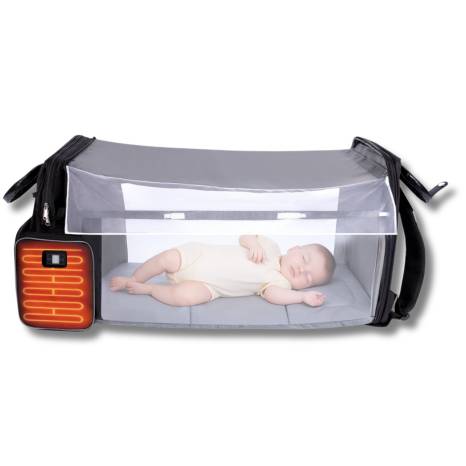
The Problem With Standard Diaper Bags
Here is the scene every new parent recognises: you're at a restaurant, a park, a friend’s house, or an airport gate, and your baby needs a diaper change. You need a clean surface. You reach into your diaper bag for the changing mat — the separate, floppy, vinyl thing you packed — and it isn't there. You left it on the bathroom floor at home. Or it's there, but it migrated to the bottom of the main compartment and now carries the scent of a three-day-old bottle of formula that leaked last Tuesday. Congratulations: you're about to change your baby on a surface you can't identify, in a bathroom that may not even have a changing table.
This isn't a rare parenting failure. It is a structural design problem. Standard diaper bags were not engineered with the changing station as an integrated, first-class feature. The mat was added as an afterthought — a flat rectangle tucked into an external pocket, a thin vinyl sheet clipped to a handle strap, or simply a “bonus item” included in the box that separates from the bag within the first week and is never seen again. The result is that millions of parents carry a bag marketed as “complete” that fails them at the single most critical moment of every outing.
“The separate changing pad that came with my diaper bag lasted exactly two outings before it got left at my mother-in-law’s house. Three months later I am still using a folded-up blanket on restaurant bathroom floors and I am not okay with this.”
r/beyondthebump · 2.1k upvotes“Can we talk about how many public restrooms just… don’t have changing tables? I have been keeping an informal count for months and the number is exactly as bad as you think. Get a bag with a mat attached to it. Non-negotiable.”
r/NewParentsWhat a Diaper Bag With Changing Station Actually Means
The phrase “diaper bag with changing station” covers everything from a thin vinyl flap attached by a velcro strap to a genuinely engineered portable baby changing station that unfolds into a padded, waterproof, bacteria-resistant surface ready to use in seconds. Knowing the difference before you buy saves you from spending $90 on a bag that solves the problem in theory and fails it in practice.
There are three levels of integration quality in the market.
Level 1 — Included-but-separate: A loose changing mat placed inside the main compartment or in an external pocket. It works in the sense that it's technically in your bag — until it migrates to the bottom under everything else, contacts the food compartment, or gets left behind. This is the most common “changing station” configuration in budget and mid-range bags.
Level 2 — Attached but thin: A mat that's tethered to the bag via a clip or attached to an external pocket. It won't get lost, but the mat itself is typically 3–4mm unpadded vinyl — a surface that's waterproof but provides no cushioning on a hard countertop or floor. Better than Level 1, but still a compromise.
Level 3 — Truly integrated: A dedicated external compartment specifically designed for the changing mat — completely separated from food, clean items, and the main compartment — that unfolds into a padded, full-size waterproof changing surface. This is what “diaper bag with changing station” should mean and what the best bags in 2026 deliver.
The hygiene distinction that matters: A changing mat that lives in your main compartment contacts everything else in the bag. A changing mat in a dedicated external pocket maintains clean/dirty separation. If your changing mat has ever touched your baby’s snacks, spare clothing, or a feeding bottle, you have a Level 1 bag pretending to be a Level 3 bag.
5 Reasons Modern Parents Are Switching in 2026
1. Hygiene: What You Don’t Know About Public Changing Tables
Public changing tables are high-traffic, rarely-sanitised surfaces, and health researchers have repeatedly flagged them as a hygiene concern in public restrooms. Bacteria such as E. coli and Staphylococcus aureus have been found on changing table surfaces in independent testing. The high-traffic, rarely-sanitised nature of public baby changing stations makes them one of the more contaminated surfaces in any public restroom.
For parents of newborns (0–3 months), this matters acutely: a baby’s immune system isn't developed enough to handle the bacterial load that an older child manages routinely. Carrying your own waterproof, wipeable, personal changing surface eliminates exposure to every pathogen that came before you on that table. It isn't an anxiety-driven parenting choice — it's a basic hygiene decision with a straightforward solution.
“I used a black light on a mall changing table once. Once. Never again. That changing mat is attached to my bag and it goes with me everywhere. The fact that I have to specify ‘attached’ because apparently that's a premium feature in 2026 is deeply upsetting.”
r/Mommit · 7.2k upvotes2. Convenience: Everything in One Place, Every Time
The cognitive load of packing for an outing with a baby is already significant — diapers, wipes, change of clothes (two), snacks, feeding supplies, toys, sunscreen, spare pacifier, your entire identity as a pre-child adult. Adding “check that changing mat is in the bag and not on the hallway floor” to this list seems small. After the fourteenth time of checking it, forgetting it, finding it somewhere else, cleaning it, re-packing it, it adds up. A changing station that's physically part of the bag can't be left behind. It is there by design, not by memory.
3. Travel-Readiness: Planes, Cars, Parks, and Restaurants
The environments where diaper changes happen outside the home are exactly the environments where a portable, clean changing surface matters most: airplane seats, car back seats, park benches, restaurant highchair areas. None of these have a changing table. All of them benefit from a surface that unfolds in seconds from the bag you're already carrying, is large enough to support a squirming 10-month-old, and folds back without touching anything clean.
“We flew to Portugal with a 7-month-old. The airplane changing table was the size of a cutting board and folded up twice while I was using it. What saved us was the changing mat in our diaper bag — used it on the seat (with a blanket down first), on the floor of the hotel, on a park bench in Lisbon. Biggest travel upgrade we made.”
r/TravelWithBabies · 3.8k upvotes4. Speed: The 90-Second Change
A diaper change in an unfamiliar environment has two phases that slow parents down: finding a suitable surface, and setting it up. In a restaurant, the “suitable surface” search often ends with a booth seat, a car bonnet, or a park bench — all of which require a changing mat anyway. An integrated changing station collapses both phases into one motion: open the dedicated pocket, unfold the mat, change the baby. Parents who have timed this report a 40–60% reduction in total change time versus the find-a-table/find-the-mat/unfold approach.
5. Peace of Mind: Always Ready, Never Scrambling
Parenting generates enough uncertainty without adding “will I have a clean surface when I need one” to the list. A diaper bag with a properly integrated changing station resolves this category of uncertainty completely. You know it's there. You know it's clean. You know it unfolds in three seconds. The mental bandwidth recovered from not managing this particular problem is small per instance and meaningful across twelve months of daily outings.
What the Reddit Parent Community Says
Across posts and comment threads on r/beyondthebump, r/NewParents, r/Mommit, r/BabyBumps, and r/TravelWithBabies, a consistent pattern emerges. Parents who purchase standard diaper bags without integrated changing stations overwhelmingly report the same complaint within the first 30 days of use: the separate mat is their single biggest regret. Parents who purchase bags with genuinely integrated changing stations almost never mention it as a problem — because the problem is solved at the design level.
“FTM here. The one thing nobody told me: buy the bag with the changing mat built in, not the one where it comes as a separate thing in the box. I ruined two changing mats in 6 weeks (lost one, one grew mould because it touched a wet wipe). Switched bags. Never looked back.”
r/BabyBumps · 5.9k upvotes“My husband thought I was being dramatic when I specified ‘the mat has to be attached to the bag.’ He is now a convert. We have changed this baby in a Zara changing room, a national park, a 6-hour flight to Scotland, and the parking lot of a Costco. The mat has been there every single time.”
r/NewParents · 4.1k upvotes“Pro tip: when evaluating a diaper bag, open it in the store and check if the changing mat is attached to the bag or just placed inside it. That one test eliminates 70% of bags immediately and saves you from a frustrating return six weeks from now.”
r/beyondthebump · 6.7k upvotesThe 6-Point Changing Station Checklist
Not all integrated changing stations are equal. Before buying, run every bag through these six criteria. A bag that fails two or more is, functionally, a Level 1 or Level 2 bag marketed as something better.
Who Needs This Most
| Parent Type | Top Pick | Why |
|---|---|---|
| ✈️ Frequent travellers | Integrated changing station | Airport changing rooms, airplane lavatories, hotel floors — travel environments never have adequate facilities |
| 🕴 Solo parents | Integrated changing station | No second adult to hold things or find the mat; everything attached and accessible in one hand |
| 🙂 Newborn parents | Integrated changing station | 0–3 month babies need the most changes and have the least immune resilience |
| 🏞 Outdoor families | Integrated changing station | Parks, beaches, hiking trails, playgrounds — zero changing infrastructure; the mat unfolds onto grass, sand, or a picnic bench in seconds |
What Makes a Great Built-In Changing Station
Based on our testing and analysis of Reddit parent discussions, the features that consistently separate a good integrated changing station from a great one come down to five engineering details that most parents discover only after buying the wrong bag.
| Changing mat size | 23 × 13 inches — unfolded |
| Padding | 8mm foam |
| Mat pocket | Dedicated external pocket — true hygiene separation |
| Materials | CPSC lab-tested, PEVA-free, BPA-free |
| Bottle pocket | USB-heated, 4+ hr temperature maintenance |
| Zippers | YKK, rated for 3+ years daily use |
| Total pockets | 14 |
| Weight (empty) | 1,200g |
The Safety Numbers Parents Need to Know
The hygiene case for carrying your own portable changing station isn't just anecdotal. Public changing tables are high-touch, infrequently cleaned surfaces, and general guidance on diaper changing outside the home recommends “a clean, flat surface” — language that tacitly acknowledges public changing tables don't reliably qualify. Surfaces contacted during diaper changes outside the home are a commonly cited source of germ transmission in young infants.
These aren't reasons to panic. They are reasons to carry a 23×13 inch piece of CPSC-certified waterproof material that weighs 180 grams and folds into a 9×7 inch pocket. The cost-benefit analysis isn't complicated.
The one-time setup rule: Choose a diaper bag with an integrated changing station once, set it up properly — diapers in the dedicated pocket, wipes accessible from the outside, mat in its separate compartment — and you won't have to think about the changing station problem again for the next 18 months. The goal is to make the right choice once and stop spending cognitive energy on it entirely.
Ready to Never Scramble for a Clean Surface Again?
The JustBabyLuv diaper bag gives you a 23×13 inch waterproof, padded changing station attached to your bag — always there, always clean, ready in 4 seconds. Built for the parent who refuses to compromise on hygiene or convenience.
Shop JustBabyLuv → Read More GuidesFrequently Asked Questions
A diaper bag with a changing station is a diaper bag that includes a built-in or integrated waterproof changing mat — designed to unfold into a clean, padded surface for diaper changes anywhere. The best versions have the mat attached to the bag (so it can't be lost or forgotten), made from waterproof and wipe-clean material, and large enough to support a baby up to 12 months comfortably. Unlike a standard diaper bag paired with a separate loose changing mat, the integrated design ensures you always have a clean surface ready without digging through the bag or carrying an extra accessory.
Public changing tables see heavy daily use and aren't always sanitized between visits, so they can carry higher bacterial loads than other public surfaces. The risk is particularly significant for newborns whose immune systems are still developing. Carrying your own portable changing station reduces this risk and gives parents more control over hygiene in any environment.
Six features matter most: (1) Integrated attachment — the changing mat must be attached to or stored in a dedicated pocket of the bag, not loose inside it; (2) Waterproof and wipe-clean surface; (3) Adequate size — minimum 20×12 inches unfolded; (4) Padded — minimum 6mm foam for comfort on hard surfaces; (5) Dedicated pocket with hygiene separation from food and clean items; (6) Non-toxic, CPSC-certified materials throughout. A bag that passes all six criteria is a genuinely useful portable baby changing station.
Newborns (0–6 months) require 8–12 diaper changes per day. For parents who leave home at least once daily, that means 2–5 changes outside the home every day during the newborn phase. By 6–12 months, frequency drops to 4–6 changes per day, but outdoor activity increases significantly. The changing station feature isn't a nice-to-have — it's used multiple times every single day for the first year of a baby’s life.
The JustBabyLuv diaper bag includes a fully waterproof, padded, wipe-clean integrated changing mat (23×13 inches, 8mm foam) stored in a dedicated external pocket completely separated from food, bottles, and clean items. Unlike competitor mats that clip to outside straps or live loose in the main compartment, the JustBabyLuv design maintains true hygiene separation between clean-side and dirty-side of the bag. All materials are CPSC lab-tested, PEVA-free, and BPA-free — the certification standard most mid-range competitors don't publish.