
Here's a scenario that plays out in Amazon seller communities every week: a brand reports a 15% ACOS and calls it a win. They increase their ad budget. Three months later they're confused about why their margins are deteriorating. The ACOS is still 15%. But their TACOS is 24%, and climbing, because organic velocity is stagnant. Ads are carrying more and more of the revenue load every month.
The numbers were telling the truth the whole time. The brand was reading the wrong number.
The Three Metrics That Actually Matter
Conversion Rate (CVR): The Foundation
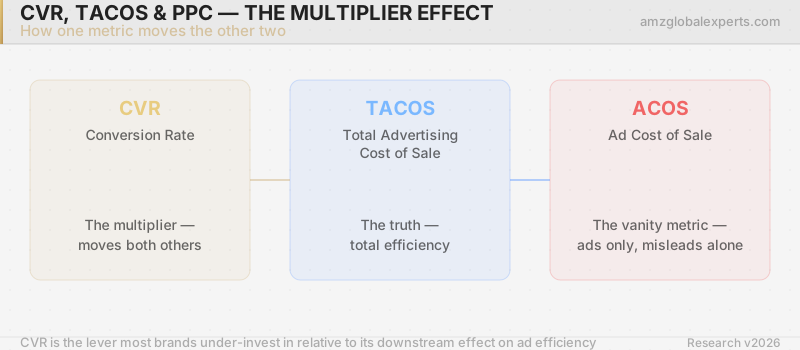
CVR is the most important number on Amazon. Not because it directly measures profit, but because it's the multiplier that every other metric runs through. A listing with a 20% CVR converts 2.5× more of your ad spend into revenue than a listing with 8% CVR, at identical traffic and pricing. That's not a 2.5× revenue increase. It's a 2.5× effective ROAS increase without changing a single bid.
Category CVR benchmarks (directional, based on Jungle Scout and Helium 10 aggregate data):
The top quartile isn't winning because they have better products. In most categories, the quality gap between rank 1 and rank 10 is marginal. The conversion gap is driven by listing quality, image strategy, psychological alignment, and review volume. All of which are engineered, not accidental.
TACOS: The Real Profitability Signal
TACOS (Total Advertising Cost of Sales) = Total Ad Spend ÷ Total Revenue. It measures what percentage of your entire business revenue is being consumed by advertising — not just the ad-attributed portion.
The critical insight: as a brand matures, organic revenue should grow faster than ad spend. If TACOS is declining month over month, your ads are building organic rank and velocity. If TACOS is flat or rising, your ads are maintaining (or losing) position while organic growth stagnates.
Brands with a fragmented approach — separate PPC agency, separate listing team, no unified conversion strategy — consistently show flat-to-rising TACOS beyond month three. Their ads aren't building organic rank, because their listings just don't convert well enough to generate the velocity signals Amazon's algorithm rewards.
CTR: The Intent Signal
Click-through rate measures whether your main image and title are compelling enough to pull a buyer out of a search results page crowded with competitors. Low CTR is an image and title problem. Adequate CTR with low CVR is a listing and psychology problem. Both require different solutions.
The Multiplier Effect: Why Messaging Alignment Changes Everything
Consider a brand spending $10,000/month on PPC with a 10% CVR and 0.30% CTR. Now consider what happens when Reddit language mining and listing optimization improve CVR to 16% and image/title work improves CTR to 0.45%. The ad budget stays the same. The targeting stays the same. The bid strategy stays the same.
This is not a hypothetical. These are the compound effects of what happens when you stop treating PPC, listing copy, and consumer psychology as three separate workstreams and start running them as one integrated system.
PPC Intent: The Layer Most Brands Get Wrong
PPC intent refers to matching the psychological state of the buyer at the moment of their search to the message they encounter in the ad and listing. A search for "baby monitor" represents early-stage research intent. A search for "best baby monitor under $100 with two cameras" represents high-purchase intent. A search for "[Brand Name] baby monitor" represents brand-loyalty intent.
Most Amazon PPC strategies run the same ad creative and the same landing experience against all three intent types. This is why brands with healthy ACOS still have poor blended ROAS — they're efficiently delivering the wrong message to the wrong buyer at the wrong moment in the decision process.
PPC Intent Framework
| Search Intent Type | Example Query | Ad Strategy | Listing Emphasis |
|---|---|---|---|
| Awareness | "baby monitor" | Broad/category targeting, low bid | Category authority, brand story |
| Consideration | "baby monitor with two cameras" | Feature-specific targeting, mid bid | Feature differentiation, comparison |
| Purchase | "best baby monitor under $100" | High bid, price+value headline | Price anchor, social proof, objection handling |
| Brand | "[YourBrand] monitor" | Defensive brand campaign | Loyalty signals, bundle offers |
| Competitor | "[Competitor] baby monitor alternative" | Conquest targeting, differentiation | Head-to-head comparison A+ |
The Unified Conversion Architecture™ and Your Metrics
The Unified Conversion Architecture™ is the operational system that ensures CVR, TACOS, and PPC intent are optimized together rather than in isolation. The three inputs that determine all three metrics simultaneously are: consumer psychology research (Reddit intelligence), listing conversion quality (copy, images, A+), and PPC intent alignment (matching ad message to buyer decision stage).
When these three inputs are managed by separate teams with separate briefs and separate KPIs, you get metric fragmentation: an ACOS that looks good while TACOS climbs and CVR stagnates. When they're managed as one architecture, the metrics compound: improving CVR reduces effective ACOS, which allows TACOS to decline, which builds organic rank, which increases organic velocity, which reduces reliance on paid traffic, which improves TACOS further.
The compounding dynamic: A 1% CVR improvement on a listing generating 1,000 sessions/month produces 10 additional organic orders. Those orders contribute to BSR improvement. BSR improvement produces more organic impressions. More organic impressions reduce the percentage of revenue that must be ad-attributed. TACOS declines without reducing ad spend. Conversion optimization is the best PPC strategy you're not running.
Key Metrics Benchmarks Summary
Actionable Checklist: Metrics Audit
- Pull your 90-day TACOS trend — is it declining, flat, or rising?
- Compare your CVR against category benchmarks — where are you in the distribution?
- Segment CTR by campaign type and match to intent (awareness vs. purchase vs. brand)
- Identify your single highest-volume listing and audit for psychology alignment
- Check if your top PPC ad copy mirrors your listing's primary value proposition
- Run a search term report and identify intent mismatches (purchase-intent queries hitting awareness-level listings)
- Set a 90-day TACOS target and build a conversion improvement roadmap to hit it
- Track CVR weekly — daily fluctuation is noise, weekly trend is signal