
Every ecommerce brand eventually hits the same wall: more ad spend produces diminishing returns, organic traffic growth is slow, and the revenue graph flattens despite consistent effort. The brands that break through this ceiling are not the ones that discover a new traffic channel. They are the ones that stopped treating their existing traffic as a fixed input and started optimizing what they do with it.
That is the core premise of conversion rate optimization. Not getting more visitors — getting more of your current visitors to take the action that matters. On Amazon, that means moving a shopper from your listing to a purchase. On Shopify, it means moving a visitor from your homepage to checkout and out the other side. In both cases, the compounding math of even marginal CVR improvements makes it one of the highest-ROI investments available to any ecommerce operator.
The CRO Math That Changes How You Think About Growth
Before getting into tactics, understand the leverage that CRO creates. The numbers are not intuitive until you run them.
Take an Amazon listing with 10,000 monthly sessions and a 10% conversion rate — 1,000 orders per month at an average order value of $45. That is $45,000 in monthly revenue.
Now compare two growth paths:
- Path A — Traffic growth: Increase sessions by 20% through higher PPC bids and expanded keyword targeting. Sessions go from 10,000 to 12,000. At the same 10% CVR, orders increase to 1,200 — $54,000 in revenue. Growth: $9,000/month. Cost: significant additional ad spend, higher CPCs, more management time.
- Path B — CVR improvement: Improve the listing conversion rate from 10% to 12% through image testing, A+ Content, and title optimisation. Sessions stay at 10,000. Orders increase to 1,200 — $54,000 in revenue. Growth: $9,000/month. Cost: a one-time listing optimisation investment with no ongoing spend increase.
Same revenue outcome. Completely different cost structure. And Path B compounds further: that improved CVR also reduces your effective ACOS on every PPC campaign running against the listing, generates more reviews faster (improving organic rank), and lowers your break-even ROAS — creating headroom to scale paid traffic more profitably. CVR improvement is a force multiplier on every other growth lever you have.
What Is Conversion Rate Optimization?
Conversion Rate Optimization (CRO) is the systematic process of increasing the percentage of visitors who complete a desired action — a purchase, a sign-up, an add-to-cart, a form submission — through data-driven analysis, hypothesis testing, and iterative improvement.
The formula is straightforward: CVR = (Conversions ÷ Total Visitors) × 100. If 1,500 people visit your product page and 180 buy, your CVR is 12%. CRO is the discipline of moving that number upward — not by accident, but through a repeatable process that identifies friction, removes it, and validates the improvement with data before scaling.
The key distinction between CRO and general website optimisation is that CRO is always hypothesis-driven and always measured against a baseline. You do not change your main image because it looks better — you test it against the original, measure the conversion impact over a statistically valid sample, and make decisions from the data. This rigor is what separates operators who compound improvements from those who apply random changes and wonder why results are inconsistent.
Amazon CRO vs. Shopify CRO: Different Levers, Same Principles
The CRO principles are universal. The specific levers are platform-dependent. Understanding this distinction is critical because tactics that work on Shopify cannot be imported directly to Amazon, and vice versa.
| Dimension | Amazon CRO | Shopify / DTC CRO |
|---|---|---|
| CVR benchmark | 10–15% average · 20–30% top listings | 1–3% average · 5–8% top stores |
| Primary CVR lever | Main image → CTR + CVR simultaneously | Page speed + above-the-fold clarity |
| Testing tool | Manage Your Experiments (native), PickFu | Optimizely, VWO, Google Optimize |
| Trust signals | Review count, star rating, Prime badge, brand store | Security badges, testimonials, press logos, guarantee |
| Friction points | Confusing bullets, weak A+ Content, missing size chart | Long checkout, required account creation, unexpected shipping cost |
| Personalization | Limited (Amazon controls the page) | Full control — dynamic content, loyalty tiers, geo-targeting |
| Algorithm impact | High — CVR directly improves A10 organic rank | Indirect — via bounce rate, session duration signals |
The table above highlights the most important structural difference: on Amazon, higher CVR directly improves your organic ranking (the A10 algorithm rewards conversion velocity), which in turn sends more traffic to your listing, which generates more conversions. It is a compounding loop. On Shopify, the relationship between CVR and traffic is indirect — improving CVR does not automatically bring more visitors, but it does reduce your customer acquisition cost and improve the ROI of every paid channel driving traffic to the store.
The CRO Process: Five Stages That Never Change
Whether you are optimising an Amazon listing or a Shopify checkout flow, the CRO process follows the same five-stage cycle. Skipping any stage — particularly stages 1 and 3 — produces guesswork, not improvement.
Stage 1: Quantitative Data Collection
Before forming a single hypothesis, collect the data that tells you what is actually happening. For Amazon: use Brand Analytics to identify search terms with high impressions but lower-than-expected click-through rates (a signal of main image weakness), pull session and unit session percentage data from Seller Central to establish your CVR baseline, and analyse the conversion funnel from search impression to detail page view to order.
For Shopify and DTC: use Google Analytics 4 to map the conversion funnel from landing page through checkout, identify the exact step where the highest percentage of users drop off, and segment by device type (mobile vs. desktop CVR gaps are almost always significant and actionable). Layer in Hotjar or Microsoft Clarity heatmaps and session recordings to see where users hesitate, scroll past without clicking, or abandon the page entirely.
The data collection stage should answer one specific question: where are users leaving the funnel, and at what rate? Everything downstream flows from a precise answer to that question.
Stage 2: Qualitative Intelligence — Why Users Leave
Quantitative data tells you where users leave. Qualitative research tells you why. These are separate inputs that require separate research methods. A heatmap showing users abandoning a checkout at the payment step tells you there is a problem. It does not tell you whether the problem is a confusing form, a missing payment method, an unexpected fee, or a lack of trust signal at the critical decision moment.
Qualitative methods include exit-intent surveys (asking users who are about to leave a specific question: "What stopped you from completing your purchase today?"), customer interviews with recent buyers about the friction they experienced before converting, and Amazon review mining — reading your own and competitor reviews to identify the objections, hesitations, and confusion points that buyers describe in their own language. That language belongs in your listing bullets, your A+ Content, and your FAQ section.
The Reddit intelligence method: For consumer products, Reddit communities (r/frugalmalefashion, r/BabyBumps, r/fitness — whatever category is relevant to your product) contain unprompted buyer language: the exact objections people raise before purchasing, the features they compare across competitors, and the questions that always come up before a buying decision. Mining this language and incorporating it into listings and landing pages routinely produces 15–25% CVR lifts because you are speaking the buyer's own vocabulary back to them.
Stage 3: Hypothesis Formation
A CRO hypothesis is not a guess. It is a structured prediction based on specific evidence that identifies a change, a reason, and a measurable expected outcome. Weak hypothesis: "Let's try a different main image." Strong hypothesis: "Replacing the main image from a white-background studio shot to a lifestyle image showing the product in use will increase click-through rate from search results by 12–18%, because Brand Analytics shows our CTR is 23% below the category average and competitor analysis shows that lifestyle images dominate the top 5 positions in our search results."
A strong hypothesis contains: the specific change you are making, the evidence that motivated the hypothesis (data point or qualitative insight), the expected outcome and the metric you will use to measure it, and a falsifiability condition — how you will know if the hypothesis was wrong.
Stage 4: Controlled Testing
On Amazon, use Manage Your Experiments for main image, title, and A+ Content testing. The tool runs a native split test showing Version A to 50% of shoppers and Version B to the other 50%, with Amazon calculating statistical significance. Minimum test duration is 4 weeks; for lower-traffic listings, 8–10 weeks is more reliable. For pre-launch image validation, PickFu allows you to survey 50–100 real Amazon shoppers on which image they would click — a fast, low-cost method of eliminating losing variants before committing to a live test.
On Shopify, A/B testing tools like Optimizely and VWO run server-side or client-side experiments across any page element: hero image, CTA copy, price display, checkout step count, trust badge placement, and more. The same statistical rigour applies — test one variable at a time, run until you reach 95% statistical significance, and never call a test early because it is trending in your favour.
Stage 5: Implementation, Measurement, and Iteration
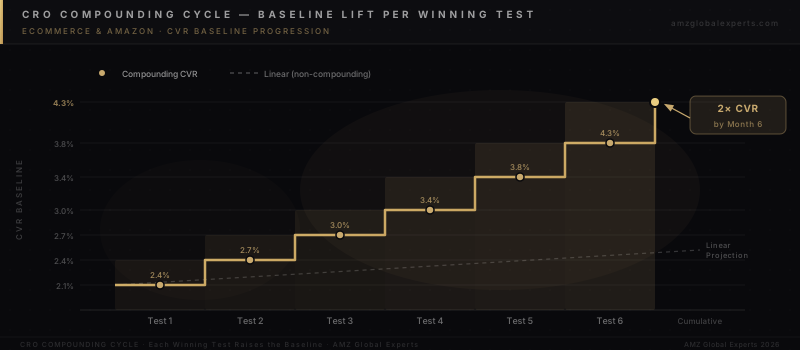
A winning test result is not the end of the CRO cycle — it is the beginning of the next one. Implement the winning variant, set a new baseline, and immediately identify the next highest-priority friction point to test. CRO compounds because each improvement is built on the previous one, and the baseline keeps rising. A brand that runs two rigorous CRO tests per month for twelve months does not end up with incremental improvement — it ends up with a fundamentally different conversion performance than where it started.
The 8 Highest-Leverage CRO Techniques for Ecommerce in 2026
1. Main Image Engineering (Amazon-Specific, Highest Leverage)
On Amazon, the main image does two jobs simultaneously: it determines whether a shopper clicks on your listing from search results (CTR), and it is the first thing they evaluate when they arrive on your listing (CVR). A weak main image suppresses both — which is why image testing typically produces the largest single CVR lift available to an Amazon seller.
The most consistent findings from split testing data: images showing the product in use (lifestyle) outperform studio shots in most consumable, apparel, and wellness categories; images that visually communicate the primary value proposition (size, quantity, use case) outperform generic product shots; and close-up images that fill the frame rather than leaving white space perform better in most categories. Test one specific change at a time to isolate the variable.
2. Above-the-Fold Clarity
Whether on a product page or a landing page, the content visible without scrolling must answer three questions instantly: what is this, who is it for, and what should I do next? If a visitor cannot answer these three questions within three seconds of landing, they leave — regardless of how compelling the rest of the page is.
For Amazon listings, this means the title must communicate the product category, primary benefit, and key specification clearly within the first 80 characters (the visible portion on mobile search results). For Shopify landing pages, it means the hero section must contain a specific, benefit-driven headline (not a clever tagline), a single sub-headline that expands the benefit, a product image that shows the product in use, and one clear CTA button with action-oriented copy.
3. Trust Signal Architecture
Conversion hesitation is almost always rooted in risk perception. The buyer is asking: "Can I trust this seller? Will this product actually work? What happens if it doesn't?" CRO's job is to eliminate that risk perception at every decision point in the funnel.
On Amazon: review count and star rating are the dominant trust signals. Getting to 50+ reviews with a 4.5+ star average removes the primary barrier for most categories. Verified Purchase badges, seller response rate, and brand store completeness are secondary signals that matter for higher-consideration purchases. On Shopify: trust signals include money-back guarantee copy placed directly adjacent to the Add to Cart button, SSL and payment security badges at checkout, authentic customer testimonials (with photos, not just text), and press logos for brands that have earned them. The placement matters as much as the presence — trust signals placed at the moment of decision (not buried in the footer) have the highest conversion impact.
4. Bullet Copy and Objection Architecture
Amazon bullet points are not a feature list. They are a conversion tool that should address the buyer's top five objections and decision criteria in order of importance. The most common mistake is writing bullets that describe features rather than outcomes: "Made from 100% stainless steel" is a feature. "Dishwasher-safe stainless steel that won't stain or rust after daily washing" is an outcome that removes a specific objection from a buyer who has been burned by rust on a previous product.
Build bullet copy from Amazon review mining: find the five most common objections in your category's 2-star and 3-star reviews. Those are the questions your bullets must pre-emptively answer. Buyers who see their specific concern addressed in the listing are significantly more likely to convert than buyers who must assume the answer is favourable.
5. Mobile CRO: The Majority Funnel
As of 2026, approximately 62% of Amazon traffic and over 70% of Shopify traffic originates from mobile devices. Your CVR on mobile is almost certainly lower than on desktop — and in most cases, the gap is larger than the data suggests because mobile abandonment is concentrated at specific friction points that are invisible on a desktop review.
Mobile CRO priorities: image loading speed (compress hero images to under 200KB without visible quality loss), tap target sizing (buttons should be minimum 44×44 pixels for reliable tapping without mis-hits), form field minimisation (every additional field on mobile loses a measurable percentage of completions), and sticky CTA buttons (a CTA that scrolls out of view on mobile requires the user to actively scroll back — each scroll interruption is an exit opportunity). Test your conversion funnel yourself on three different mobile devices before making any other CRO investment.
6. Page Speed as a Conversion Lever
A one-second improvement in Shopify page load time improves mobile conversion rates by 3.79%, according to Google's Core Web Vitals data. At higher traffic volumes, this is not a minor consideration — it is a direct revenue line. The CRO impact of page speed is largest on mobile, where connection speeds vary and shoppers are less tolerant of wait times than on desktop.
Practical speed improvements that produce measurable CVR gains: compress all product images using WebP format (50–80% smaller than JPEG at equivalent visual quality), eliminate unnecessary app scripts from page load (audit your Shopify app stack — each app adds JavaScript that loads on every page view), and implement lazy loading for below-the-fold images so the critical above-the-fold content loads first. On Amazon, you cannot control page speed, but A+ Content with oversized, uncompressed images slows loading on mobile — keep module images under 1MB.
7. Behavioral Psychology Triggers
Conversion decisions are rarely purely rational. Behavioral psychology identifies consistent cognitive patterns that influence purchase decisions — and incorporating these patterns into your CRO strategy produces reliable, measurable lifts when applied at the right moments in the funnel.
- Social proof: "12,847 customers trust this product" or "Best seller in [category] for 3 consecutive months." The credibility of social proof scales with specificity — vague claims ("customers love it") underperform specific claims ("4,200 verified 5-star reviews").
- Scarcity and urgency: "Only 7 left in stock" (Amazon displays this automatically when inventory drops below a threshold) and "Order in the next 3 hours for same-day dispatch" create genuine urgency. Artificial urgency — countdown timers that reset — erodes trust when buyers notice.
- Anchoring: Displaying the crossed-out "was" price next to the current price anchors value perception. Even a modest discount looks more significant when the original price is visible.
- Loss aversion: "Don't miss out on [benefit]" outperforms "Get [benefit]" in most A/B tests because humans weight potential losses more heavily than equivalent gains. Apply carefully — overuse triggers skepticism.
8. Exit-Intent Recovery and Retargeting
Not every conversion failure is permanent. Shoppers who reach the cart or checkout and abandon have already self-selected as high-intent buyers — they demonstrated enough interest to take action. Exit-intent interventions and structured retargeting sequences recover a meaningful percentage of these abandons.
Exit-intent popups that offer a specific reason to stay (a first-purchase discount, a free shipping threshold, or social proof they haven't seen) convert 2–10% of would-be abandons into completions when triggered at the right moment (cursor moving toward browser close, not after every scroll). Retargeting sequences via Meta Ads or Google Display targeting cart abandoners with a specific reminder and, optionally, a time-limited offer recover 5–15% of abandoned carts depending on category and price point. On Amazon, Sponsored Display ads can retarget visitors who viewed your listing but didn't purchase — a direct application of the same principle within the Amazon ecosystem.
Conversion Rate Benchmarks: What Good Actually Looks Like
Benchmarks only have meaning when segmented by platform and category. A 3% CVR on Amazon is a crisis signal. A 3% CVR on a Shopify store selling $400 furniture is excellent. Context matters.
| Platform / Context | Poor | Average | Strong | Top Performer |
|---|---|---|---|---|
| Amazon — General | Under 8% | 8–12% | 12–20% | 20–30%+ |
| Amazon — Consumables / Health | Under 12% | 12–18% | 18–25% | 25–35%+ |
| Shopify — General Ecommerce | Under 1% | 1–2.5% | 2.5–4% | 4–8%+ |
| Shopify — High-AOV ($300+) | Under 0.5% | 0.5–1.5% | 1.5–3% | 3–5%+ |
| Lead generation (free offer) | Under 5% | 5–15% | 15–30% | 30–50%+ |
| Email CTA (existing list) | Under 1% | 1–3% | 3–6% | 6–12%+ |
The reason Amazon CVR benchmarks are an order of magnitude higher than Shopify involves purchase intent. A shopper who types "organic baby shampoo" into Amazon's search bar and clicks on your listing is near the bottom of the purchase funnel — they have already decided to buy, they are comparing options. A visitor who lands on a Shopify store from a Facebook ad may be in early discovery mode, with no specific purchase intent yet. Higher intent = higher conversion rate. CRO for Amazon is optimising a near-ready buyer; CRO for Shopify often includes building the intent that Amazon shoppers arrive with pre-formed.
The CVR–ACOS connection on Amazon: If your ACOS is higher than your target and you are frustrated with PPC costs, check your CVR before changing your bids. A listing converting at 8% compared to a competitor converting at 16% means your competitor generates twice as many orders from the same number of clicks. At identical bid levels, their effective ACOS is half of yours — not because their bids are smarter, but because their listing converts better. Fix the listing first. Bid optimisation on a weak listing is rearranging deck chairs.
Building a CRO Testing Calendar
The most effective CRO programs are run on a structured calendar, not reactively. A structured testing calendar does three things: it ensures a continuous pipeline of hypotheses rather than testing gaps, it prevents multiple simultaneous changes that contaminate results, and it creates an institutional record of what has been tested, what won, and why — so knowledge compounds across the team rather than residing in one person's memory.
A practical CRO calendar for an Amazon-first brand running 3–5 active listings looks like this:
- Month 1: Baseline audit — pull CVR, CTR, and session data for all listings. Rank by CVR gap versus category benchmarks. Identify the three listings with the highest improvement potential (typically the highest-traffic listings with below-average CVR).
- Months 1–2: Main image test on the priority listing. Run Manage Your Experiments for a minimum 6 weeks. Simultaneously conduct PickFu research on secondary image variants to build the next test queue.
- Months 2–3: Title test on priority listing (using the winner from the image test as the new baseline). Simultaneously launch image test on the second-priority listing.
- Month 3 onwards: Continuous cycle — one active test per listing at all times, with test results reviewed and documented weekly. A+Content and bullet optimisation cycles run quarterly based on accumulated review mining intelligence.
At this cadence, a five-listing brand runs 10–12 meaningful CRO tests per year. At an average 8–12% CVR lift per winning test (a conservative assumption based on documented split test outcomes), the compounding effect on revenue over twelve months is substantial — typically 30–60% CVR improvement from starting baseline, with zero increase in traffic or ad spend.
The CRO Metrics That Actually Matter
Tracking the wrong metrics is as dangerous as not tracking at all, because it creates confidence in numbers that do not reflect commercial reality. The metrics that matter for CRO accountability:
- Unit Session Percentage (Amazon): The native Amazon CVR metric. Orders divided by sessions. This is your primary conversion KPI on Amazon — not clicks, not impressions, not ad spend.
- Checkout Completion Rate (Shopify): The percentage of users who reach checkout and complete a purchase. This is the most direct measure of checkout friction.
- Add-to-Cart Rate: On Shopify, separating add-to-cart from checkout initiation from purchase completion reveals exactly which funnel stage has the highest abandonment — and therefore the highest-priority CRO target.
- Revenue Per Visitor: CVR × Average Order Value. This single number tells you the commercial value of each visitor and is the metric that CRO improvements show up in most clearly.
- Statistical Significance: The probability that the observed difference between test variants is real rather than random variation. Set your threshold at 95% minimum before implementing a test winner. Tests called at 80% significance regularly produce false positives.
Frequently Asked Questions
What is a good conversion rate for an Amazon listing?
Amazon's average listing conversion rate is 10–15% — significantly higher than general ecommerce (1–3%) because shoppers have high purchase intent when they arrive. Top-performing Amazon listings convert at 20–30%. Anything below 8% signals a listing issue that is actively suppressing both organic rank and PPC efficiency.
What is the difference between CRO for Amazon and CRO for a Shopify store?
On Amazon, CRO is primarily about the listing itself — main image, title, bullets, A+ Content, pricing, and reviews. You cannot control the overall page experience, but you can engineer every element Amazon allows. On Shopify, CRO encompasses the full page experience: site speed, navigation, checkout flow, trust signals, and personalization. Both require behavioral data and systematic testing, but the levers are different.
How long does a valid A/B test take on Amazon?
Amazon's Manage Your Experiments tool requires a minimum of 4 weeks per test and recommends up to 10 weeks for statistically reliable results. You need a minimum of approximately 1,000 sessions per variant to draw valid conclusions. Listings with lower traffic volumes need longer test windows to reach significance.
What is the most impactful CRO lever on Amazon?
The main hero image is the single highest-leverage CRO element on Amazon. It drives click-through rate from search results and is the first thing a buyer evaluates when they arrive. A/B testing the main image typically produces the largest CVR lift of any single change — often 15–40% — because it affects both traffic volume and conversion probability simultaneously.
Can improving CVR lower my Amazon PPC costs?
Yes — directly. A listing that converts at 15% vs. 8% is nearly twice as efficient with the same PPC budget and bid level. Every click generates more orders, which lowers your effective ACOS without changing a single bid. Higher CVR also improves your organic rank, meaning your paid traffic investment compounds into organic visibility over time.
What tools should I use for ecommerce CRO?
For Shopify and DTC: Google Analytics 4 for funnel data, Hotjar or Microsoft Clarity for heatmaps and session recordings, Optimizely or VWO for A/B testing, and Klaviyo for email flow performance. For Amazon: Manage Your Experiments (native A/B testing), PickFu for image and listing research with real buyer panels, and Amazon Brand Analytics for search term and click-through data.