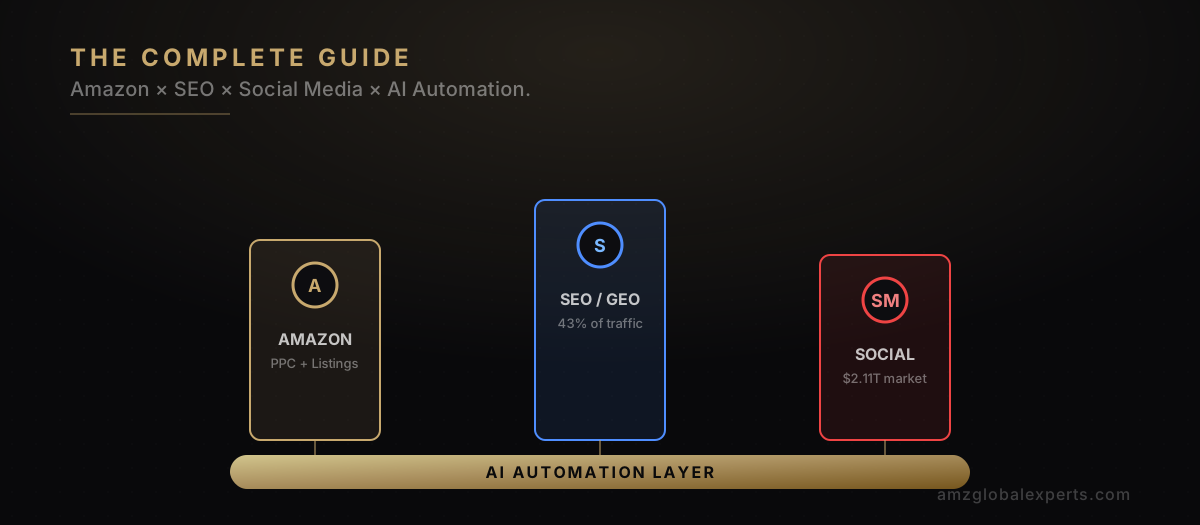
Amazon advertising revenue reached an estimated $68.63 billion in 2025, the omnichannel retailing market is valued at approximately $11.57 billion in 2026 and projected to reach $29.30 billion by 2033, and the global social commerce market is worth $2.11 trillion in 2026 — growing at a 29.12% compound annual rate toward a projected $7.55 trillion by 2031. Three channels, three growth curves, and one increasingly obvious conclusion: a brand strategy built around any single one of them is now structurally incomplete.
This is the complete, sourced guide to how AI automation, SEO, and social media combine into a single growth system for Amazon and ecommerce brands in 2026 — not three separate initiatives run by three separate teams, but one coordinated engine.
The Three Growth Engines and Why They No Longer Work in Isolation
Organic search still drives 43% of all ecommerce traffic and 23.6% of all online orders — it remains the largest single channel most brands have. But McKinsey's retail research found that 73% of shoppers engage across multiple channels during a single buying journey, interacting with an average of six touchpoints before purchase. A brand optimized purely for Amazon PPC, with no coordinated SEO or social presence, is only visible at the final touchpoint of that six-step journey — and is competing on price and Buy Box position rather than on brand recall built earlier in the funnel.
Social commerce adds the third leg. The global social commerce market crossed $2.11 trillion in 2026, and in the US specifically, social commerce sales crossed $100 billion for the first time, with live shopping converting at up to 30% compared to 2–3% for traditional ecommerce checkout flows. TikTok and Instagram Reels together now drive 67% of all shoppable video impressions in ecommerce, and brands publishing at least 10 short-form videos per month see 3× the organic reach and 2× the paid ROAS of brands posting fewer than four.
Where AI Automation Fits Between the Three Channels
McKinsey's State of AI research found that 78% of companies now use AI in at least one function specifically to enable omnichannel experiences, and AI-powered next-best-experience decisioning — the system that decides which channel and message to serve a given customer — improves customer satisfaction by 15 to 20%, increases revenue by 5 to 8%, and reduces cost-to-serve by 20 to 30%. Applied to the Amazon-SEO-social triangle, this means the same buyer-language data extracted from Amazon reviews and PPC search-term reports should be informing organic SEO content and social video hooks — not sitting in an Amazon-only dashboard nobody outside the PPC team ever opens.
Key Finding: Campaigns running across three or more coordinated channels generate 287% higher purchase rates than single-channel campaigns, according to 2026 omnichannel marketing research. That figure alone explains why brands treating Amazon, SEO, and social as three separate line items — rather than one coordinated system — are leaving measurable revenue on the table regardless of how well any single channel performs.
What Real Amazon Sellers Are Saying
r/ecommerce brand owner: "Our Amazon reviews are basically a free focus group. We started pulling the exact phrases customers use into our TikTok captions and blog headlines. Engagement went up almost immediately — because it's literally what people already say about the product." — This reflects a pattern seen across multiple threads: brands that treat Amazon review language as a cross-channel content asset outperform those that write social and SEO copy from scratch.
r/AmazonSeller seller: "We had three different people running Amazon, our website SEO, and TikTok. None of them knew what the others were doing. Once we consolidated it under one strategy, our off-Amazon traffic started actually moving Amazon rank instead of just sitting on the side." — A recurring theme: fragmented ownership across channels blocks the compounding effect that coordinated strategy produces.
Building the Coordinated System: Amazon, SEO, and Social Together
| Channel | Primary Role | Feeds Into |
|---|---|---|
| Amazon (PPC + listings) | Purchase-intent capture | Buyer-language data for SEO and social |
| SEO / GEO content | Discovery + AI citation | Off-Amazon traffic, brand authority |
| Social (TikTok Shop, IG) | Organic reach + native checkout | Top-of-funnel demand into Amazon + DTC |
| AI signal layer | Unifies all three | Continuous, not campaign-by-campaign |
Native checkout integration on TikTok Shop and Instagram Checkout now delivers 30–50% higher completion rates compared to redirect-to-site flows — which means social is no longer just a discovery layer feeding Amazon, it is increasingly a direct revenue channel in its own right. A coordinated strategy treats all three as one funnel with multiple entry and conversion points, rather than ranking them by which one gets the biggest budget line.
Strategic Recommendations
Short-Term (0–90 Days)
Pull the highest-frequency phrases from your Amazon review section and PPC search-term reports, and check whether those exact phrases appear anywhere in your social captions or SEO content. If they do not, you are writing three different brand voices for one buyer.
Mid-Term (90–180 Days)
Increase short-form video cadence toward the 10-per-month threshold associated with 3× organic reach and 2× paid ROAS, and route the highest-performing hooks back into Amazon A+ Content and listing video.
Long-Term (6–18 Months)
Move from channel-by-channel ownership to one coordinated strategy with a shared signal layer, consistent with the 287% purchase-rate lift associated with 3+ channel coordination. See our related report on the omnichannel flywheel connecting TikTok, Amazon, Shopify, and AI search.
Amazon Marketing Budget Allocation: What the Data Suggests
Most brands still allocate marketing budget the way they did in 2020: the overwhelming majority to Amazon PPC, a smaller slice to SEO or content, and social treated as an afterthought run by whoever has time. The 2026 data argues for a different split. With organic search still driving 43% of ecommerce traffic and campaigns spanning 3+ channels generating 287% higher purchase rates than single-channel efforts, the highest-leverage marginal dollar is rarely the next PPC dollar — it is the dollar spent closing whichever of the three channels is currently weakest relative to the other two.
| Channel | Typical Legacy Budget Share | Data-Justified Priority Signal |
|---|---|---|
| Amazon PPC | 60–75% | High, but diminishing returns without listing/CVR work |
| SEO / GEO content | 10–15% | Under-resourced relative to 43% traffic share |
| Social / short-form video | 10–20%, inconsistent cadence | Highest current growth-rate channel (social commerce +29.12% CAGR) |
This is not a recommendation to defund Amazon PPC — it remains the highest-intent, closest-to-purchase channel most brands have. It is a recommendation to stop treating SEO and social as residual budget line items and start treating them as the two channels most likely to be under-invested relative to their measured growth rate and purchase-rate contribution.
The Governance Question Most Brands Skip
Even brands that intellectually agree on coordinated budgeting often fail to execute it because no single person or system owns cross-channel performance. Three specialists optimizing three channels independently will, by default, each optimize their own channel's isolated metric — ACOS for PPC, rankings for SEO, follower growth for social — none of which is the brand's actual objective of blended revenue and LTV. Fixing the budget split without fixing the governance structure underneath it rarely produces the 287% lift the coordinated-channel data promises.
A 12-Month Sequencing Model for the Three-Channel Build
Brands rarely have the resources to build Amazon, SEO, and social coordination simultaneously from a standing start, and trying to do all three at once is a common reason coordinated strategies stall before they compound. The sequencing that shows up most often in brands that successfully make the transition starts with Amazon, since it is typically the largest existing revenue base and the richest source of buyer-language data. Months one through four focus on stabilizing and extracting signal from Amazon — PPC, listings, and review mining. Months four through eight route that signal into SEO and GEO content, since organic search still carries the largest addressable traffic share at 43% of ecommerce traffic. Social is deliberately sequenced last, months eight through twelve, once there is a validated content voice and message bank to draw from — short-form video built on unproven messaging burns budget faster than any other channel in this system, so getting the voice right before scaling video cadence protects the 3× organic reach and 2× ROAS gains documented for consistent, well-targeted posting.
How AMZ Global Experts Helps
AMZ Global Experts runs Amazon, SEO/GEO, and social as one coordinated system rather than three billed line items — buyer-language signal extracted from Amazon reviews and search terms feeds directly into content briefs for organic SEO and short-form social video, and performance from all three routes back into one shared reporting layer. This is the model detailed further in our Future of Ecommerce: AI, Omnichannel and Social Media research and our UGC Creator Economy report.
Conclusion
The data across every channel points the same direction: Amazon, SEO, and social media are no longer separate initiatives competing for budget — they are one funnel that compounds when coordinated and leaks revenue when it isn't. If your Amazon, SEO, and social strategies are being run by three teams that don't talk to each other, book a strategy audit and we'll show you exactly where the disconnect is costing you.
Frequently Asked Questions
Buyer-language data extracted from Amazon reviews and PPC search terms can directly inform SEO content and social video hooks, creating one coordinated brand voice across channels instead of three disconnected strategies. Campaigns running across three or more coordinated channels generate 287% higher purchase rates than single-channel campaigns, according to 2026 omnichannel research.
The global social commerce market is worth an estimated $2.11 trillion in 2026 and is projected to reach $7.55 trillion by 2031, growing at a 29.12% compound annual rate. In the US, social commerce sales crossed $100 billion for the first time, with live shopping converting at up to 30% versus 2–3% for traditional ecommerce checkout.
TikTok and Instagram Reels together drive 67% of all shoppable video impressions in ecommerce, and brands publishing at least 10 short-form videos per month see 3× the organic reach and 2× the paid ROAS of brands posting fewer than four videos monthly.
Yes — organic search remains the single largest traffic driver for online retail, responsible for 43% of all ecommerce traffic and 23.6% of all online orders. A brand relying purely on Amazon PPC with no coordinated SEO presence is missing the largest channel most ecommerce businesses have available to them.
AI-powered next-best-experience decisioning, which McKinsey found improves customer satisfaction by 15–20% and revenue by 5–8%, works by routing buyer signal from one channel into decisions on the others in real time rather than requiring manual coordination between separate teams. This is what allows Amazon review language, SEO content, and social hooks to stay consistent without added headcount.