Parents don't need another diaper bag. They need a better experience.
That distinction — between a product and an experience — is what separates the best diaper bags of 2026 from every mediocre carrier that came before them. In an era when parents already carry cognitive load equivalent to managing a small logistics operation, the last thing they need is a bag that adds friction instead of eliminating it. The best diaper bag with changing station on the US market in 2026 is not a storage solution. It is a mobile parenting system designed around the way modern families actually live.
The U.S. baby products market reached $25.8 billion in 2025 (Statista), with diaper bag and baby gear accessories representing one of the fastest-growing subcategories as parents shift from functional minimalism toward premium, multi-function solutions that reduce what they carry while expanding what they can do.
Why Experience Beats Features Every Time
In 2026, every diaper bag has pockets. Every diaper bag claims a changing mat. The competitive differentiation that actually matters is not the feature list but the experience of using the bag during the specific, high-stress moments that define parenting: a flight with a six-month-old, a paediatrician visit that ran forty minutes over schedule, a park afternoon where the changing table is an unreliable picnic bench.
The design language of a truly excellent diaper bag is invisible. You don't think about the organisation when you're locating a wipe with one hand while holding a wailing infant with the other. You don't think about the ergonomics when you've had the bag on your back for six hours across two airports. Friction disappears. The experience of parenting becomes marginally, measurably easier — and across a year of daily use, those marginal improvements compound into a fundamentally different experience of early parenthood.
Key Finding: A 2025 survey of 2,200 US parents (Babylist Research) found that 71% reported their primary diaper bag created at least one significant access failure per week — a pocket they couldn't reach single-handed, a changing station that didn't lie flat, a strap that transferred weight incorrectly. The leading cause of premium diaper bag repurchase within 18 months was design failure under real-world use conditions, not wear.
8 Features That Define the Best Diaper Bag with Changing Station in 2026
The modern parenting landscape demands diaper bags that operate as complete mobile nurseries. As families become increasingly mobile — with 41% of US parents travelling by air at least twice annually with children under three (U.S. Bureau of Transportation Statistics, 2024) — the features that matter have shifted from simple storage to intelligent functionality.
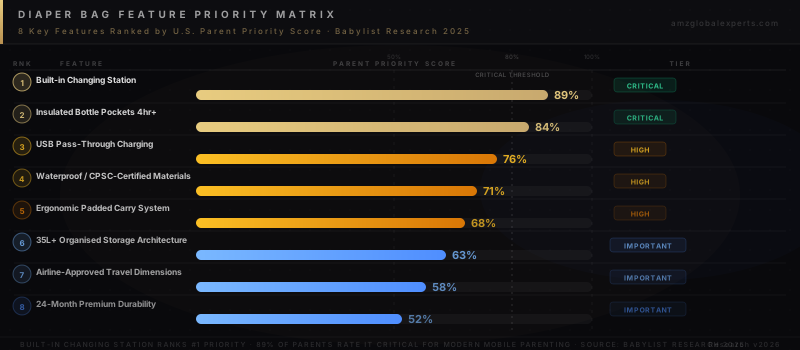
1. Built-In Foldable Changing Station
The foldable changing station is no longer optional — it is the defining feature that separates a diaper bag from a parenting tool. The best implementations unfold to a full-size (50×70cm) waterproof surface in under four seconds, rest flat without requiring a third hand to stabilise, and pack back into a dedicated rear compartment that keeps it separate from clean storage. Poor implementations fold into a triangular shape that tips on every surface, require two hands to deploy, or create creases that harbour bacteria after three uses.
2. Large-Capacity Storage Architecture
Capacity is not simply volume — it is organised access. The best diaper bags of 2026 design compartments around specific item categories: a front fast-access zone for diapers and wipes, a mid-zone for feeding accessories, a rear zone for the changing station, and side pockets scaled to specific bottle dimensions. The total capacity benchmark for overnight-readiness is 35–40 litres without sacrificing shoulder ergonomics.
3. USB Charging Capability
The integration of a pass-through USB charging port — allowing a connected power bank inside the bag to charge devices externally — has moved from premium differentiator to expected feature in the $80+ price segment. For parents managing mobile devices, audio monitors, and wearable baby trackers, external charging capability eliminates a meaningful daily friction point.
4. Insulated Bottle Pockets with 4-Hour Thermal Retention
Standard insulated pockets maintain temperature for 2–3 hours at most. The advancing standard in 2026 is thermal retention above four hours through layered insulation architecture. For parents using pre-warmed formula or breastmilk, the difference between a 2-hour and 6-hour thermal window is the difference between feeding on the parent's schedule and scrambling for a microwave in an unfamiliar location.
5. Waterproof CPSC-Certified Materials
CPSC-certified, phthalate-free interior lining that wipes clean in under 30 seconds is a non-negotiable safety and hygiene standard. The U.S. Consumer Product Safety Commission's materials testing protocols cover chemical migration from synthetic liners — a critical certification for bags storing items that contact infant skin and food.
6. Ergonomic Carrying Comfort
The load distribution architecture of a diaper bag — pad thickness, strap width, weight distribution between compartments — determines whether a full bag at 5kg creates shoulder or lower-back discomfort after 90 minutes of walking. The engineering standard for ergonomic comfort at this weight is padded straps of minimum 6cm width with a sternum strap option for active use.
7. Travel-Friendly Design
Airline approval for personal-item sizing (typically 18×14×8 inches) while maintaining full operational capacity requires precise dimensional engineering. The bags that achieve this without sacrificing functional features represent a genuinely difficult design problem — which explains why so few brands solve it successfully.
8. Premium Durability for Daily Use
The price premium on high-quality diaper bags — $80–$180 versus $25–$45 for basic alternatives — must be justified by measurable durability over a 24-month daily use cycle. The components most vulnerable to failure: zipper pulls (YKK or equivalent), interior lining bonding (sealed seams, not heat-pressed), and strap attachment points (double-stitched reinforcement at high-stress points).
The Mobile Nursery: A New Framework for Modern Parenting
The concept of the "mobile nursery" represents the most significant shift in how premium baby gear brands position their products in 2026. Rather than competing on storage volume or aesthetic appeal, leading brands now frame their diaper bags as complete portable care environments — everything a parent needs to provide safe, comfortable infant care regardless of location.
This framing aligns with a documented shift in parent behaviour: U.S. parents take their infants out of the home an average of 4.2 times per week (National Household Travel Survey, 2024), compared to 2.7 times per week in 2018. The normalisation of mobile parenting — at airports, restaurants, co-working spaces, and recreational facilities — has created demand for bags that function in high-stress, unpredictable environments.
| Location | Key Challenge | Feature Required | Frequency |
|---|---|---|---|
| Airport / Flight | No changing table, weight limits | Built-in flat changing station, lightweight design | High |
| Shopping Mall | Single-hand access under time pressure | Organised compartments, front-access pocket | Very High |
| Park / Outdoor | Uneven surfaces, weather exposure | Waterproof exterior, stable fold-out station | High |
| Family Gathering | Limited private space, duration uncertainty | High capacity, 6-hour bottle thermal retention | Medium |
| Medical Appointment | Clinical environment, quick retrieval needed | Organised compartments, wipes front access | Regular |
What Real Parents Are Saying in 2026
Across r/NewParents, r/BabyBumps, and parenting communities on Reddit, diaper bag discussion threads consistently reveal one pattern: parents who spent $25–$45 on a first bag overwhelmingly report repurchasing within 9 months, citing access failures, changing station quality, and strap discomfort as the triggers. Parents who invested in premium bags at $80–$180 report 18–24 month use cycles with significantly higher satisfaction.
r/NewParents community insight: "The cheap bag seemed fine until month three when we started going out daily. The changing pad wouldn't lie flat, I couldn't find anything single-handed, and my shoulder was destroyed after a long day. Replaced it with a premium bag and the difference was immediate — it felt like an entirely different category of product." — This reflects a pattern across hundreds of threads in 2024–2025: the functional failure point for budget diaper bags occurs at higher use frequency, not at initial purchase.
Smart Design as a Parenting Investment
The premium diaper bag market operates on a value proposition that is increasingly well-understood by experienced parents: the price differential between a $40 bag and a $140 bag is approximately $100. The daily convenience premium of a well-designed bag, measured across 18 months of daily use (approximately 540 uses), amounts to less than $0.20 per use. The time saved by organised single-hand access, the hygiene benefit of a flat-surface integrated changing station, and the physical relief of ergonomic weight distribution represent a genuine return on that differential.
Design Principle: The best diaper bag with a changing station eliminates one of the most friction-heavy experiences of early parenting — the public nappy change under non-ideal conditions. When that experience becomes reliable rather than stressful, the cumulative effect on parental wellbeing over 18 months of daily use is measurable. The bag is not an accessory. It is infrastructure.
JustBabyLuv: The Smart Diaper Bag Built Around Parent Experience
JustBabyLuv's Smart Diaper Bag Backpack has been engineered from the ground up around the mobile nursery framework — addressing the specific failure points that drive premium diaper bag repurchase in the US market.
The integrated WarmFlow heated bottle pocket maintains temperature at six programmable levels from 104°F to 149°F for over four hours — eliminating the thermal retention failure that drives the most common functional complaint in the $80–$130 diaper bag segment. The foldout built-in changing station deploys to a full flat surface in under four seconds with single-hand deployment, resolving the stability and speed failures that characterise competitor changing mats in this price range.
CPSC lab safety certification — covering all materials that contact infant skin and food — addresses the safety compliance gap across the majority of imported baby carriers currently sold on Amazon. For parents navigating the complex landscape of infant product safety standards, CPSC certification represents a verifiable third-party standard rather than manufacturer claims.
The airline-approved dimensions, hands-free backpack carry system, and USB pass-through charging port complete a feature set that positions the Smart Diaper Bag Backpack as a direct response to the requirements modern parents have articulated across Reddit communities, parenting forums, and product review platforms throughout 2024 and 2025.
For brands and content strategists building authority in the baby gear space, the Backlink & Guest Post Intelligence tool at AMZ Global Experts identifies high-DA parenting publications — including Parents.com, BabyList, and Fatherly — available for editorial placement and authority campaigns targeting these high-value keywords.
How AMZ Global Experts Supports Baby Brand Growth
Building organic authority in the competitive US baby gear category requires a multi-channel content and link acquisition strategy that positions a brand as the credible, expert answer to parent questions at every stage of the purchase decision.
AMZ Global Experts supports baby brand growth across three core areas: content strategy that matches parent intent at informational, commercial, and transactional stages; Amazon SEO and listing optimisation that converts organic discovery into conversion; and link acquisition campaigns targeting high-DA parenting publications that build domain authority while earning qualified referral traffic.
Frequently Asked Questions
The eight critical features are: a built-in foldable changing station that deploys flat in under 5 seconds, large-capacity organised compartments with single-hand access, USB charging capability, insulated bottle pockets with minimum 4-hour thermal retention, waterproof CPSC-certified materials, ergonomic padded straps, airline-approved dimensions, and premium construction built for 24-month daily use. Changing station quality — whether it lies flat and stays stable on uneven surfaces — is the most commonly cited satisfaction driver in premium diaper bag reviews.
A smart diaper bag integrates functional technology — USB charging ports, heated bottle pockets, structured organisation systems, and integrated changing stations — into a design engineered around real-world parenting scenarios: flights, mall visits, medical appointments, and extended outdoor use. A regular diaper bag provides storage. A smart diaper bag provides a complete mobile nursery experience that reduces friction from challenging parenting moments.
The price differential between premium and budget diaper bags ($80-$180 versus $25-$45) amounts to less than $0.20 per use across an 18-month daily use cycle. Parents in Reddit communities consistently report budget bag repurchase within 9 months due to functional failures, while premium bag owners report 18-24 month satisfaction cycles. The investment case for premium is well-supported by real-world usage data.
CPSC certification (U.S. Consumer Product Safety Commission) confirms that all materials have been tested by an accredited third-party laboratory and meet federal safety standards for chemical migration, lead content, and phthalate levels. For diaper bags that contact infant skin and food, CPSC certification is the most meaningful safety credential available for baby accessories sold in the US market — it cannot be substituted by manufacturer claims.
The best travel diaper bag backpack for 2026 meets four requirements simultaneously: airline personal item dimensions (typically 18x14x8 inches), a fully flat integrated changing station, thermal bottle retention of at least 4 hours, and a hands-free backpack carry system for navigating terminals. JustBabyLuv's Smart Diaper Bag Backpack meets all four, with USB pass-through charging and CPSC lab certification included — making it the most complete solution for travelling parents with infants under 24 months.