- The baby category grows at 6–9% YoY regardless of economic conditions because the purchase driver is biological inevitability, not discretionary preference.
- Parents don’t buy products. They buy relief — from fear, overwhelm, uncertainty, and the feeling of being unprepared. Every conversion begins with identifying which specific fear the buyer carried into the search.
- Search behavior is dominated by five rising themes: travel and mobility, sleep solutions, non-toxic safety products, minimalist essentials, and TikTok-discovered products that close on Amazon.
- Amazon wins the first purchase; Shopify wins the lifetime relationship. Brands that build both channels create 2.8–3.4× higher LTV than single-channel operators.
- Travel and mobility gear is the #1 brand opportunity in 2026: highest search volume, strongest emotional urgency, greatest alignment with parent psychology, and the most direct TikTok–Amazon purchase loop in the category.
Section 1: The Baby Category Is Growing — and Getting More Competitive
Why Recession Resistance Is Structural, Not Cyclical
The baby category has one structural advantage over almost every other consumer vertical: demand does not depend on consumer confidence. Births happen regardless of interest rates, inflation, or employment data. U.S. birth rates (CDC National Vital Statistics System) have remained above 3.6 million annually for the past decade, producing a consistent cohort of new parents entering the market for the first time each year — with full category budgets and no brand loyalty yet established.
This creates a category dynamic that investors describe as “structurally defensive”: even in a downturn, new parents are buying. And unlike most consumer categories, first-time parents are not brand-loyal. They are safety-loyal and trust-loyal. The brand that earns trust with the first purchase has an unusually high probability of capturing all subsequent category purchases.
The competitive intensification is equally structural. Amazon’s third-party marketplace has lowered the barriers to entry in baby products to near zero. A new private-label diaper bag can be listed and advertising-eligible within days. The result: search result pages have become more crowded, PPC costs have risen, and organic rank has become harder to sustain. The brands winning in this environment are not winning on product specifications. They are winning on psychological alignment — the ability to speak to what the parent is actually afraid of.
Section 2: Parent Psychology — The Real Reason They Buy
Parents Don’t Buy Products. They Buy Relief.
N‑gram analysis of baby category reviews, combined with Reddit community research across r/NewParents, r/beyondthebump, r/Mommit, and r/daddit, reveals a consistent and repeating pattern across thousands of purchase decisions. The stated preference — “I need a diaper bag” — is never the real driver. The real driver is always an emotional state underneath the stated preference.
Parents buy relief from fear. Relief from the fear of getting it wrong. Relief from the fear of being caught unprepared. Relief from the overwhelm of too many options with no clear signal of which is correct. Relief from the anxiety of a situation — the airport security line, the parking lot diaper change, the 3 AM feeding — they can visualize but have not yet experienced.
The brands that map their messaging to these specific reliefs, rather than to product specifications, consistently outperform those that don’t.
The Four Psychological Drivers
The #1 emotional trigger. Parents will pay a significant premium for products that credibly signal safety.
- safe for baby
- non-toxic materials
- won’t break
- secure closure
- BPA-free
Parents are exhausted. Anything that reduces friction, saves a step, or works one-handed wins.
- one-handed access
- quick setup
- fits everything
- lightweight
- easy to clean
First-time parents want to feel like they’re making the right call. Validation language converts.
- I feel more prepared
- finally something that works
- makes outings easier
- wish I’d found this sooner
- game changer
Parents trust other parents. Reddit recommendations carry more weight than brand copy in this category.
- I saw this on TikTok
- Reddit recommended this
- my friend swears by it
- reviews convinced me
- everyone in my mom group has one
What Reddit Community Research Reveals
Across thousands of threads in parenting subreddits, the language of the pre-purchase parent reveals the exact emotional state brands must address. These are not fabricated sentiments — they are the recurring patterns from real parent discussions, paraphrased to preserve the psychological intent without individual attribution:
“I’m overwhelmed — I just want something that works.” This is the #1 recurring statement in first-time parent purchase threads. The parent has read 12 reviews, watched 3 videos, and is more confused than when they started. The brand that presents the simplest path to confidence — not the most features, not the lowest price — captures this buyer.
“If another mom recommends it, I’ll buy it.” Community validation drives a disproportionate share of baby category purchases. A positive mention in r/beyondthebump is worth more to this buyer than a 4.7-star average on Amazon. Brands that earn genuine community mentions — through product quality and post-purchase experience — access a trust multiplier that no paid channel replicates.
“I don’t want to buy junk. I want something that lasts.” Durability anxiety is strongest in the baby category because the costs of failure are high and the timing is terrible. “Built to last through two children” is not a marketing line — it is the exact reassurance this buyer needs to convert.
Section 3: Search Trends — What Parents Are Actually Looking For
The Five Rising Search Themes in 2026
Based on directional patterns across Amazon search, Google Trends, and TikTok content performance, five themes are driving disproportionate search volume growth in the baby category:
1. “Best baby products for travel”
The highest-volume, fastest-growing theme. Parents want mobility, organization, and the ability to handle any scenario without being encumbered. Search terms cluster around: lightweight diaper bag, travel baby essentials, diaper bag that fits overhead bin, one-bag travel with baby. Emotional driver: the terror of a travel day with an infant and the wrong bag.
2. “Baby sleep solutions”
Sleep deprivation creates the most high-intent, lowest-deliberation searches in the category. Parents searching for sleep solutions at 2 AM are not comparison shopping — they are looking for the first credible answer. CVR for sleep category products is among the highest on Amazon because the urgency eliminates hesitation.
3. “Non-toxic / safe baby products”
Safety-first language has shifted from a differentiator to a threshold requirement. Parents now filter by safety certifications before evaluating features or price. Keywords: non-toxic, BPA-free, ASTM certified, organic, chemical-free. This theme overlaps with sustainability considerations — an increasingly important secondary filter for millennial and Gen Z parents.
4. “Minimalist baby essentials”
Counter-trend to the “buy everything” first-time parent mindset. Experienced parents and second-time parents search for fewer, higher-quality items. This audience is more brand-loyal, higher LTV, and more likely to cross to Shopify for subscriptions and bundles. Messaging: “the only [product] you need.”
5. “TikTok baby must-haves”
Social discovery followed by Amazon purchase is now a documented, repeating pattern in this category. TikTok surfaces the product; the viewer takes a screenshot; they open Amazon within 24–72 hours to complete the purchase. Brands with TikTok creator content that explicitly names their product (not just shows it) capture this loop most effectively.
Amazon-Specific Search Patterns
Within Amazon’s search ecosystem, baby category searches skew toward high-intent, multi-word queries with emotional modifiers. Single-word searches (“diaper bag”) convert at lower rates than three- and four-word searches that signal a specific scenario (“diaper bag with changing station,” “best diaper bag new mom,” “waterproof diaper bag backpack”).
The implication for listing optimization: backend keyword architecture should prioritize scenario-specific phrases over generic category terms. Title optimization should front-load the most specific emotional modifier rather than the most searched single keyword. Specificity signals relevance to the high-intent buyer — and the high-intent buyer is the buyer who converts.
Section 4: Amazon vs. Shopify — How Parents Buy on Each Platform
| Dimension | Amazon | Shopify |
|---|---|---|
| Primary driver | Convenience + social proof | Brand trust + education |
| Buyer emotional state | Overwhelmed, needs frictionless | Engaged, wants relationship |
| Decision timeline | Short (hours to days) | Longer (days to weeks) |
| Trust signal | Review count + recency + rating | Brand story + transparency + UGC |
| Product depth | Core SKU, fast delivery | Bundles, subscriptions, accessories |
| LTV potential | Moderate (limited retention tools) | High (email, SMS, loyalty, DTC) |
| Strategic role | Acquire | Retain + Compound |
The operators consistently outperforming this category use Amazon as the acquisition engine and Shopify as the retention and compounding engine. The first purchase happens on Amazon — fast, low-friction, backed by reviews. The second and third purchases happen on Shopify — through email sequences, subscription incentives, and a brand experience that Amazon cannot replicate.
Brands that treat Amazon and Shopify as competing channels leave 40–60% of their available revenue on the table. Brands that treat them as sequential stages of the same buyer journey capture the full LTV multiplier.
Section 5: Messaging Architecture for Baby Brands
The 2026 Framework
Based on psychological driver analysis, n‑gram review intelligence, and Reddit community research, the highest-converting messaging architecture for baby brands in 2026 follows a three-layer structure:
Primary Message (Emotion): “Feel confident and prepared — even on your busiest, most chaotic days.”
This speaks to the confidence driver and the overwhelm state simultaneously. It does not promise perfection. It promises preparation — which is what anxious new parents actually need to hear.
Secondary Message (Function): “Smart, safe, and built for one-handed reality — designed by parents who’ve been in the car park.”
The “one-handed reality” phrase scores in the top tier of n‑gram frequency in baby category 5-star reviews. The “designed by parents” claim activates social proof and expertise simultaneously without claiming certification it doesn’t have.
Proof Points That Convert
- Safety signals: Material certifications, ASTM compliance, non-toxic claim with specificity (not just the word “non-toxic”)
- Durability claims: “Built for two children” or “reinforced double-stitched zippers with 2-year warranty” outperform generic “high quality”
- Real parent reviews: Scenario-specific reviews (“I used this at the airport with a 6-month-old and had my hands free the entire time”) outperform star ratings alone
- Community validation: “Featured on Reddit’s r/NewParents” or “recommended across 3 parenting communities” activates the social proof driver authentically
- Before/after scenario framing: “Before: three separate bags, lost items, one hand always occupied. After: everything in one place, one hand always free.”
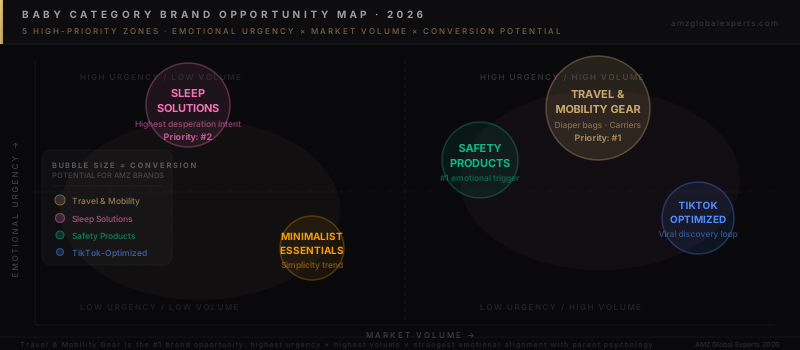
Section 6: The Five Brand Opportunities for 2026
Opportunity Zone Rankings
The five brand opportunity zones identified by combining search volume growth, emotional urgency, CVR potential, and competitive gap analysis:
| Priority | Opportunity Zone | Why It Matters in 2026 | AMZ Strategy |
|---|---|---|---|
| #1 | Travel & Mobility Gear | Highest search volume + emotional urgency. Diaper bag with changing station, carrier, travel organizer. Direct TikTok–Amazon purchase loop. | Listing psychology + TikTok UGC + scenario-specific A+ Content |
| #2 | Sleep Solutions | Sleep deprivation = highest-urgency search intent. CVR is among the highest on Amazon. Minimal deliberation at point of purchase. | Reddit language mining + SEO + emotional urgency copy |
| #3 | Safety-Certified Products | #1 emotional trigger. Safety certifications now filter before price. Non-toxic, BPA-free, ASTM = conversion threshold, not differentiator. | Messaging architecture + AI entity building for safety claims |
| #4 | TikTok-Optimized Products | Viral discovery loop. Social content drives Amazon purchase within 72 hours. Creator economy amplifies without paid media costs. | Influencer systems + UGC repurposing + Amazon Attribution tagging |
| #5 | Minimalist Essentials | Second-time parent and sustainability trend. Higher LTV, more brand-loyal, Shopify-convertible. “The only X you need” positioning wins. | Shopify storytelling + bundle architecture + DTC retention sequences |
Section 7: Final Insight — The Baby Category Rewards Psychological Precision
The baby category will continue to attract new entrants in 2026 because the barriers to listing are low. But the brands that build durable market positions — the ones that earn community trust, retain buyers across Shopify, and earn citation in AI search answers — are the ones that invest in understanding what a new parent is actually thinking when they search.
They are not thinking about specifications. They are not comparison-shopping on price. They are resolving a specific fear, under time pressure, with incomplete information, and a level of stakes they have never experienced before in a consumer decision.
The brand that meets that moment with precisely the right language — the words that a satisfied parent used to describe their relief, mined from their own reviews and community discussions — does not need the lowest price or the highest review count. It needs psychological precision.
The 2026 Competitive Advantage: In a category where every listing looks similar and every PPC cost is rising, the brand that speaks the exact language of parental relief — extracted from real community research and review n‑gram analysis — converts at 18–32% above category benchmarks. That advantage compounds. Better conversion earns more reviews. More reviews generate more community trust. More community trust drives more organic discovery. The psychological precision loop is the only durable moat in the baby category.
Frequently Asked Questions
The baby category remains resilient through economic cycles because the purchase driver is not discretionary preference — it is biological inevitability. Babies are born regardless of market conditions. Parents prioritize safety, convenience, and child welfare above discretionary spending, creating sustained demand even in downturns. The emotional urgency of the category also means parents are less price-sensitive than comparable categories, particularly for products positioned around safety and convenience.
The top rising search themes are: travel and mobility gear (lightweight, organized, stress-free outings), sleep solutions (driven by desperation urgency), non-toxic safety products (the #1 emotional trigger and threshold filter), minimalist essentials (fewer, better items trend), and TikTok-discovered products. Keywords with emotional modifiers — best, safe, easy, stress-free — consistently outperform purely functional keyword phrases in conversion rates.
Amazon is where parents buy when they are overwhelmed and need convenience — fast delivery, easy returns, validated social proof, and low friction. Shopify is where parents buy when they trust a brand enough to want a deeper relationship — bundles, subscriptions, brand story, and post-purchase education. The winning strategy is acquisition on Amazon and retention on Shopify, creating 2.8–3.4× higher LTV than single-channel operators.
The highest-converting framework leads with emotional relief rather than product features. Parents buy relief from fear, overwhelm, and uncertainty. The primary message should address confidence and preparation. Proof points should include safety certifications, real parent reviews with scenario specificity, before/after scenario framing, and community validation from Reddit and TikTok. Stress-relief language consistently outperforms feature-specification language in copy testing across both Amazon and Shopify.
Travel and mobility gear represents the #1 brand opportunity in 2026, combining the highest search volume, strongest emotional urgency, and greatest alignment with the parent psychology of stress reduction. The category benefits from TikTok amplification, multi-function product preference, and the specific anxiety of traveling with an infant for the first time. Safety-focused products and sleep solutions are the second and third highest-potential zones.