Brands publishing at least 10 short-form videos per month see 3× the organic reach and 2× the paid ROAS of brands posting fewer than four, TikTok and Instagram Reels together now drive 67% of all shoppable video impressions in ecommerce, and native checkout integrations on TikTok Shop and Instagram Checkout deliver 30 to 50% higher completion rates than redirect-to-site flows. For Amazon sellers, that data points to an uncomfortable truth: the brands scaling fastest in 2026 are not the ones with the best-optimized listing — they are the ones treating Amazon as one node in a coordinated social-to-marketplace system.
This report explains how full-service Amazon marketing agencies are using AI to move buyer signal from Amazon into social content, and from social back into Amazon rank and conversion — and what that flywheel looks like with real numbers behind it.
Amazon Is No Longer the Whole Funnel
The social commerce market reached $2.11 trillion globally in 2026, growing at a 29.12% compound annual rate toward a projected $7.55 trillion by 2031. TikTok in particular has become the fastest-growing organic channel available to consumer brands: median brand follower counts on the platform rose more than 200% year-over-year in 2025, even as organic reach continued drying up across most post types on Instagram. That divergence matters for sequencing — a brand allocating content effort evenly across platforms in 2026 is under-investing in the channel where organic growth is actually available.
None of this replaces Amazon. It feeds it. McKinsey's retail research found that 73% of shoppers engage across multiple channels during a single buying journey, interacting with an average of six touchpoints before purchase — and a viral TikTok clip or Reel is increasingly one of those early touchpoints, driving search-intent traffic directly into Amazon rather than converting entirely on-platform.
How AI Automation Moves Signal From Amazon to Social and Back
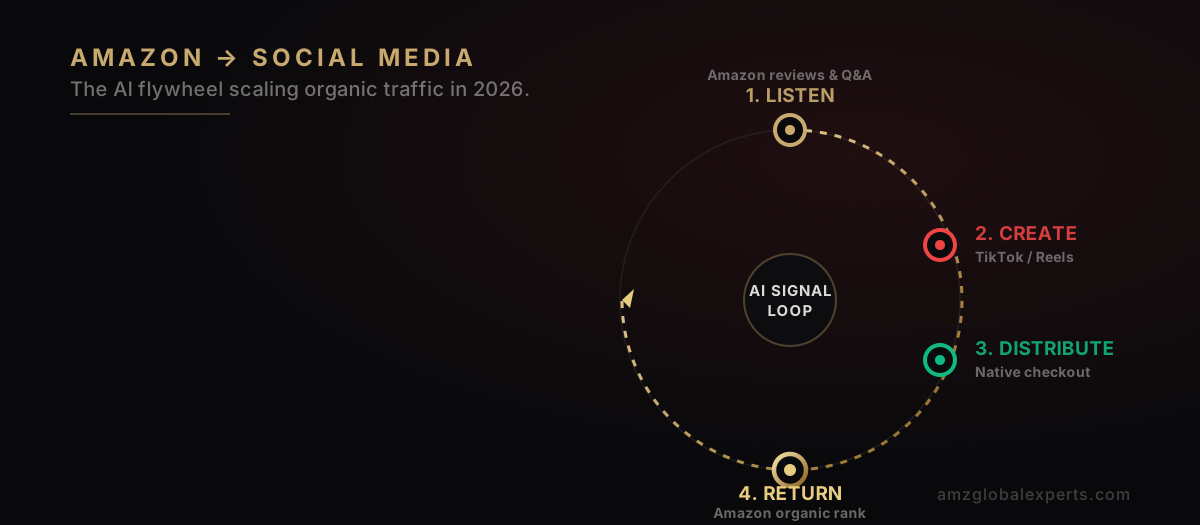
McKinsey's State of AI research found that 78% of companies now use AI in at least one function to enable omnichannel experiences, and AI usage among B2C marketers' omnichannel strategy sits at 95.4% — a near-universal baseline. Applied to the Amazon-to-social flywheel specifically, AI automation does three things a manual process cannot do at the same speed: it extracts high-frequency objection and desire language directly from Amazon reviews and Q&A sections, it identifies which of those phrases are already trending in short-form video hooks within the category, and it routes the overlap into content briefs before a human ever opens a spreadsheet.
Key Finding: Brands publishing 10+ short-form videos per month see 3× the organic reach and 2× the paid ROAS of brands posting fewer than four — and with 67% of all shoppable video impressions in ecommerce now coming from TikTok and Instagram Reels combined, a full-service Amazon agency that stops at the marketplace edge is optimizing a shrinking share of where buyer attention actually forms.
What Real Amazon Sellers Are Saying
r/ecommerce brand owner: "We started posting UGC-style videos using language straight from our one-star and five-star Amazon reviews — what people loved and what they were scared of before buying. Those videos consistently outperform our polished brand content." — This reflects a broader pattern: authentic, review-sourced language outperforms produced brand messaging in short-form video specifically, because it mirrors how real buyers already talk.
r/FulfillmentByAmazon seller: "Our Amazon agency doesn't touch TikTok at all, and our TikTok agency has never looked at our Amazon reviews. We're basically running two disconnected businesses that happen to sell the same product." — A recurring theme across threads: sellers increasingly recognize the cost of disconnected vendor relationships, even when each vendor individually performs well.
The Social-to-Amazon Flywheel
| Stage | Signal Source | AI Action | Destination |
|---|---|---|---|
| 1. Listen | Amazon reviews, Q&A, search terms | Extract high-frequency language | Content brief database |
| 2. Create | Trending audio/format data | Match language to format | Short-form video (TikTok/Reels) |
| 3. Distribute | Organic + creator/affiliate network | Route by performance signal | TikTok Shop, IG Checkout, off-Amazon traffic |
| 4. Return | Off-platform demand | Attribute + reinforce | Amazon organic rank + conversion |
Native checkout on TikTok Shop and Instagram Checkout delivers 30 to 50% higher completion rates than redirect-to-site flows, which means the flywheel above does not require every social viewer to leave the platform and search Amazon manually — a meaningful share converts natively, while the remainder arrives on Amazon as branded search traffic, which A10 ranking logic rewards more heavily than generic keyword traffic.
Strategic Recommendations
Short-Term (0–90 Days)
Pull your top 20 recurring phrases from Amazon reviews and Q&A and check whether any of them exist in your current social content calendar. Most brands find the overlap is close to zero — which is the fastest fix available.
Mid-Term (90–180 Days)
Increase short-form video output toward the 10-per-month threshold tied to 3× organic reach, prioritizing TikTok given the 200%+ year-over-year follower growth brands are seeing there relative to slowing organic reach on Instagram.
Long-Term (6–18 Months)
Build a single content and attribution system where Amazon, TikTok Shop, and Instagram Checkout report into one dashboard, consistent with the coordinated-channel approach detailed in our UGC Creator Economy report and our Facebook, Instagram, and TikTok social commerce framework.
Attribution: Proving the Flywheel Is Actually Working
The hardest part of running a social-to-Amazon flywheel is not building it — it is proving it works to a finance team that wants a clean, single-channel ROAS number. Social-driven Amazon sales rarely show up as a clean last-click conversion because the buyer sees a TikTok video, searches the brand name on Amazon two days later, and converts on what looks like organic or branded-search traffic. Without deliberate tracking, that sale gets attributed to "organic," and the social investment that created the demand looks like it produced nothing.
Key Finding: Branded search volume is the most reliable proxy metric for social-driven Amazon demand when direct platform attribution is unavailable. A sustained lift in branded search term impressions and clicks inside Amazon Brand Analytics, timed against a specific content push, is the strongest available signal that a social flywheel is functioning — even when no individual sale can be traced click-by-click.
Three Attribution Signals Worth Tracking Together
First, branded search lift in Amazon Brand Analytics in the 3–7 days following a content push. Second, Amazon Attribution tags on any social links that do drive direct click-through, even though this only captures a fraction of the true influence. Third, direct correlation between TikTok Shop or Instagram Checkout order volume and organic Amazon sales trend — when both move together across multiple content cycles, that consistency is stronger evidence than any single dashboard number. Brands that only look at platform-native analytics in isolation consistently undercount the value of their social investment, which is part of why so many sellers report running "two disconnected businesses" in the Reddit threads above — the tooling itself reinforces the disconnection unless someone deliberately builds the bridge.
Building the Content-to-Commerce Feedback Loop
The most reliable version of this flywheel runs on a fixed weekly cadence rather than ad hoc posting. Each week, the highest-frequency new phrases from that week's Amazon reviews and Q&A are logged; the following week's short-form content draft pulls from that log rather than from a generic content calendar; and the week after that, branded search and native-checkout performance for the resulting content is fed back into the next review-mining pass. This closes the loop end to end — listening, creating, distributing, and measuring — on roughly a three-week rolling cycle, which is fast enough to stay responsive to what buyers are actually saying about the product right now, rather than working from language that was accurate six months ago but has since drifted as the product, competitors, or the review base itself has changed. Brands that automate this cadence with AI — rather than relying on someone remembering to check reviews before the next content shoot — are the ones who sustain the flywheel long enough to see it compound instead of treating it as a one-time campaign.
How AMZ Global Experts Helps
AMZ Global Experts runs the full Amazon-to-social flywheel as one system: buyer-language signal extracted from Amazon reviews and search terms feeds directly into short-form content briefs, creator and affiliate distribution is managed alongside Amazon PPC rather than as a separate retainer, and off-platform performance is attributed back into Amazon ranking strategy instead of sitting in an unconnected social report. See our Amazon Full-Service Marketing Agency: The AI Omnichannel Report for the full system architecture behind this model.
Conclusion
The organic reach, conversion, and checkout-completion data all point the same direction: a full-service Amazon agency that stops at the marketplace edge is leaving the fastest-growing channel in ecommerce — social commerce, now worth $2.11 trillion globally — entirely on the table. If your Amazon and social strategies are being run as two disconnected businesses that happen to sell the same product, book a strategy audit and we'll show you what the flywheel looks like for your brand.
Frequently Asked Questions
Short-form video that mirrors language from Amazon reviews and Q&A tends to outperform produced brand content because it reflects how real buyers already talk, and off-platform social demand often arrives on Amazon as branded search traffic, which A10 ranking logic rewards more heavily than generic keyword traffic. McKinsey found 73% of shoppers engage across multiple channels before purchase, with an average of six touchpoints in the journey.
Brands publishing at least 10 short-form videos per month see 3× the organic reach and 2× the paid ROAS of brands posting fewer than four, according to 2026 social commerce benchmarking data, making cadence one of the highest-leverage and lowest-cost levers available to Amazon brands expanding into social.
TikTok is currently the stronger organic growth channel — median brand follower counts rose more than 200% year-over-year in 2025, while organic reach has been drying up across most post types on Instagram. TikTok and Instagram Reels combined still drive 67% of all shoppable video impressions in ecommerce, so both remain relevant, but TikTok currently offers more organic upside.
Yes — platforms with integrated native checkout, including TikTok Shop and Instagram Checkout, see 30 to 50% higher completion rates compared to redirect-to-site flows, because they remove the friction of leaving the platform and re-entering payment information elsewhere.
Sellers commonly report running disconnected Amazon and social vendors that never share data, which blocks the compounding effect of routing buyer-language signal from Amazon reviews into social content and attributing off-platform demand back into Amazon rank. A coordinated agency treats both as one flywheel rather than two separate retainers.