
Amazon is not a traffic problem. It is a conversion problem wearing a traffic problem's clothes.
Spend any time in Amazon seller communities and you will find brands obsessing over PPC budgets, keyword ranking, and impression volume — while their listings convert at 7% when competitors in the same category are converting at 18%. The math on this situation is unforgiving: at the same traffic level, the brand converting at 18% generates 2.6× more revenue, reviews, and organic rank signal than the brand converting at 7%. Every month that gap persists, the compounding deficit grows wider.
Amazon success is a multiplication equation. Impressions × CTR × CVR × Average Order Value = Revenue. Every factor in that equation can be engineered — but CTR and CVR are the two that most sellers under-invest in relative to their actual revenue impact. This guide is the systematic playbook for both.
The Amazon Revenue Formula Every Operator Must Internalize
Before optimizing anything, understand the equation that governs every dollar of Amazon revenue. Impressions are how often your listing appears in search results and browsing placements. CTR determines what percentage of those impressions become visits. CVR determines what percentage of visits become purchases.
The Amazon Revenue Equation
Revenue = Impressions × CTR × CVR × AOV
Every variable compounds the others. A 2× improvement in CTR and a 1.5× improvement in CVR produces 3× the revenue from the same impression volume — without changing a single bid.
This formula reveals something that changes how you think about listing optimization: CTR and CVR are not independent metrics. They multiply together. A 1% CTR and a 10% CVR produces the same revenue as a 2% CTR and a 5% CVR — but the second scenario gets there by sending twice as many people to a listing that barely converts. The most efficient path is engineering both simultaneously, starting with CVR (because it works on your existing traffic immediately) and then amplifying with CTR improvement once the listing is ready to convert the additional traffic profitably.
What Is CTR on Amazon?
Click-Through Rate (CTR) on Amazon measures the percentage of shoppers who see your listing in search results or placement positions and click on it. Amazon calculates CTR using data from Sponsored Products campaigns and, partially, from Brand Analytics organic search data.
CTR Formula
CTR = (Clicks ÷ Impressions) × 100
Example: 850 clicks from 72,000 impressions = 1.18% CTR. The industry average across Amazon search placements is 0.5–1.5%. Top-performing listings in strong positions achieve 3–5%+.
CTR is the first battle in the Amazon funnel — fought entirely in the search results page before a shopper ever sees your detail page. The buyer makes a split-second decision based on four signals: your main image, your title, your price, and your star rating and review count. You have approximately 1.2 seconds to earn the click before their eyes move to the next listing. Everything on your listing that appears in search results is a CTR signal. Nothing else is.
What makes Amazon CTR uniquely challenging compared to general ecommerce is that you are competing in a visual grid where every competitor's main image is visible simultaneously. The decision is comparative, not absolute. Your image is not evaluated on its own merits — it is evaluated against 5–15 other images in the same viewport. This is why CTR optimization on Amazon is fundamentally about visual differentiation, not just product presentation.
What Is CVR on Amazon?
Conversion Rate (CVR) on Amazon, measured as Unit Session Percentage in Seller Central, tracks the percentage of detail page sessions that result in a purchase. It is the core commercial metric of your listing's performance — and it is the metric that Amazon's A10 algorithm weights most heavily when determining organic rank.
CVR Formula (Unit Session Percentage)
CVR = (Orders ÷ Sessions) × 100
Example: 340 orders from 2,800 sessions = 12.1% CVR. Find this metric in Seller Central under Reports → Business Reports → Detail Page Sales and Traffic by ASIN.
Amazon's average CVR of 10–15% is dramatically higher than general ecommerce (1–3%) for a structural reason: Amazon shoppers are bottom-of-funnel buyers. When someone types "stainless steel water bottle 32oz insulated" into Amazon, they have already decided to buy a water bottle. They are comparing options, not discovering a need. This high purchase intent means a listing's job is not to create desire — it is to resolve the final objections that stand between a ready buyer and the Add to Cart button.
Understanding this changes how you write bullets, structure A+ Content, and present images. You are not selling to someone who needs to be convinced they want this product category. You are answering the four or five specific questions that are preventing an already-interested buyer from committing.
The CTR–CVR Relationship: How They Multiply Into Revenue
The most important insight for Amazon sellers about CTR and CVR is that they do not add — they multiply. Consider these three listing scenarios, all receiving 100,000 monthly impressions at an AOV of $38:
| Scenario | CTR | Clicks | CVR | Orders | Revenue |
|---|---|---|---|---|---|
| Current listing | 0.8% | 800 | 9% | 72 | $2,736 |
| CTR improved only | 1.6% | 1,600 | 9% | 144 | $5,472 |
| CVR improved only | 0.8% | 800 | 18% | 144 | $5,472 |
| Both improved | 1.6% | 1,600 | 18% | 288 | $10,944 |
The final scenario — improving both CTR and CVR by 2× — does not double revenue. It quadruples it, from $2,736 to $10,944 per month, from the same 100,000 impressions. This is the multiplication effect in practice. It is also why optimising only one lever while ignoring the other is an inherently limited strategy.
The organic rank dividend: The revenue math above only accounts for direct conversion improvement. It does not capture the A10 algorithm effect — where higher CVR improves organic rank, which increases impression volume, which feeds more clicks into the equation. The compounding loop means that a listing improved to the scenario above will generate more than 4× the revenue within 60–90 days as organic rank responds to the improved purchase velocity signal.
The Amazon Listing Optimization Framework: 6 Layers
Amazon listing optimization is not a single action — it is a six-layer system where each layer contributes to either CTR, CVR, or both. Understanding which layer drives which metric prevents the common mistake of investing in CVR improvements (A+ Content, bullets) when the actual constraint is CTR (main image, price positioning).
| Layer | Primary Impact | Secondary Impact | Testing Method |
|---|---|---|---|
| Main Image | CTR (dominant) | CVR (first impression) | Manage Your Experiments, PickFu |
| Title | CTR (search relevance) | CVR (clarity on page) | Manage Your Experiments |
| Price & Badges | CTR (value signal) | CVR (anchoring) | Pricing tests, coupon strategy |
| Image Stack | — | CVR (objection removal) | A+ Content testing |
| Bullet Copy | — | CVR (decisive) | Copy variants via Experiments |
| A+ Content & Reviews | CTR (star rating/count) | CVR (trust architecture) | A/B Content, Vine, review strategy |
How to Improve Amazon CTR: Deep Tactical Breakdown
Main Image Strategy
The main image is the single most impactful CTR variable on Amazon. In a search results grid, it is the dominant visual signal — accounting for an estimated 60–70% of the CTR variation between competing listings at similar price points. The goal of the main image is not to show the product clearly. It is to make a shopper's eye land on your listing and stay there long enough for intent to form.
Amazon's technical requirements constrain main images to a pure white background (RGB 255,255,255) with the product occupying a minimum 85% of the image area. Within these constraints, the highest-performing main images in most categories share four characteristics:
- Frame fill: The product occupies 90–95% of the frame rather than floating in white space. Larger products appear more substantial and command more visual attention.
- Angle and dimensionality: A three-quarter angle that shows depth and volume outperforms a flat front-facing shot in most categories — particularly for products where size, shape, or construction quality is a purchase driver.
- Contextual props (where allowed): In some categories (kitchen, personal care, supplements), a single contextual prop element — a lemon next to the supplement, a glass of water next to the shaker bottle — is permitted and improves CTR by signaling use context instantly.
- Visual texture and color contrast: Products with texture, glossy finishes, or high-contrast color combinations stand out more in a grid of competing images than flat, matte, monochrome products presented on identical white backgrounds.
The fastest way to validate main image changes before committing to a live A/B test is PickFu — a research platform that puts your image options in front of 50–100 real Amazon shoppers and asks which product they would click on and why. PickFu results typically mirror live A/B test outcomes within 10–15 percentage points and cost a fraction of the time and traffic required for a statistically valid live test.
Title Engineering for CTR
Your listing title serves two distinct audiences simultaneously: Amazon's search algorithm (which reads the full title for keyword relevance) and human shoppers (who read the first 60–80 characters visible in mobile search results before truncation). Title optimization requires satisfying both — and the common mistake is writing for the algorithm at the expense of the human.
The title structure that consistently drives the highest CTR places the elements buyers care most about first: product category, primary benefit or key specification, and brand name. Everything after position 3 is secondary search term content. A title beginning "32oz Insulated Stainless Steel Water Bottle — Leakproof, BPA-Free | BrandName" communicates more to a mobile shopper in the visible truncation than one beginning "BrandName Water Bottle Stainless Steel BPA Free Leakproof Insulated 32oz Wide Mouth."
Pricing Psychology and Badge Influence
Price is a CTR signal before it is a CVR signal. In search results, your price appears alongside your main image and star rating — and shoppers use it as a quick quality and value filter. Prices ending in $.99 or $.97 historically outperform round-dollar prices in direct response environments, though the effect is smaller on Amazon than in traditional retail because Amazon shoppers are price-comparison-native and more sensitive to the relative positioning versus competitors than the absolute ending digit.
Coupons (the "Clip Coupon" badge visible in search results) are one of the most underused CTR drivers available to Amazon sellers. A 10% coupon badge adds a visible green promotional signal to your search result tile — improving CTR by 15–25% in most categories, often by more than the discount costs in margin. Best Seller and Amazon's Choice badges have similar CTR impact by functioning as credibility signals at the moment of the click decision, before a buyer has time to read reviews.
Review Count and Star Rating
Reviews are both a CTR signal (visible in search results) and a CVR signal (read in detail on the listing page). For CTR purposes, the two variables that matter are review count and star rating. Research consistently shows that CTR improves substantially as a listing moves from 0–10 reviews to 50+ reviews — the presence of a meaningful sample removes the "this must be a new or unknown product" hesitation that suppresses clicks on unfamiliar brands.
Star rating matters most at the extremes: listings below 4.0 stars experience significant CTR suppression, and the transition from 4.3 to 4.5+ is commercially meaningful. A 4.4-star listing with 200 reviews will generally outperform a 4.7-star listing with 12 reviews in CTR — volume signals reliability more than a high average from a small sample.
How to Improve Amazon CVR: Deep Tactical Breakdown
Bullet Copy: Objection Architecture, Not Feature Lists
Amazon bullet points are not a feature inventory. They are a conversion tool — and the highest-converting bullet structures address buyer objections and decision criteria in order of commercial importance, not product specification order.
The methodology: mine your category's 2-star and 3-star reviews (your product and competitors) for the most frequently cited concerns. These are the objections that prevented satisfied buyers from leaving 5-star reviews — and they are almost certainly suppressing conversion in buyers who leave without purchasing at all. Build each bullet around one specific objection: not "Stainless steel construction" (a feature) but "Double-wall stainless steel that keeps drinks cold for 24 hours — no condensation, no rust, and dishwasher-safe for easy cleanup" (a feature that directly answers three common objections in sequence).
The Reddit language method for bullets: Go to the subreddit most relevant to your product category. Search for posts asking for product recommendations. Read the comment threads — not the recommendations, but the criteria people use to evaluate options. The exact language buyers use when they explain why they chose one product over another ("I needed something that wouldn't leak in my gym bag," "I wanted something my kid could open themselves") is the language that should appear in your bullets. Listings written in buyer vocabulary convert at measurably higher rates than listings written in product specification language.
Image Stack Architecture
Secondary images (positions 2–7 in the Amazon image carousel) are CVR tools. Shoppers who scroll through your image stack have already converted from a "passive scroller" into an "active evaluator" — they are investigating your product before committing. The image sequence should be engineered to move an active evaluator toward purchase by answering questions in the order they typically arise.
The highest-converting image stack architectures follow a consistent pattern:
- Image 2 — Lifestyle in use: Show the product being used in a realistic context. This answers the implicit question "can I see myself using this?" — the first conversion barrier for most consumer products.
- Image 3 — Key features and dimensions: An infographic image that highlights 3–4 key specifications with callouts and dimensions. Resolves the "is this the right size/spec for my need?" question.
- Image 4 — Comparison or differentiation: A side-by-side comparison (your product vs. the problem it solves, or vs. a lower-quality alternative) or a feature highlight showing what makes this product superior. Directly addresses the "why this one over the others?" objection.
- Image 5 — Close-up detail: Material quality, construction, texture, or the element that justifies the price. Answers the "is it actually well made?" question that suppresses conversions on products that rely on quality perception.
- Image 6 — Social proof or certification: A composite of review quotes, certification badges, or press mentions. Provides external validation at the moment of decision.
- Image 7 — Video thumbnail (if available): Product demonstrations outperform static images for high-consideration or instructional products. Even 30 seconds of video demonstrating the product in use can lift CVR by 5–15%.
A+ Content: The Highest-Leverage CVR Investment
A+ Content (formerly Enhanced Brand Content) is available to Brand Registered sellers and allows rich HTML-style content below the fold: additional image modules, comparison charts, brand story sections, and feature highlight layouts that are not possible in standard listing elements.
Amazon's own published data shows that Brand Registered sellers who add A+ Content experience an average CVR improvement of 3–10%, with some categories and product types seeing lifts as high as 20%. The mechanism is straightforward: A+ Content reduces purchase hesitation by providing additional context, social proof, and product education that answers questions buyers would otherwise leave the listing to find — and often not return from.
The highest-impact A+ Content modules for CVR are the comparison chart (which keeps comparison shopping on your listing rather than in a new search tab) and the use-case image grid (which visually expands the buyer's perception of the product's applicability to their specific situation). Both reduce the uncertainty that is the most common reason a ready buyer does not convert.
Pricing Architecture and Value Perception
On the listing page, price is evaluated differently than in search results. In search results, price is a quick filter. On the listing, price is weighed against perceived value. Strategies that increase perceived value relative to price — without changing the price itself — are pure CVR tools.
- Was-price / list-price display: Showing a crossed-out original price anchors value perception. Even a 10% discount looks more substantial when the original price is visible. Amazon's algorithm restricts artificial pricing here — the reference price must reflect a genuine recent pricing history.
- Subscribe & Save: The Subscribe & Save option reduces the effective price for committed buyers while increasing LTV and repeat purchase rate. For consumable and replenishable products, S&S enrollment typically improves CVR among high-intent shoppers and increases LTV by 15–25%.
- Bundle and multi-pack positioning: A 3-pack priced at a 15% per-unit discount presents a higher headline price but a better per-unit value — which improves both AOV and CVR among value-motivated buyers who respond to the "better deal" signal.
Trust Signal Architecture on the Listing
Every friction point that prevents a ready buyer from clicking Add to Cart is a trust deficit. The listing page's job is to systematically eliminate those deficits. The trust signals that matter most for Amazon CVR:
- Prime badge: Fast, free delivery is the single most powerful trust signal on Amazon. FBA enrollment (or SFP for sellers who qualify) is a CVR prerequisite for most categories, not an optimization option.
- Review recency: A listing with 1,000 reviews but the most recent from 14 months ago raises product lifecycle concerns. Recent reviews (within 30–60 days) signal an actively sold product. The Vine program for new launches accelerates this signal.
- Answered Questions: The "Questions & Answers" section below the listing is read by a segment of high-intent buyers who have a specific concern not addressed by the bullets or images. Each unanswered question in this section represents a conversion that potentially failed. Actively answering questions within 24–48 hours, and incorporating recurring question themes into bullet copy, compounds CVR improvement over time.
- Brand Store link: Buyers evaluating an unfamiliar brand will click through to the Brand Store to assess legitimacy. A well-designed Brand Store (with coherent product line, brand story, and navigation) functions as a trust amplifier for the listing that linked to it.
How CTR and CVR Impact Amazon A10 Organic Ranking
Amazon's A10 algorithm is, at its core, a purchase prediction engine. Its objective is to rank listings in search results that are most likely to result in a purchase — because every purchase is revenue for Amazon. CTR and CVR feed directly into this prediction model through the purchase velocity signal: the rate at which a listing converts impressions into transactions over a given time window.
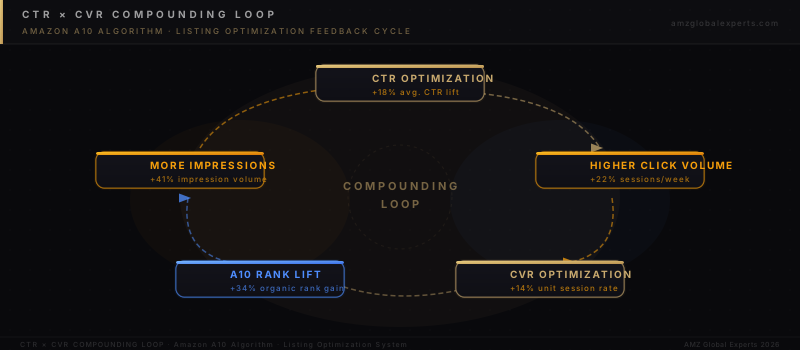
The ranking implication is significant. A listing with improving CTR and CVR will receive more organic impressions over time — not because Amazon is rewarding you for good listing design, but because its algorithm has calculated that your listing is more likely to produce a purchase per impression than lower-converting competitors. This creates the compounding loop: better listing → higher CVR → higher rank → more organic impressions → more purchases → higher rank.
The inverse is equally true and more urgent. A listing with deteriorating CVR (due to accumulating negative reviews, a price increase without corresponding value signal, or a competitor listing a superior alternative) will lose organic rank as Amazon's algorithm recalibrates its purchase prediction. Monitoring Unit Session Percentage weekly — not monthly — is the early warning system for this deterioration before it becomes a ranking crisis.
Advanced Optimization Strategies
Manage Your Experiments: The Systematic Testing System
Amazon's Manage Your Experiments tool allows Brand Registered sellers to run native A/B tests on main image, secondary images, title, bullet points, and A+ Content. It is the most direct method of validating listing optimization hypotheses with real buyer data — and it is underused by most Amazon sellers because running tests requires patience (4–10 weeks per test) that most operators do not build into their optimization calendar.
The systematic approach: prioritize tests by expected impact (main image first, then title, then A+ Content, then bullets) and maintain a running log of test outcomes, including the hypothesis behind each test, the observed result, and the statistical confidence level. This log becomes an institutional asset — a library of validated optimization learnings that prevents teams from re-testing things that have already been ruled out and builds a compounding evidence base for future listing strategy.
Brand Analytics: Competitive Intelligence for CTR
Amazon Brand Analytics (available to Brand Registered sellers) provides click-through and conversion data at the search term level — including which of the top-3 clicked ASINs for any given keyword your listing is or is not appearing among, and what the relative CTR of those positions is. This data is the foundation of a systematic CTR gap analysis: identifying high-volume keywords where your listing receives impressions but underperforms the category's top-3 CTR benchmarks, and diagnosing why (usually main image or price positioning versus the top performers on that keyword).
Behavioral Psychology Triggers for CVR
Certain psychological principles operate consistently in purchase decisions regardless of product category. Integrating them into listing design produces measurable CVR improvements:
- Social proof specificity: "4,200 five-star reviews" outperforms "thousands of happy customers" because specificity signals legitimacy. Vague social proof is ignored; specific social proof is processed and weighted.
- Scarcity signals: Amazon automatically displays "Only 8 left in stock" when inventory drops below a threshold — a genuine urgency signal that measurably increases conversion probability. Maintaining inventory above this threshold for your highest-margin SKUs avoids unintentional CVR suppression from "out of stock" risk perception.
- Loss framing: Bullet copy written as loss prevention ("Never deal with a leaking lid again") converts better than equivalent gain framing ("Enjoy a leakproof experience") for products solving a known frustration — because buyers who have already experienced the problem weight loss avoidance more heavily than equivalent gain.
- Authority and certification: Third-party certifications (FDA, NSF, USDA Organic, dermatologist-tested) displayed prominently in the image stack and A+ Content activate authority bias — buyers defer to expert endorsement when evaluating products they cannot physically assess.
Common Amazon Seller Mistakes That Suppress CTR and CVR
- Testing multiple variables simultaneously: Changing the main image and the title at the same time makes it impossible to know which change drove any observed result. One variable per test, always.
- Optimizing for desktop and ignoring mobile: Over 60% of Amazon traffic is mobile. Images optimized for a 1400px desktop view often appear cluttered, small, or illegible on a 390px mobile screen. Test your listing on three different mobile devices before finalizing any image changes.
- Writing bullets for search algorithms, not buyers: Keyword-dense bullets ("Perfect water bottle stainless steel insulated BPA free — best water bottle for hiking camping gym work outdoor sports") rank for keyword coverage but convert poorly because they do not answer a single real buyer question.
- Ignoring A+ Content on main revenue ASINs: Brand Registered sellers who have not built A+ Content on their top-5 revenue ASINs are leaving the most direct, lowest-cost CVR improvement available to them entirely on the table.
- Letting review age without a velocity strategy: A listing that has not received a new review in 60+ days looks stagnant to high-intent buyers who check review recency. The Vine program, post-purchase follow-up inserts, and Product Sampling are the velocity tools available within Amazon's Terms of Service.
- Scaling PPC on a weak listing: Increasing ad spend on a listing converting at 7% when the category average is 14% is not a traffic strategy — it is an expensive way to discover that traffic is not the problem.
The Amazon CTR & CVR Optimization Checklist
CTR Checklist
- Main image fills 90–95% of the frame with no unnecessary white space
- Main image tested via PickFu against at least 2 alternatives before going live
- Main image A/B tested via Manage Your Experiments with statistical significance ≥ 95%
- Title front-loads the product category and primary benefit within the first 60 characters
- Title includes primary keyword naturally in the first 30 characters
- Price positioned within 15% of the category median for the target keyword
- Coupon badge active on top-revenue ASINs (if margin allows)
- Review count above 50 on primary keyword landing ASIN
- Star rating above 4.3 — negative review response strategy in place if below this threshold
- Best Seller or Amazon's Choice badge actively pursued through rank and velocity strategy
- Sponsored Products position 1–3 for primary keywords tested at higher bids to capture CTR data
CVR Checklist
- Unit Session Percentage tracked weekly in Seller Central Business Reports
- Top 5 buyer objections identified from 2-star and 3-star review mining
- Each bullet addresses one specific objection using buyer vocabulary (not product spec language)
- Image stack follows the 6-position sequence: main, lifestyle, dimensions/features, comparison, detail, social proof/video
- A+ Content live on all top-5 revenue ASINs (at minimum)
- A+ Content includes a comparison module that keeps shoppers on the listing
- Subscribe & Save enabled for all replenishable products
- Questions & Answers section monitored and responded to within 48 hours
- Brand Store designed and linked from all main ASINs
- Prime badge active (FBA or SFP enrolled)
- Video content in image slot 7 for products requiring demonstration or assembly
- Price anchoring active (was-price showing where pricing history qualifies)
- Vine or sampling program active on new launch ASINs to build review velocity
The Strategic Takeaway: Fix the Listing Before Scaling the Traffic
Every dollar spent on PPC is a multiplier on your listing's CVR. If the listing converts at 8%, you are paying full price for clicks that produce 8% of their potential revenue. If the listing converts at 18%, you are paying the same price for clicks that produce 2.25× more revenue. PPC spend does not change. Listing performance determines what you get for it.
The systematic path for any Amazon brand looking to increase revenue without proportionally increasing ad spend: audit your Unit Session Percentage versus your category benchmark. If you are below 12%, your listing has a CVR problem that is actively suppressing the ROI of every traffic source you have. Fix it before adding impressions. Run the main image through PickFu and Manage Your Experiments. Rebuild the bullet structure around buyer objections from review mining. Build A+ Content on every top-revenue ASIN. Get Vine reviews active on every launch ASIN. Then — once the listing converts at category-average or above — scale PPC into a system that is actually ready to make the most of every click it generates.
The brands that compound on Amazon are not the ones with the biggest ad budgets. They are the ones whose listings convert so efficiently that every impression they earn — organic or paid — produces a disproportionate return. That efficiency is built in the listing. Build there first.
Frequently Asked Questions
What is a good CTR for an Amazon listing?
The average Amazon search CTR is 0.5–1.5% depending on category and keyword competitiveness. Top-performing listings in strong positions achieve 3–5%+. CTR is primarily driven by main image quality, price relative to competitors, and review count and star rating. A CTR below 0.3% on a high-impression keyword signals a main image or price problem that must be resolved before scaling PPC spend.
What is the difference between CTR and CVR on Amazon?
CTR (Click-Through Rate) measures the percentage of shoppers who click your listing after seeing it in search results — it determines how many people arrive at your detail page. CVR (Conversion Rate, also called Unit Session Percentage in Seller Central) measures the percentage of those visitors who complete a purchase. Both multiply together in the revenue equation: Impressions × CTR × CVR × AOV = Revenue.
How does Amazon's A10 algorithm use CTR and CVR?
Amazon's A10 algorithm uses conversion velocity — the rate at which a listing converts impressions into purchases — as a primary organic ranking signal. Listings with higher CVR receive more organic visibility because Amazon's objective is to surface products most likely to be purchased. Higher CTR increases the volume of sessions feeding that conversion signal. Both improve organic rank, which drives more impressions — creating a compounding virtuous loop.
How long should I run a listing A/B test on Amazon?
Amazon's Manage Your Experiments requires a minimum of 4 weeks per test and recommends 8–10 weeks for reliable statistical significance. You need at least 1,000 sessions per variant before drawing conclusions. Ending a test early because it is trending in one direction produces false positives — Amazon's traffic varies significantly by day of week and season.
What is the most impactful change I can make to improve Amazon CVR?
For most listings, A+ Content is the highest-leverage CVR improvement outside of the main image. Amazon's own data shows that Brand Registered sellers who add A+ Content experience an average 3–10% CVR lift. After A+ Content, bullet copy that addresses the top five buyer objections (sourced from review mining) consistently produces 10–20% CVR improvements.
Should I optimise for CTR or CVR first?
Optimise CVR first. If you improve CTR first, you send more traffic to a listing that does not convert well — your PPC spend increases and your ACOS rises with minimal revenue gain. If you improve CVR first, every session your listing already receives — organic and paid — becomes more valuable immediately. Fix the listing, then drive traffic to it.