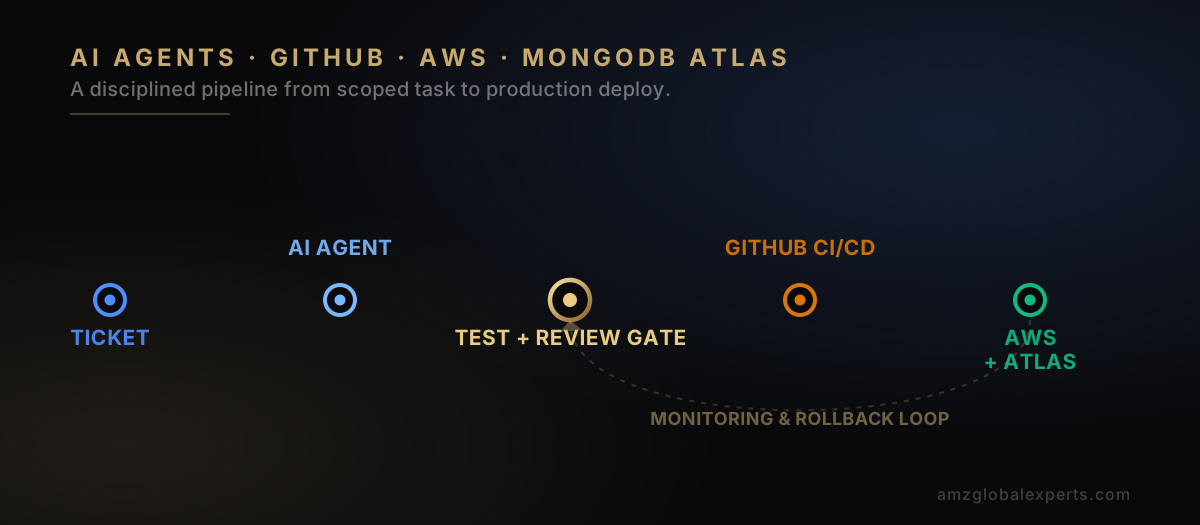
"Can AI agents actually be trusted to write production code?" is now one of the most common questions engineering leaders type into a search bar before a planning meeting. It sits next to a related one — "how do development teams use AI agents without losing code quality control?" — and both deserve a direct answer, not a marketing one. AI coding agents change how software gets built. They don't change what makes software good: tested, reviewed, documented, deployed carefully, and reversible when something breaks. The organizations getting real acceleration from AI agents in 2026 are the ones that kept that second part fixed while changing the first. That's the whole trick.
This article walks through how a modern development stack — AI coding agents, GitHub, AWS, MongoDB Atlas, APIs, CI/CD automation — fits together in practice, where agents genuinely help, where human judgment stays non-negotiable, and what a governance model looks like for a team that wants speed without giving up control.
What "AI-Powered Development" Actually Means
An AI coding agent isn't autocomplete. Autocomplete predicts the next few tokens as a developer types. An agent reads a codebase, plans a multi-step change, writes files, runs commands, executes the test suite, reads the failures, and iterates, inside a boundary someone else defined. That boundary is the entire point. Nothing else matters as much. A well-configured agent operates against a specific skill, tool set, and task scope: implement this function against this interface, refactor this module to match this pattern, write tests for this file, fix this reproducible bug. It doesn't get to decide, on its own authority, that the database schema should change or that a new microservice should exist.
That distinction, bounded execution versus open-ended authority, is the difference between AI-accelerated development and what practitioners increasingly call "vibe coding": accepting AI-generated changes without test coverage, without review, without a deployment gate, just because the output looked plausible and the demo worked. Plausible-looking code and correct code aren't the same thing, and the gap between them is exactly where production incidents come from. Every time.
The stack, not the model, determines the outcome. An AI agent generating code inside a scoped skill boundary, gated by automated tests and human review, moving through the same GitHub CI/CD pipeline and staged AWS rollout as any other change, is a different proposition than the same agent given open commit access to a production branch. The model capability is nearly identical in both cases. The engineering discipline around it is not.
What Developers Are Actually Saying About AI Agents
Spend time in developer communities — r/programming, r/ExperiencedDevs, r/ClaudeAI, r/cursor — and a consistent pattern emerges beneath the noise. It's not uniform enthusiasm and it's not uniform rejection. It's a set of recurring, specific concerns from people who use these tools daily.
The most common theme is confidence without correctness: engineers describing agents that produce clean, well-formatted, plausible-sounding code for an architectural decision the agent was never equipped to make — a caching strategy, a data model, an authentication flow — and that code passes a quick read but fails under a use case the agent never considered. The consensus in these threads is rarely "the tool is bad." It's closer to "the tool is confident in places it has no business being confident, and confidence isn't the same signal as correctness." Never was.
A second recurring thread is the sharp distinction between bounded and open-ended work. Developers reporting genuinely good outcomes tend to describe narrow, well-specified tasks: "write tests for this module," "implement this function to match this existing interface," "convert this callback pattern to async/await across these twelve files." Developers reporting frustration tend to describe open-ended asks: "build me an authentication system," "design the data layer for this app." The pattern holds across nearly every thread on the topic. Scope discipline, not model choice, predicts the outcome. Every single time.
A third theme is the non-negotiable role of test coverage. Experienced engineers in these communities repeatedly make the same point in different words: an AI agent working against a codebase with strong existing test coverage is safe to let loose on a bounded task, because the tests catch what a fast read misses. An agent working against an untested codebase is a liability, because nothing catches a subtle regression before it ships. Test coverage, in this framing, is not a nice-to-have next to AI-agent adoption — it is the precondition for it.
Finally, there is real and growing skepticism toward "vibe coding" as a production practice, distinct from skepticism toward AI coding tools themselves. The sentiment is not anti-AI; it is anti-shortcut. The pattern across these communities is a preference for AI agents used inside disciplined, reviewed workflows over AI agents used as a way to skip review discipline altogether.
The Workflow: How a Task Moves From Ticket to Production
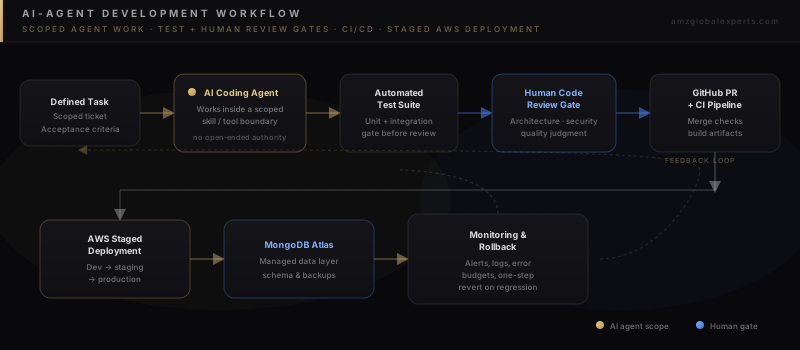
The diagram above reflects the sequence separating disciplined AI-agent adoption from the incident reports developers describe in the threads above. Each stage exists to catch a specific class of failure the previous stage can't catch on its own.
Where AI Agents Fit Well
- Bounded implementation tasks — writing a function against a defined interface, implementing a ticket with clear acceptance criteria.
- Test generation — writing unit and integration tests for existing code, which also happens to build the safety net future agent work depends on.
- Refactoring with a fixed target — converting a pattern consistently across many files where the "correct" output is unambiguous.
- Bug fixes with a clear reproduction — a failing test or a described defect gives the agent a concrete success condition.
- Documentation and boilerplate — API docs, README updates, scaffolding around an established project pattern.
Where Human Judgment Stays Essential
- Architecture and system design — first-time decisions about data models, service boundaries, and technology choices, where there is no existing pattern to match against.
- Security review — authentication, authorization, secrets handling, and data-access logic need a human threat model, not just passing tests.
- Production deployment approval — the decision to promote a change from staging to production is a business and operational judgment call, not a technical one an agent should make alone.
- Ambiguous or evolving requirements — work where the correctness criteria are still being discovered is not yet ready to hand to an agent; it needs a human to define the boundary first.
Governance and Quality Practices
None of the acceleration from AI-agent-assisted development is worth anything if it costs you the practices keeping software maintainable and safe. The governance layer is what makes the speed durable, not just borrowed.
| Practice | Why It Matters More With AI Agents |
|---|---|
| Testing discipline | Test coverage is the safety net that catches an agent's confident-but-wrong output before a human even looks at it. |
| Mandatory code review | A human reviewer evaluates architecture fit, security implications, and judgment calls no automated check can fully cover. |
| Staged CI/CD deployment | Development, staging, and production environments give every change — human or agent-authored — a chance to fail somewhere that isn't live traffic. |
| Documentation standards | Agent-authored changes need the same inline comments, changelogs, and API docs as any other change, or the codebase becomes harder to reason about over time. No exceptions. |
| Security review | Dependency changes, authentication logic, and data-access code get explicit security sign-off, independent of the general code review. |
| Rollback capability | Every deployment — regardless of who or what authored the change — needs a fast, tested path back to the last known-good state. |
This is where twenty-five-plus years of IT experience changes the outcome. AI coding agents are a new capability layered onto an old discipline. The teams getting consistent value from them are, almost without exception, the teams that already had strong testing culture, real code review, and staged deployment before adopting agents, because the agent's output is only as safe as the process it runs through. Applying AI inside an established engineering methodology, one built over decades of shipping production systems, not one improvised around a new tool, is the differentiator that determines whether AI-accelerated development scales safely or creates a slow-motion reliability problem.
Strategic Recommendations for Adopting AI-Agent-Assisted Development
Short-Term: 0–30 Days
- Audit current test coverage on the codebase(s) where AI agents will first be used — close the largest gaps before introducing agent-authored changes.
- Define explicit scope boundaries for a pilot: pick two or three bounded task types (test writing, defined refactors, documented bug fixes) rather than open-ended feature work.
- Confirm the GitHub branch protection rules require passing CI and at least one human approval before merge — for every contributor, human or agent.
Mid-Term: 30–90 Days
- Stand up or confirm a staged AWS deployment pipeline (development → staging → production) so agent-originated changes are promoted, not shipped directly.
- Formalize a security review checkpoint for any change touching authentication, authorization, or data access, independent of general code review.
- Expand agent scope gradually into adjacent bounded work — API endpoint implementation against a documented contract, data-layer changes reviewed against MongoDB Atlas schema and index standards — based on what the pilot period showed was reliable.
Long-Term: 6–12 Months
- Build internal, reusable "skills" — documented, scoped task definitions the organization's agents work within — so consistency doesn't depend on any one engineer's prompting habits.
- Invest in monitoring and rollback tooling so production issues, regardless of origin, are caught and reversed quickly rather than discovered by customers.
- Treat the governance model itself as a living system — revisit which task types are safe for agent scope as test coverage, monitoring maturity, and team experience grow.
How AMZ Global Experts Helps
We bring AI-agent-accelerated development into client engagements the same way we approach Amazon and ecommerce automation more broadly: capability paired with governance, not capability instead of it. Twenty-five-plus years of IT experience inform how our engineering work is structured — testing discipline before automation, staged deployment before production, human review before a merge, documented standards before scale. When we apply AI agents to a client's development, integration, or Amazon and marketplace automation work, they operate inside that same methodology: scoped tasks, automated test gates, code review, GitHub-based CI/CD, and staged deployment on AWS with MongoDB Atlas as a governed data layer. The result is faster delivery on defined work, without the reliability risk of ungoverned AI-generated code reaching production. That's the whole point.
For teams evaluating AI-agent adoption for their own product or internal tooling, and for Amazon sellers and ecommerce brands looking for automation built on this same disciplined foundation, see our services overview for how we structure engagements around governed automation rather than one-off AI experiments.
If you're weighing whether AI-agent-assisted development is right for your team, or you want a second opinion on a governance model before scaling agent use across a codebase, book a strategy session — we'll walk through where agents fit your specific stack and where they don't.
Frequently Asked Questions
Can AI agents actually be trusted to write production code?
AI agents can be trusted with well-scoped, bounded tasks inside an established engineering process — writing a tested function, refactoring a defined module, generating documentation, or fixing a reproducible bug. They should not be trusted with open-ended architectural decisions, production deployment approval, or security-sensitive changes without human review. Trust in AI-assisted development comes from the surrounding governance — test coverage, code review, staged deployment — not from the agent's capability alone.
How do development teams use AI agents without losing code quality control?
Teams keep quality control by giving AI agents scoped tool and skill boundaries, requiring passing automated tests before any human review, mandating a human code review gate on every pull request, and routing all changes through the same GitHub CI/CD pipeline and staged AWS deployment process used for human-written code. The agent accelerates the work inside the pipeline; it does not bypass the pipeline.
What is an AI coding agent, and how is it different from autocomplete?
An AI coding agent can read a codebase, plan a multi-step change, run commands, execute tests, and iterate on its own output within a defined task boundary — closer to a junior engineer working a ticket than to inline autocomplete. Autocomplete suggests the next few lines as you type; an agent can complete an entire scoped task with minimal supervision, then hand the result to a human for review.
Where do AI agents fit best in the software development lifecycle?
AI agents fit best in well-defined, testable, repetitive-pattern work: writing unit tests, implementing a specified function against an existing interface, refactoring for consistency, generating documentation, fixing bugs with a clear reproduction case, and building boilerplate around established patterns. They fit worst in open-ended system design, first-time architectural decisions, and any change where the correctness criteria are not yet clearly defined.
Why do MongoDB Atlas and AWS matter in an AI-agent development workflow?
AWS provides the staged deployment environments (development, staging, production) and infrastructure that let AI-agent-generated changes move through controlled promotion gates rather than going straight to production. MongoDB Atlas provides a managed, schema-flexible data layer with built-in backups and monitoring, so an agent's data-model changes are still governed by the same operational safety net as any other change.
Is "vibe coding" with AI agents safe for a real business?
Unsupervised "vibe coding" — accepting AI-generated code without tests, review, or a deployment gate — is not safe for production systems handling real customer data or revenue. It can work for prototypes and throwaway scripts. For anything a business depends on, AI-agent output needs the same testing discipline, code review, and staged rollout that any other engineering change requires.
Related reading: why disciplined AI-engineering systems replaced ad-hoc vibe coding, a practical framework for prompt engineering with Claude Code, and how proprietary AI tooling compounds ecommerce productivity.