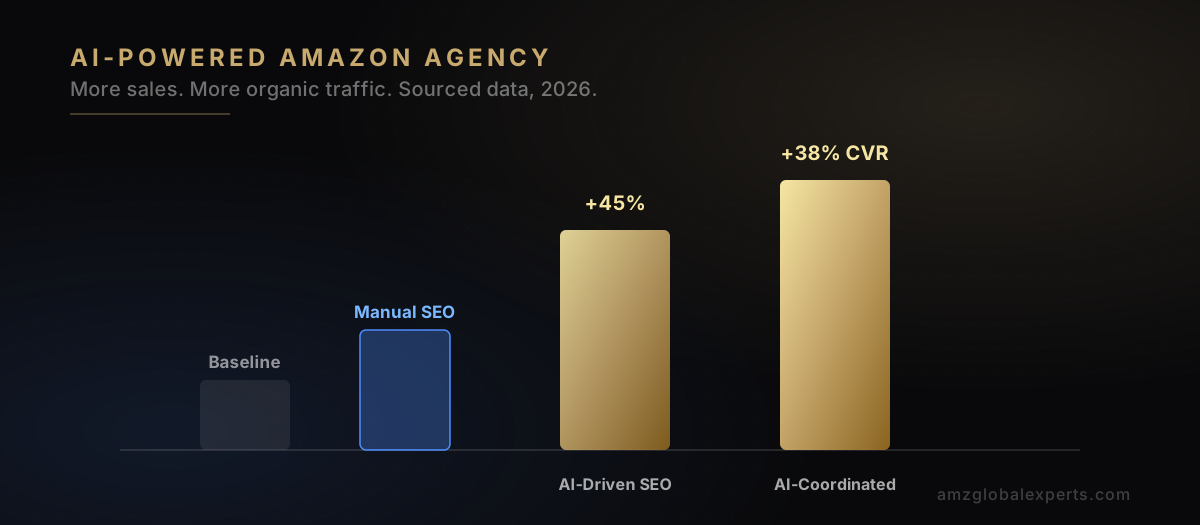
AI-driven SEO campaigns produce an average 45% increase in organic traffic and a 38% increase in conversion rate for ecommerce sites, according to 2026 industry benchmarking research, while 83% of SEO teams at organizations with 200+ employees report measurable performance gains after integrating AI into their workflow. For Amazon sellers, the same shift is happening one layer down — inside PPC bid logic, listing optimization, and cross-channel signal routing — and the agencies that have not rebuilt around AI are now the visible laggards, not the safe choice.
This report lays out, with sourced data, what an AI-powered Amazon marketing agency actually changes about sales and organic traffic outcomes in 2026 — and why the gap between AI-native and legacy-process agencies is now wide enough to show up directly in TACoS, organic rank, and blended revenue.
Why AI Adoption Is No Longer Optional for Amazon Growth
Organic search remains the single largest traffic driver for online retail, responsible for 43% of all ecommerce traffic and 23.6% of all online orders — but the composition of that organic traffic is changing fast. AI Overviews appeared on just 2.1% of shopping queries in November 2025 and climbed to 14% by March 2026, a 5.6-fold increase in four months, and Google's AI Overviews have cut organic click-through rate by more than half on the queries they now appear on. Meanwhile, traffic arriving from AI sources — ChatGPT, Perplexity, Gemini — to US retail websites grew 393% year-over-year in Q1 2026 alone, even though it still represents under 1% of total referral volume today.
Read together, these numbers describe a market in transition, not a market that has already flipped. Organic search still converts better and drives more volume than AI referral traffic right now. But the growth curve on AI-sourced traffic is steep enough that any agency not building for it — alongside traditional SEO and Amazon A10 optimization — is optimizing for a shrinking share of a market that is actively redistributing itself.
What AI Actually Changes in an Amazon Marketing Engagement
56% of marketers are already using generative AI for SEO work, but there is a meaningful difference between using an AI writing tool and running an AI-coordinated growth system. An AI-powered Amazon marketing agency applies machine-learning decisioning to three layers simultaneously: PPC bid and budget allocation across thousands of keyword-match combinations updated in near real time, listing and content optimization informed by buyer-language pattern analysis rather than static keyword lists, and cross-channel signal routing that feeds Amazon performance data into SEO and social content decisions instead of treating each channel as a separate report.
Key Finding: AI-driven SEO campaigns show a documented 45% average increase in organic traffic and 38% increase in conversion rate for ecommerce sites — and 83% of larger SEO teams report measurable gains after adopting AI tooling, versus only 6.2% reporting no improvement at all. That gap is now large enough that "we don't really use AI, we do it manually" has become a genuine competitive disadvantage rather than a point of craftsmanship.
What Real Amazon Sellers Are Saying
Sellers on r/AmazonSeller and r/FulfillmentByAmazon have been vocal about the gap between agencies that talk about AI and agencies that actually run on it.
r/AmazonSeller seller: "We switched agencies specifically because the old one was still manually adjusting bids once a week. Our new one has bids updating multiple times a day based on conversion data. TACoS dropped noticeably in the first month." — This is a recurring complaint pattern: sellers increasingly treat manual, batch-cadence bid management as a red flag, not a baseline.
r/FulfillmentByAmazon seller: "Every 'AI-powered' agency pitch sounds the same until you ask what the AI actually does. Half of them just mean they use ChatGPT to write bullet points." — Sellers are increasingly skeptical of AI as a marketing label rather than an operating system, which raises the bar for what "AI-powered" needs to mean in practice.
The pattern across both threads: sellers are no longer impressed by the phrase "AI-powered." They are asking a sharper question — does the AI touch bid logic, listing architecture, and cross-channel routing, or is it decorating a manual process with automated copywriting.
How AI Automation Compounds Organic Traffic Growth
| Growth Lever | Manual/Legacy Process | AI-Coordinated Process |
|---|---|---|
| PPC bid adjustment cadence | Weekly or monthly review | Continuous, conversion-data-driven |
| Listing keyword selection | Static keyword tool exports | Buyer-language pattern clustering |
| Cross-channel signal use | Siloed, channel-by-channel reporting | Unified signal routing across Amazon, SEO, social |
| AI-search / GEO visibility | Rarely addressed | Structured for AI Overview + LLM citation |
The compounding effect matters more than any single lever. Amazon performance data — which keywords convert, which objections buyers raise in reviews, which price points trigger hesitation — is the same behavioral data that should inform organic content and GEO strategy. An AI-coordinated system routes that signal automatically; a manual process requires someone to notice the pattern and manually brief a second team, which is where most of the delay and dilution in legacy agency models actually happens.
Strategic Recommendations
Short-Term (0–90 Days)
Ask your current agency exactly where AI touches your account — bid logic, listing content, or reporting summaries only. If AI is only generating your monthly report narrative, it is not driving the 45% organic-traffic-class gains documented in 2026 benchmarking data.
Mid-Term (90–180 Days)
Audit your GEO exposure. With AI-source referral traffic up 393% year-over-year and AI Overviews now appearing on 14% of shopping queries, brands with no structured GEO strategy are increasingly invisible in a fast-growing discovery channel, even while it remains a minority of total traffic today.
Long-Term (6–18 Months)
Build (or hire for) a unified signal layer connecting Amazon performance data to SEO, GEO, and content decisions. See our related framework in AI Amazon Listing Optimization and the A10 Algorithm for how buyer-language signal should inform listing architecture specifically.
The Cost of Running a Legacy-Process Agency in 2026
The gap between AI-coordinated and manual-process agencies is not theoretical — it shows up directly in the numbers a brand can measure inside its own Seller Central account. A manual bid review cadence of once per week means a keyword can drift 10 to 15% off its optimal bid for up to six days before anyone adjusts it; a continuous, conversion-data-driven system closes that same gap in hours. Multiplied across a catalog of even 50 to 100 active keywords, that lag compounds into meaningfully higher TACoS over a quarter, even before accounting for the 38% average conversion lift documented in 2026 AI-SEO benchmarking data.
Implementation note: the fastest way to audit this gap is to ask your current agency for the exact date and time of the last three bid adjustments on your top five keywords by spend. A manual-cadence agency will show adjustments clustered on the same day each week. An AI-coordinated system shows adjustments distributed across days, driven by conversion data rather than a calendar.
Why Sellers Delay Switching Even After Recognizing the Gap
Reddit threads on this topic surface a consistent hesitation pattern: sellers recognize their agency is behind on AI adoption but delay switching because of migration risk — fear of losing historical campaign data, disrupting Buy Box stability, or resetting review velocity during a transition. Those risks are real, but they are also manageable with a structured handoff, and the 2026 data suggests the larger risk is the compounding cost of staying with a manual-process agency while AI-source traffic continues growing at 393% year-over-year and AI Overviews expand their share of shopping queries. Delay has a cost; it is simply less visible month-to-month than a migration would be.
What a Structured AI Handoff Actually Looks Like
A well-run migration does not touch live campaigns on day one. The first two weeks are read-only: the incoming AI system ingests 12 to 24 months of historical search-term, bid, and conversion data before it makes a single automated decision, which is what allows it to avoid repeating the same trial-and-error ramp a brand-new account would need. Buy Box and review velocity are monitored, not modified, during this window. Only once the model has a validated baseline does bid and budget control transfer — typically on a subset of the catalog first, expanding to full account control once the conversion-data-driven bids are shown to outperform the prior manual cadence. Sellers who insist on this staged handoff, rather than an immediate full switch, consistently report the smoothest transitions in Reddit threads discussing agency changes.
How AMZ Global Experts Helps
AMZ Global Experts runs AI decisioning through the parts of the account that actually move revenue — continuous PPC bid and budget optimization, buyer-language-informed listing architecture, and a unified signal layer that feeds Amazon behavioral data into SEO and GEO strategy in the same system, not a separate one. This is the same operator-built approach detailed in our Amazon Agency Performance Report and our GEO for Amazon Brands research.
Conclusion
The data is directionally consistent: AI-coordinated marketing produces measurably more organic traffic, higher conversion, and faster response to buyer behavior than manual, batch-cadence processes — and the AI-search channel it increasingly touches is growing fast enough that ignoring it now is a compounding mistake, not a neutral one. If your agency cannot explain exactly where AI touches your bids, your listings, and your content strategy, book a strategy audit and we will show you where the gap is.
Frequently Asked Questions
2026 industry benchmarking data shows AI-driven SEO campaigns produce an average 45% increase in organic traffic and a 38% increase in conversion rate for ecommerce sites, with 83% of larger SEO teams reporting measurable performance gains after integrating AI tooling into their workflow.
AI-source referral traffic to US retail websites grew 393% year-over-year in Q1 2026, though it still represents under 1% of total referral traffic today, with organic search remaining the largest source by volume and conversions. The growth rate, not the current share, is why brands are beginning to build GEO strategy now rather than waiting.
A genuinely AI-powered agency applies machine-learning decisioning to PPC bid and budget allocation, buyer-language-informed listing content, and cross-channel signal routing — not just AI-generated report summaries or bullet-point copywriting. Sellers increasingly report skepticism toward agencies using the label without AI touching the underlying decisions.
AI Overviews appeared on 14% of shopping queries in March 2026, up from 2.1% in November 2025, and have cut organic click-through rate by more than half on the queries where they appear. Brands with structured GEO strategy are positioned to be cited inside those AI Overviews rather than losing the click entirely.
If AI is not touching your PPC bid logic, listing keyword architecture, or cross-channel signal routing, you are not capturing the organic traffic and conversion gains documented in 2026 AI-SEO benchmarking data. Ask directly where AI is used in your account before assuming an "AI-powered" label reflects your actual results.