
The agency model has a structural problem that no amount of account management, quarterly business reviews, or reporting dashboards can solve: the incentive to grow your brand is fundamentally misaligned with the incentive to grow the agency's revenue. A traditional Amazon agency charging 15% of ad spend earns more when you spend more — not when you spend better. An agency earning a flat monthly retainer earns the same whether your TACOS is 8% or 28%. The structure does not reward outcomes. It rewards retention.
This misalignment has always existed. What has changed in 2026 is that brands now have a credible alternative that does not suffer from it. AI commerce operating systems — unified architectures that connect data, decision intelligence, and automated execution across every growth channel — are delivering the execution layer that agencies sold for a decade, at lower cost, with greater consistency, and with compounding performance improvement built into the model. The 2026 operator who understands this is not choosing between an agency and more in-house headcount. They are choosing between a cost center that decays and a system that compounds.
The Agency Retainer Trap
Understanding why the AI Commerce OS represents a structural upgrade — not just a cost play — requires an honest diagnosis of where the legacy agency model breaks down. It breaks down in exactly four places, and all four are baked into the model's DNA rather than fixable with better hiring or better tooling.
Failure Mode 1: Execution Latency
An Amazon PPC campaign responding to a competitor price drop, a viral TikTok product moment, or a sudden keyword intent shift needs to update bids, budgets, and targeting within hours — not at the next weekly check-in. Agency teams are human. They have client loads, internal meetings, approval chains, and operating hours. An AI system monitoring your campaign performance 24 hours a day and executing bid adjustments within minutes of detecting a signal has a structural reaction speed advantage that no staffing decision can close. In competitive categories where CPCs move intraday, latency is directly measured in wasted ad spend and lost organic ranking momentum.
Failure Mode 2: Institutional Knowledge Decay
The agency account manager who knew your brand, your category seasonality, your top-performing creative formats, and the six-month history of your A/B tests — they left. Their replacement inherited a handoff document and a Slack channel. This is not an edge case; agency team turnover in the Amazon services industry averages 35–42% annually according to industry surveys. Every rotation resets institutional knowledge to near-zero. An AI Commerce OS accumulates every campaign decision, every test result, every conversion signal into a persistent model that gets more accurate over time. The system never leaves.
Failure Mode 3: Cross-Channel Blindness
A brand running Amazon PPC through one agency, Meta ads through another, and email retention through a third is operating with three disconnected data silos and three separate attribution models, each telling a different story about what is driving revenue. The Meta agency does not know that the TikTok creator campaign last Tuesday drove a 340% spike in Amazon branded search that the PPC agency accidentally under-bid. No individual agency sees the full system. An AI Commerce OS — connected to every channel data source — does.
Failure Mode 4: Fixed-Cost Inflexibility
Agency retainers are priced for the median month. When your brand has a 6-week Q4 peak requiring 3× the execution bandwidth of a typical August, you pay the same retainer — and receive degraded service because the agency is overloaded. When you are in a trough quarter and need to conserve cash, you still pay the retainer. AI systems scale execution capacity with your actual demand, not with a pricing model designed around agency overhead and margin targets.
What an AI Commerce OS Actually Is
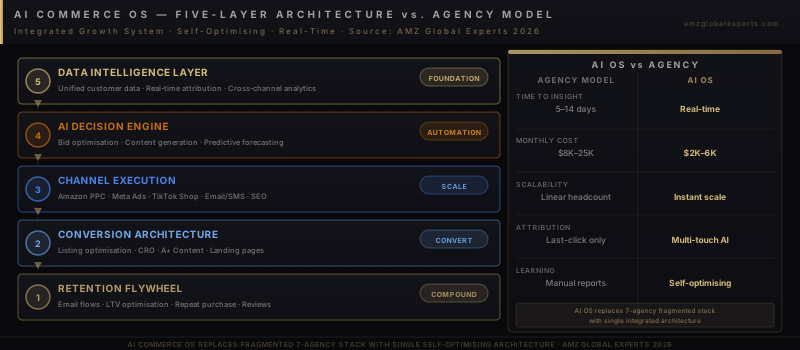
The term “AI Commerce OS” is used loosely enough in 2026 marketing copy that it has nearly lost its signal. An AI Commerce OS is not a dashboard. It is not a SaaS subscription with an AI-generated copy feature. It is not a Zapier automation connecting three tools. A genuine AI Commerce OS has five interlocking architectural layers, and the power is not in any single layer — it is in the connections between them. Data flows upward through the stack; decisions flow downward. The system is closed-loop: every execution action generates new data that feeds back into the intelligence layer to improve the next decision.
The Five Layers of an AI Commerce OS
Layer 1: Data Unification
Every channel your brand operates generates data — Amazon Seller Central sales and session metrics, Shopify order and customer data, TikTok Shop creator and GMV performance, Meta Ads spend and ROAS, Klaviyo email open and revenue rates, Google Analytics 4 traffic attribution. In most brands, this data lives in seven separate dashboards that never talk to each other. Layer 1 of the AI Commerce OS is a unified data warehouse: every channel's performance data flowing into a single normalised schema, updated in real time, queryable by the intelligence layers above it. Without this layer, everything else is guesswork.
Layer 2: Demand Intelligence
With unified data as its foundation, the demand intelligence layer reads the signals that indicate where growth is available and where spend is being wasted. This includes Amazon A10 ranking signal analysis (conversion rate trends, external traffic attribution, sales velocity relative to category), Rufus AI search query intent mapping (what buyers are asking the Amazon AI assistant before they convert), TikTok trend velocity monitoring (identifying rising demand signals before they show up in Amazon keyword data), competitive price and inventory gap detection, and cross-channel attribution modelling that connects a Meta ad impression from three weeks ago to an Amazon purchase today. The demand intelligence layer does not execute anything. It surfaces opportunities and risks with quantified confidence scores — inputs for the execution layer below it.
Layer 3: Automated Execution
This is the layer that most directly displaces the agency execution team. Automated execution covers: PPC campaign architecture — campaign creation, ad group structure, keyword harvesting from Search Term Reports, bid adjustment on a 4–6 hour cycle based on conversion rate signals; listing optimisation — automated keyword position monitoring triggering title and backend keyword refresh recommendations when ranking slips; price management — dynamic repricing within preset margin guardrails responding to competitor pricing changes within minutes; inventory alert management — IPI score monitoring, reorder trigger calculations, stranded inventory resolution queues; and A+ Content testing — automated variant rotation connected to Manage Your Experiments performance data. Human review and approval thresholds can be set at any level of sensitivity, but the default operating mode is autonomous execution within defined parameters.
Layer 4: Content Machine
Content production is the highest-labour-hour cost in most agency relationships — and the most directly automatable. The AI content machine layer generates listing copy (titles, bullets, A+ Content, product descriptions) trained on your brand's highest-converting language, competitor listing analysis, and real buyer language mined from Amazon reviews, Reddit communities, and TikTok comment sections. It generates email retention sequences triggered by purchase events, browse abandonment, and replenishment windows. It generates social content calendars — TikTok product education angles, Instagram carousel structures, Pinterest keyword-optimised descriptions — from a single product brief. The output is not generic AI copy: it is brand-specific, buyer-language-calibrated content that would have required 3–5 agency content hours per asset.
Layer 5: Compound Intelligence
This is the layer that makes the AI Commerce OS structurally superior to any static agency team over a 12–24 month horizon. Every campaign decision creates a data point: this keyword bid adjustment at this CPCinput produced this conversion rate change at this sales velocity. Every content variant produces a data point: this title structure produced a 2.1% CTR increase versus the control. Every email test produces a data point. The compound intelligence layer trains on these outcomes, updating the decision models that feed Layers 2 and 3. A system that has been running for 18 months on your brand and category is operating with a precision advantage over any newly onboarded agency team that cannot be closed by talent quality alone. The compound intelligence layer is why brands that deploy an AI Commerce OS in 2026 will have a structural performance moat by 2028 against competitors still operating on the agency model.
The compounding math: A brand deploying an AI Commerce OS in January 2026 will, by December 2027, have 24 months of closed-loop campaign learning — approximately 8,760 hours of continuous performance monitoring and model refinement — embedded in their growth system. A competitor onboarding a new agency in 2028 starts at zero institutional knowledge. The performance gap widens with every passing quarter, not with every passing campaign.
The Cost Arithmetic
The financial case for the AI Commerce OS is not marginal. It is decisive. A $2M Amazon brand with a full-service agency relationship typically pays: $8,000–$12,000/month in base retainer; 15% of ad spend managed (on $50K/month ad budget, that is $7,500/month); additional project fees for listing refreshes, A+ Content creation, and email setup. Total: $15,500–$19,500 per month, or $186,000–$234,000 per year, in agency cost alone. This excludes the cost of cross-channel blindness, execution latency, and knowledge decay described above.
| Cost Category | Traditional Agency | AI Commerce OS |
|---|---|---|
| Monthly base fee | $8,000–$12,000 | $1,500–$3,000 |
| Ad management fee (15% of $50K spend) | $7,500/mo | Included |
| Content production (per asset) | $150–$400 | $0 (automated) |
| Cross-channel attribution | Partial / siloed | Unified, real-time |
| Execution response time | 24–72 hours | 4–6 hours (automated) |
| Performance improvement over time | Resets with team turnover | Compounds continuously |
| Total annual cost | $186,000–$234,000 | $36,000–$60,000 |
The $120,000–$180,000 annual difference represents the premium a brand pays for the agency model's structural disadvantages. Redirected into incremental ad investment, product development, or creator partnerships, it produces compounding returns. Left in an agency relationship, it funds overhead, account manager salaries, and the agency's own margin.
What Agencies Cannot Automate (Honestly)
A fair analysis requires acknowledging where human agency expertise retains genuine irreplaceable value in 2026. Three areas are clear. First: strategic pivots that require irreducible market judgment — the decision to enter a new category, to reposition a brand from commodity to premium, to exit a channel entirely. These decisions require integrating qualitative market signals, founder risk tolerance, and multi-year competitive dynamics in ways that current AI systems cannot model with sufficient nuance. Second: creative direction for brand identity — defining the visual language, tone of voice, and emotional positioning of a brand at a foundational level requires human creative intelligence. An AI system can execute content within that creative direction at scale, but it cannot originate the direction itself without human creative input. Third: relationship-dependent channel navigation — TikTok creator negotiations above a certain GMV threshold, retail buyer relationships, brand licensing discussions, and influencer equity arrangements all require human relationship capital that cannot be automated.
The brands winning in 2026 are not choosing between AI and human expertise. They are deploying AI for the 80% of execution work that is automatable — PPC management, listing optimisation, email retention, content production, competitive monitoring — and applying senior human intelligence exclusively to the 20% requiring irreducible judgment. The agency model inverts this ratio, billing human hours at a premium for tasks that AI executes with higher consistency and lower latency.
The AMZ Global Experts AI Commerce OS Architecture
AMZ Global Experts built its AI Commerce OS architecture over 18 months of live brand deployments, iterating through three generations of data pipeline design, decision model architecture, and execution automation. The system is not a product stack assembled from off-the-shelf SaaS tools — it is a custom-integrated architecture where the intelligence layer is proprietary and brand-specific rather than generic. The five tools at the core of the system — ListingIQ™, IntentMapper™, ChannelBridge™, DemandSignal™, and GEOPulse™ — each operate on a single layer of the OS but share data across layers through a unified API layer that ensures every tool is working from the same performance reality.
The deployment model is structured as a 90-day activation sequence. Days 1–30: data unification and baseline establishment — connecting all channel data sources, establishing performance benchmarks, configuring automated execution guardrails and human approval thresholds. Days 31–60: demand intelligence calibration — training the Rufus intent model on brand-specific query data, calibrating the A10 signal weighting to the specific category's competitive dynamics, launching the first automated PPC optimisation cycles. Days 61–90: content machine activation and compound intelligence initialisation — deploying AI content generation for listing and email, launching the A/B testing framework, beginning the compound learning cycle that will improve every subsequent decision. Measurable performance improvements — TACOS reduction, CVR lift, email revenue contribution — are typically visible by week 6 and significant by day 90.
The 2026 operator decision: The question is no longer whether AI can execute the tasks agencies have been charging premium retainers to perform. It demonstrably can. The question is how long your brand can afford the performance gap — in cost, in latency, in cross-channel blindness, and in compounding intelligence — that the legacy agency model represents versus the AI Commerce OS alternative that already exists.
The 2026 Inflection Point
Three converging forces make 2026 specifically the inflection year — not 2024, not 2028. First: LLM maturity at production grade. The generation of large language models available in 2024 was sufficiently capable for content generation tasks but not sufficiently reliable for autonomous decision-making in commercial environments where mistakes carry direct cost. The models available in mid-2026 cross a reliability threshold that makes them deployable for PPC decision-making and listing optimisation without constant human review. Second: Amazon API and data access expansion. Amazon's programmatic advertising API, the Selling Partner API, and the Amazon Marketing Cloud now expose sufficient granularity of campaign and consumer data that AI systems can build accurate performance models in ways that were not possible two years ago. Third: multimodal AI for commerce. The ability for AI systems to analyse product imagery, video creative performance, and A+ Content visual structure — not just text data — means the AI Commerce OS can now optimise the full listing experience, not just the keyword and bid layers.
The brands building AI Commerce OS infrastructure in 2026 are not early adopters taking an unproven risk. They are operators making a rational capital allocation decision based on demonstrated performance data. The agencies that survive the next five years will be the ones that transform themselves into AI Commerce OS architects — building and operating AI systems for brands rather than staffing execution teams to perform tasks that AI executes better. The agencies that do not make this transition will face a structural revenue decline that no account management quality improvement can reverse.
Frequently Asked Questions
An AI Commerce OS is a unified system that connects data, decision intelligence, and automated execution across every growth channel — Amazon, Shopify, TikTok, Meta, email — in a single operating layer. Unlike individual SaaS tools (which solve isolated problems), an AI Commerce OS treats the entire brand as a connected system where every signal informs every other signal. It does not replace your team; it multiplies what your team can execute without adding headcount.
For execution-layer tasks — PPC campaign management, listing optimisation, keyword refresh, email sequences, price response, inventory alerts — AI systems now match or outperform agency teams at a fraction of the cost. Where agencies retain genuine value is in strategic pivots requiring deep market judgment, creative direction for brand positioning, and relationship-dependent channels like influencer negotiation. The brands winning in 2026 are using AI for the 80% of execution work that is automatable, and applying senior human intelligence to the 20% that requires irreducible judgment.
A traditional full-service Amazon agency retainer for a $2M+ brand typically runs $15,500–$19,500 per month all-in (base retainer plus percentage of ad spend). An AI Commerce OS for the same brand — combining best-in-class tools with an AI-native operator building and maintaining the system — costs $3,000–$5,000 per month all-in. The performance gap compounds over time: the AI OS improves with every campaign cycle; agency teams rotate, lose institutional knowledge, and reprice contracts upward.
The five layers are: (1) Data Unification — a single source of truth connecting Amazon, Shopify, TikTok Shop, Meta, and email into one performance dashboard; (2) Demand Intelligence — AI reading demand signals from A10, Rufus, social trends, and competitive data in real time; (3) Automated Execution — PPC management, bid optimisation, listing updates, and price adjustment running on AI decision rules without human latency; (4) Content Machine — AI-generated listing copy, email sequences, and social content fed by real buyer language; (5) Compound Intelligence — the system learns from every decision cycle, improving performance quarter over quarter.
A functioning AI Commerce OS covering Amazon PPC automation, listing intelligence, and email retention can be operational in 30–45 days for a brand with clean data and existing channel infrastructure. Full five-layer deployment — including demand intelligence, multi-channel attribution, and compound learning — typically reaches full operational capacity at day 90. The first measurable performance improvements (TACOS reduction, CVR lift, email revenue increase) are typically visible within weeks 3–6.