15 Omnichannel Metrics Every Ecommerce Brand Must Track in 2026
Most ecommerce brands track the wrong numbers. They obsess over ROAS, ACoS, open rates, and follower counts — metrics that tell you what happened, not why, and not what to do next. The brands that scale in 2026 track ecosystem metrics: the numbers that reveal how Amazon, Shopify, TikTok, email, and AI‑search all reinforce each other.
RA
Robert Assaad
Founder · Lead Amazon Strategist · AMZ Global Experts
Key Findings
Single-channel metrics — ROAS, ACoS, open rate — tell you what happened on one platform. Ecosystem metrics tell you how the whole system is compounding.
TACoS is the only Amazon metric that matters for profitability: it tracks total revenue against total ad spend, not just attributed revenue.
Blended ROAS exposes the real cost of growth: brands running 4.5× platform ROAS while bleeding margin at 1.8× blended ROAS are optimizing the wrong number.
The TikTok → Amazon loop is now documented and measurable via Amazon Attribution tags — brands not tracking it are leaving a major acquisition signal unread.
Brands that optimize the connections between channels — not the channels in isolation — build the compounding growth systems that separate 7‑figure operators from 8‑figure ones.
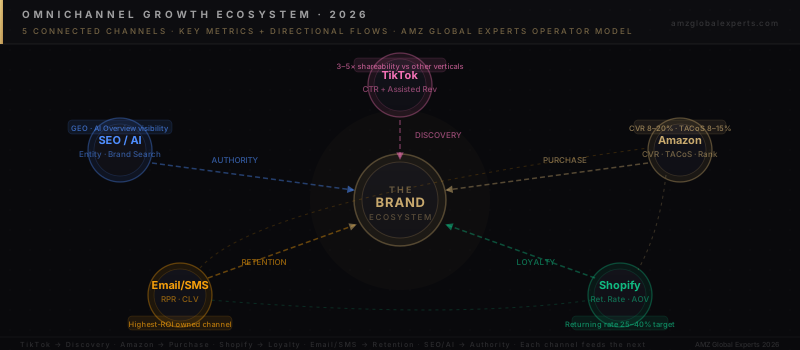
Figure 1: The AMZ Global Experts Omnichannel Growth Ecosystem. Each channel node shows its primary role in the customer journey and the key metrics that reveal whether it is performing that role effectively. Dashed lines show directional flows: TikTok drives discovery into Amazon; Amazon acquires into Shopify; Shopify retains into Email/SMS; Email/SMS reactivates back into Amazon. SEO and AI engines reinforce brand authority across all nodes.
Your Amazon CVR is the most direct indicator of whether your listing psychology is working. Amazon is intent-driven: the buyer has already decided to purchase in the category. Low CVR means the listing is misaligned with buyer psychology — not your ads.
Fix it if low: Rewrite bullets with fear-first structure using n‑gram-extracted customer language. Audit the secondary image stack for scenario-resolution gaps. Strengthen A+ Content with objection-first structure.
Metric #2 — Amazon
TACoS — Total Advertising Cost of Sale
● Healthy: 8–15% stable brands · 20–35% during launches
TACoS is the only Amazon profitability metric that tells you the full truth. Unlike ACoS — which measures ad spend against ad-attributed revenue — TACoS divides total ad spend by total revenue (organic + paid). A brand with high ACoS but low TACoS has strong organic rank supplementing paid. A brand with low ACoS but high TACoS has almost no organic velocity and is entirely dependent on PPC.
Fix it if high: Improve organic rank through listing CVR optimization and review velocity. Reduce wasted spend through negative keyword architecture. Improve listing CVR to capture existing traffic more efficiently without additional spend.
TACoS Formula
TACoS = Total Ad Spend ÷ Total Revenue (Organic + Paid)
A stable brand targeting 12% TACoS with $50K monthly revenue needs total ad spend under $6,000/month — regardless of how much of that revenue Amazon attributes to ads directly. This is the true profitability signal.
Metric #3 — Amazon
Search Term Ranking Velocity
● Track: daily position change · Velocity > absolute position
Ranking velocity — how fast you are climbing for a target keyword — is more actionable than current rank. Fast upward movement signals to Amazon’s A10 algorithm that your listing is generating purchase intent, which compounds into further rank improvement. A listing at position 18 moving up 3 positions per day is a better signal than a listing that has been static at position 8 for 90 days.
Track it with: Helium 10 Rank Tracker or Amazon Brand Analytics Search Query Performance report. Monitor organic share of voice alongside absolute position.
Closely related to CVR but distinct in one way: CVR is often measured against specific traffic sources, while session-to-order ratio measures across all sessions including organic, PPC, and external. A large gap between keyword-level CVR and session-to-order ratio suggests low-quality traffic sources inflating sessions without driving orders.
Fix it if low: Audit traffic sources for quality. Improve main image for mobile thumbnail CTR. Strengthen the first bullet for conversion psychology.
Metric #5 — Amazon
Repeat Purchase Rate
● Healthy: 18–35% depending on category
Your Amazon repeat purchase rate is your true profitability signal. The cost to acquire a new buyer is absorbed by the first order. Every repeat purchase flows directly to margin. Brands with strong repeat purchase rates on Amazon are building a compounding revenue base that reduces dependency on PPC for growth.
Fix it if low: Add product inserts driving to Shopify or email capture. Launch complementary accessories or consumables. Build post-purchase sequences using Amazon’s Buyer-Seller Messaging.
Section 2: Shopify Metrics
Metric #6 — Shopify
Shopify Conversion Rate
● Healthy: 1.5–3.5% cold traffic · Higher for returning customers
Shopify CVR reveals how well your brand story, product detail page structure, and trust signals convert traffic that does not arrive with the same purchase intent as Amazon buyers. The lower benchmark reflects the reality that Shopify traffic includes cold discovery visitors who require more persuasion than intent-qualified Amazon buyers.
Fix it if low: Simplify above-the-fold content. Add before/after scenario storytelling. Improve mobile UX — over 65% of Shopify traffic is mobile. Add bundle offers that resolve the “I need everything” anxiety of new buyers.
Metric #7 — Shopify
Returning Customer Rate
● Healthy: 25–40% for strong DTC brands
Your Shopify returning customer rate is your brand loyalty score. It is the single number that reveals whether you are building a business or running an acquisition campaign. Brands with returning customer rates above 30% are compounding — every new customer added to the base becomes a recurring revenue stream. Brands below 20% are on a customer acquisition treadmill.
Fix it if low: Build email and SMS post-purchase flows. Launch a loyalty programme. Improve unboxing experience. Develop complementary product lines that create natural repurchase occasions.
Section 3: TikTok Metrics
Metric #8 — TikTok
TikTok → Amazon Click-Through Rate
● Track: CTR from bio links, influencer videos, TikTok Shop
This is the new viral loop metric — the number that reveals whether your TikTok presence is actually driving purchase intent or just impression volume. TikTok drives discovery; Amazon captures the sale. The CTR between them reveals how strong that handoff is. Use Amazon Attribution tags on all TikTok-linked URLs to close this measurement gap.
Improve it: Use creator briefs that explicitly name the product with a verbal call-to-action. Pin the Amazon link in bio with a frictionless landing page. Test link-in-bio tools vs. direct Amazon Attribution URLs.
Metric #9 — TikTok
TikTok → Shopify Assisted Revenue
● Track: sessions, returning user conversions, branded search lift
Even when TikTok doesn’t convert directly, it influences the entire downstream purchase journey. A viewer who sees a product on TikTok but doesn’t click will often return to search branded terms on Google or Amazon within 72 hours. This dark-funnel influence is measurable through branded search volume lift, Shopify referral sessions, and post-purchase survey data.
Measure it: Compare branded search volume before and after TikTok campaigns using Google Search Console. Track Shopify referral sessions and returning visitor conversion rates in GA4.
Platform-reported ROAS is one of the most misleading numbers in ecommerce. Meta takes credit for conversions that Google initiated. Google takes credit for conversions that TikTok seeded. Blended ROAS cuts through platform attribution warfare: it divides total revenue by total ad spend across all platforms. A brand can show 4.5× ROAS on Meta while its blended ROAS is 1.9× — meaning the business is growing unprofitably despite impressive platform numbers.
Fix it if low: Audit channel-level contribution. Cut underperforming channels before increasing top-line spend. Improve landing page CVR to extract more revenue from existing traffic.
Blended ROAS Formula
Blended ROAS = Total Revenue ÷ Total Ad Spend (All Platforms)
A brand spending $15,000/month across Meta, Amazon PPC, and TikTok Ads generating $52,000 in total revenue has a blended ROAS of 3.47×. This is the only ROAS number that determines whether the business is profitable at scale.
Metric #11 — Paid Media
Influencer Cost Per Acquisition (iCPA)
● Track: CPA per creator, per content type, per platform
Influencer marketing has matured from a brand awareness play into a performance channel — and should be measured as one. iCPA tracks what each new customer acquired through influencer content actually costs, accounting for the creator fee, production cost, and the revenue generated from the tracked link or promo code over a defined attribution window (typically 30 days).
Fix it if high: Shift toward UGC creators with smaller audiences and higher trust signals. Use content whitelisting to convert top-performing creator videos into paid ads. Build a library of top-performing content and repurpose across Amazon, Shopify, and email.
Section 5: Retention Metrics
Metric #12 — Email
Email Revenue Per Recipient (RPR)
● Track: total email revenue ÷ total emails sent in period
RPR is the metric that separates email programs that are growing versus email programs that are just growing their list. A list of 8,000 subscribers generating $0.12 per email sent outperforms a list of 40,000 generating $0.02 per email sent — in absolute revenue, not just efficiency. RPR forces the question that list size avoids: how efficiently are you converting the audience you have?
Fix it if low: Segment by purchase behavior rather than demographics. Prioritize flow revenue (post-purchase, abandoned cart, winback) over campaign revenue. Reduce broadcast frequency and increase personalization depth.
Metric #13 — SMS
SMS Revenue Per Recipient
● Track separately from email · Never blend the two
SMS is a high-intent, high-risk channel — subscribers can opt out with a single reply, and frequency fatigue sets in faster than email. SMS RPR should be tracked independently from email RPR because the channels have fundamentally different tolerance thresholds, optimal content types, and subscriber expectations. Blending them obscures both signals.
Fix it if low: Reduce send frequency. Reserve SMS for urgency-based offers and time-sensitive triggers (browse abandonment, cart abandonment, back-in-stock). Never use SMS for the same content you send via email in the same week.
Section 6: Authority Metrics
Metric #14 — SEO / GEO
SEO Entity Growth Score
● Track: brand mentions, topic authority, AI engine visibility
In 2026, SEO is no longer keyword-first — it is entity-first. Google, Perplexity, and ChatGPT understand the web through entities: named brands, products, categories, and the relationships between them. A brand that appears in editorial content, community discussions, expert citations, and AI-generated answers has entity authority. Entity authority drives organic traffic, AI citation, and branded search volume independently of paid media.
Improve it: Publish research-backed long-form content that AI engines will quote. Build citations from industry publications and community resources. Verify your brand entity appears in AI search responses for your primary category keywords.
This is the most important metric of all — and the one most brands never build. Customers do not buy in a straight line. They move across TikTok → Reddit → Amazon → Shopify → email → Google → Amazon. No single-platform attribution model captures that journey. Without omnichannel attribution, the brand cannot see which touchpoints are actually driving revenue and which are consuming budget while taking credit for conversions they didn’t initiate.
Build it with: Amazon Attribution tags on all external traffic. Post-purchase survey question: “How did you first hear about us?” Google Analytics 4 multi-touch attribution. Triple Whale or Northbeam for cross-channel media attribution. Combine all four signals for a complete picture.
How to Use These Metrics Together: The Operator Framework
Metrics only matter when they tell a story. The AMZ Global Experts ecosystem model connects these 15 numbers into a single coherent growth narrative. Each metric illuminates one node in the system. Together they reveal whether the system is compounding or fragmenting.
1
TikTok Drives Discovery
Track: TikTok → Amazon CTR (Metric #8) + TikTok → Shopify assisted revenue (Metric #9). If CTR is low, creator briefs need revision. If assisted revenue is unmeasured, install Amazon Attribution tags immediately.
2
Amazon Captures the Sale
Track: CVR (Metric #1) + TACoS (Metric #2) + ranking velocity (Metric #3) + session-to-order ratio (Metric #4). These four numbers together reveal listing health, organic momentum, and true profitability. A listing with strong CVR and rising velocity has a self-reinforcing flywheel. A listing with low CVR and flat velocity needs intervention before more spend.
3
Shopify Builds Loyalty
Track: returning customer rate (Metric #7) + Shopify CVR (Metric #6). Returning customer rate is your brand loyalty score. If it’s rising, your post-purchase experience and retention marketing are working. If it’s flat or falling, no amount of acquisition spend will produce sustainable growth.
4
Email and SMS Drive Retention
Track: email RPR (Metric #12) + SMS RPR (Metric #13) + Amazon repeat purchase rate (Metric #5). Retention metrics compound more than acquisition metrics. A 5% improvement in repeat purchase rate produces more revenue than a 15% improvement in new customer acquisition at most brands operating above $500K annually.
5
SEO and AI Reinforce Authority Across All Nodes
Track: entity growth score (Metric #14) + omnichannel attribution (Metric #15) + blended ROAS (Metric #10). Authority reduces paid media dependency over time. Every editorial mention, community discussion, and AI engine citation drives organic traffic that costs nothing. The brand that builds authority while competitors spend on paid media gains a compounding cost-per-acquisition advantage.
The Ecosystem Insight:Metrics only reveal problems. Systems resolve them. The 15 numbers above, tracked in isolation, produce 15 separate optimization priorities that fragment your team’s attention. Tracked as a connected ecosystem, they reveal the one or two leverage points where a single intervention — a listing rewrite, a flow optimization, a creator brief revision — unlocks improvement across multiple metrics simultaneously. That leverage is where compounding brands spend their time.
The Brands That Win in 2026 Think in Systems, Not Channels
Most ecommerce brands optimize channels in isolation. The Meta team runs the Meta numbers. The Amazon team runs the ACoS. The email team celebrates the open rate. Nobody is looking at what happens between the channels — and that is exactly where the growth is hiding.
The brands that scale to eight figures — the ones building durable, compounding growth systems — treat their ecosystem as a single organism. TikTok discovery is wasted if the Amazon listing doesn’t convert. Amazon acquisition is wasted if there’s no Shopify retention. Shopify retention is wasted if email flows aren’t driving repurchase. Email repurchase is wasted if the brand isn’t building entity authority that reduces its long-term dependence on all of the above.
The 15 metrics in this report are not a dashboard to build. They are a system map — a way of seeing the connections between channels so clearly that when one metric moves, you know which other metrics will follow, and why.
Track the connections. Optimize the system. That is how brands compound.
Frequently Asked Questions
What is the most important omnichannel metric for ecommerce brands?
Omnichannel revenue attribution is the most important metric because it reveals how customers actually move across channels. No single channel metric tells the full story. TACoS is the most important Amazon-specific profitability metric, combining organic and paid efficiency into one signal. Blended ROAS is the most important paid media metric, revealing true cross-channel efficiency rather than platform-reported attribution.
What is a healthy Amazon TACoS?
A healthy Amazon TACoS is 8–15% for established brands with strong organic rank. TACoS above 20% typically indicates over-reliance on PPC to compensate for weak organic rank or poor listing CVR. Brands during product launches can tolerate higher TACoS of 20–35% while building rank, but should target a 12-month trajectory toward sub-15% as organic rank strengthens.
What is blended ROAS and why does it matter?
Blended ROAS is total revenue divided by total ad spend across all platforms — Amazon PPC, Meta, TikTok, Google, and any other paid channel. Unlike platform-reported ROAS, which only measures revenue attributed to that platform’s last-click model, blended ROAS reveals true cross-channel paid efficiency. A brand can show 4.5× ROAS on Meta while its blended ROAS is 2.1× because the Meta metric is taking credit for sales that other channels initiated.
What is email revenue per recipient (RPR)?
Email revenue per recipient (RPR) measures total email-attributed revenue divided by total emails sent. Unlike open rate or click rate, RPR directly connects email activity to revenue per communication. A list of 10,000 subscribers generating $0.08 per email sent is more valuable than a list of 50,000 generating $0.01 per email. RPR reveals the monetization efficiency of your email program, not just its size.
How do you track TikTok to Amazon attribution?
TikTok to Amazon attribution requires Amazon Attribution tags applied to any external link driving traffic to Amazon product pages. When a TikTok creator video includes an Amazon link with an Attribution tag, Amazon tracks sessions, page views, add-to-cart events, and purchases from that source. Complement this with branded search volume lift monitoring — if branded search spikes after a TikTok campaign, TikTok drove discovery — and post-purchase survey data asking customers how they first heard about the product.